


 Enviar
 Compartilhar
 Ver detalhes
 Guia de Obras do Aluno

 Baixar imagem
 Semelhantes
 Apresentação de slides
 Estatísticas
Fancy
 Escultura em bronze
- Neo-Dada
 133.0 x 114.0 cm
 Chrysler Museum of Art
 Ver mais
A obra de arte exibida nesta página é protegida por leis de direitos autorais, o que significa que não podemos criar ou vender legalmente uma reprodução idêntica. Esta proteção é aplicada por meio de acordos internacionais, tais como a Convenção de Berna e pelas leis nacionais, incluindo as estabelecidas por Lei de Direitos Autorais dos EUA - Título 17.
Como uma alternativa respeitosa e legal, oferecemos obras de arte personalizadas e pintadas à mão, inspiradas na obra original. Nossos artistas profissionais e experientes estudam cuidadosamente o estilo, a atmosfera e a essência artística da obra original para criar uma peça nova e única que evoque a mesma sensação — permanecendo como uma criação original por direito próprio.
Este método cumpre plenamente as regulamentações de direitos autorais, pois não envolve a cópia ou duplicação da obra protegida. Em vez disso, trata-se de uma reinterpretação criativa — uma nova pintura que é influenciada pela original, mas não idêntica a ela.
Reprodução em Óleo Feita à Mão
Óleo sobre tela pintado à mão no tamanho e moldura de sua escolha, feito sob encomenda pelos nossos artistas. ( Alternar para Impressão Ver Imagem Digital)




































Escolha entre os nossos tamanhos pré-definidos que respeitam as proporções originais da obra de arte.

Pode inserir as suas próprias dimensões para se adequar a uma moldura ou espaço específico. Se o tamanho selecionado não corresponder às proporções da imagem original, iremos cortar a obra de arte ou estender a pintura com elementos adicionais pintados à mão. Um esboço digital será enviado para sua aprovação antes do início da produção.
Tenha em atenção que a pré-visualização no ecrã não reflete o corte ou extensão real. Apenas o esboço mostrará com precisão a composição final.
Embora tamanhos personalizados estejam disponíveis, recomendamos selecionar uma dimensão da lista predefinida para preservar as proporções originais.
Após o pedido, a equipa ArtsDot.com enviará um e-mail ao cliente para solicitar instruções e fornecer uma prévia do esboço.
Entrega mundial () em 3 a 4 semanas, em vez das 5 semanas padrão. (10 Outubro). Sem comprometer a qualidade.

Envio expresso gratuito para todo o mundo

Tela de Linho Premium

Seguro de transporte total

Garantia de Reembolso de Impostos Alfandegários

Garantia de Fidelidade de Cor

Política de Devolução em 100 Dias (Apenas para Defeitos)

Garantia de reembolso de 100%

Desconto para múltiplas unidades
 A opção de vidro está disponível apenas para tamanhos inferiores a 110 cm

Fancy
Técnica de Reprodução
Dimensões da Reprodução
-


Preço Total
€ 226
Fancy That
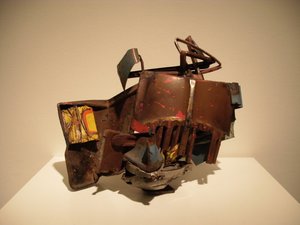
John Angus Chamberlain’s sculpture “Fancy That” stands as a testament to the transformative power of repurposing industrial detritus into breathtaking artistic expression—a cornerstone of Neo-Dada and deeply rooted in the legacy of Abstract Expressionism. Released in 2025, this piece captures the spirit of innovation and reimagining familiar materials with remarkable finesse.A Dialogue Between Painting and Sculpture
Chamberlain’s approach wasn't merely about assembling scrap metal; it was a deliberate provocation against conventional sculptural practices. Influenced by figures like Marcel Duchamp—whose readymades questioned artistic definition—he sought to blur the boundaries between painting and sculpture, mirroring the stylistic explorations of Abstract Expressionists such as Jackson Pollock and Willem de Kooning. This fusion resulted in monumental forms that pulsate with energy and texture, reflecting a fascination for chance and process.The Sculpture's Anatomy: Material Transformation
“Fancy That” utilizes primarily wood, metal, and fabric—materials typically relegated to utilitarian purposes—to create an arresting visual experience. The sculpture’s centerpiece is a red chair constructed from a wooden seat and a steel frame, meticulously welded together. This deliberate juxtaposition of contrasting textures – smooth wood against rough metal – immediately draws the eye and establishes a dynamic interplay between form and surface. Furthermore, the inclusion of additional couches adds depth to the composition, inviting contemplation on spatial relationships and materiality.Historical Context: Neo-Dada’s Embrace of Chance
Chamberlain's work emerged during the Neo-Dada movement, which reacted against the perceived excesses of Surrealism and championed spontaneity and accident as creative drivers. Embracing techniques like crushing and welding—methods antithetical to traditional craftsmanship—he deliberately disrupted established artistic conventions. This rebellious spirit aligns perfectly with the broader aesthetic concerns of the era, where artists questioned notions of beauty and originality.Emotional Resonance: Beyond Representation
Ultimately, “Fancy That” transcends mere visual representation; it evokes a profound emotional response rooted in its exploration of materiality and process. The sculpture’s monumental scale commands attention, prompting viewers to consider the relationship between human creativity and the discarded remnants of industrial society. Like many Neo-Dada artworks, it invites interpretation beyond literal depiction, encouraging contemplation on themes of decay, transformation, and the inherent beauty found within unexpected combinations—a captivating reflection of Chamberlain's artistic vision.Perguntas e Respostas
Como posso visualizar uma reprodução de "Fancy" de John Angus Chamberlain?
Uma prévia de "Fancy" de John Angus Chamberlain está disponível na página de Visualização da obra.
Qual é a luminosidade percebida de "Fancy" de John Angus Chamberlain?
No geral, "Fancy" é registrado como brilhante. A luminosidade percebida descreve o quão clara ou escura a obra parece ser.
Onde posso comprar uma impressão de "Fancy" de John Angus Chamberlain?
"Fancy" está disponível como uma impressão fine art em tela de algodão ou papel canvas de arquivo. Os pedidos podem ser feitos em esta página, no tamanho de sua escolha.
Onde posso comprar uma imagem digital de "Fancy" de John Angus Chamberlain?
Uma imagem digital de "Fancy" de John Angus Chamberlain pode ser adquirida em esta página: download de imagem digital em alta resolução.
Quem vende cópias pintadas à mão de "Fancy" de John Angus Chamberlain?
Você pode encomendar uma reprodução pintada à mão de "Fancy" de John Angus Chamberlain diretamente em esta página: uma reprodução a óleo pintada à mão sobre tela de linho, feita sob encomenda.
Quem criou "Fancy"?
"Fancy" é atribuída a John Angus Chamberlain.
A que período da carreira de John Angus Chamberlain pertence "Fancy"?
"Fancy" representa o Mature Period de John Angus Chamberlain.
Obras Relacionadas


Biografia do Artista
The Alchemist of Automobilia: The Life and Legacy of John Angus Chamberlain
In the intersection of industrial decay and high art, few figures loom as large or as provocatively as John Angus Chamberlain. Born in 1927 in Rochester, Indiana, Chamberlain did not merely create sculpture; he orchestrated a metamorphosis of the discarded. To look upon his work is to witness a violent yet poetic dialogue between the mechanical past and the abstract present. He possessed a singular vision that allowed him to see not just rusted scrap, but a vocabulary of form, color, and texture. His journey from the son of a saloonkeeper in the American Midwest to a titan of the Neo-Dada movement is a testament to an unyielding creative impulse that sought to find beauty within the crushed and the broken.
Chamberlain’s artistic consciousness was forged through a diverse and rigorous educational odyssey. After serving in the United States Navy during the pivotal years of World War II, he utilized the GI Bill to immerse himself in the burgeoning avant-garde scenes of America. His time at the Art Institute of of Chicago provided him with a foundational mastery of form, but it was his tenure at the legendary Black Mountain College that truly expanded his intellectual horizons. At Black Mountain, he moved beyond the purely visual, studying under influential poets such as Charles Olson and Robert Creeley. This literary immersion profoundly shaped his sculptural language; he famously viewed his collection of automotive fragments as a reservoir of words, where the act of welding was akin to composing a stanza, seeking the perfect placement of one jagged edge against another to achieve a rhythmic, poetic resonance.
A Symphony of Steel and Spontaneity
The hallmark of Chamberlain’s oeuvre lies in his revolutionary technique of assemblage. While many of his contemporaries were exploring the flat planes of Abstract Expressionist painting, Chamberlain sought to bring that same gestural energy into three-dimensional space. He became a master of the "crushed" aesthetic, meticulously dismantling abandoned automobiles and extracting their vibrant, enamel-coated metal components. Through the intense processes of welding, bending, and compressing, he transformed these industrial remnants into monumental forms that pulsed with an almost organic vitality.
His work defies easy categorization, existing in a fluid state between several major movements:
- Abstract Expressionism: He translated the spontaneous, emotional brushstrokes of painters like Pollock into the physical manipulation of steel and chrome.
- Neo-Dada: By utilizing found objects and "readymades" from the industrial age, he challenged the sanctity of traditional sculptural materials like marble or bronze.
- Pop Art: His use of consumerist detritus—the very skin of the American automobile—connected his high-art ambitions to the burgeoning mass culture of the mid-20th century.
There is a palpable tension in his sculptures, a sense of captured motion and compressed energy. The bright flashes of Cadillac red or Chevrolet blue, often peeking through layers of rust and grime, create a chromatic intensity that mirrors the dynamism of urban life. He did not seek to represent the car, but rather to capture the spirit of its movement and the inevitable entropy of its decay.
Historical Significance and the Enduring Pulse of Art
Throughout his prolific career, Chamberlain’s presence was felt across the most significant art hubs of the world, from Manhattan and Los Angeles to Shelter Island and even Belgium. His ability to disrupt the boundaries between sculpture and painting left an indelible mark on the trajectory of modern art. He proved that the debris of the industrial revolution could serve as the medium for a profound spiritual and aesthetic inquiry. Critics often noted that while his materials were cold and hard, the emotional impact of his work was deeply visceral, aiming—as he himself desired—to "make the viewer’s heart beat."
As we reflect on his life, which concluded in 2011, Chamberlain remains a pivotal figure who bridged the gap between the mechanical and the lyrical. He taught us that art is not merely about the creation of something new, but about the radical reimagining of what already exists. His legacy lives on in every artist who looks at the wreckage of the world and sees the potential for a masterpiece, reminding us that even in the crushed and the discarded, there is an eternal, unyielding beauty waiting to be welded back together.
John Angus Chamberlain
1927 - 2011 , United States of America
Informações Rápidas
- Full Name: John Angus Chamberlain
- Nationality: American
- Date Of Birth: 1927
- Date Of Death: 2011
- Place Of Birth: Rochester, United States of America
- Notable Artworks:
- Fancy
- Sleeping Giant
- Artistic Movement Or Style: Abstract Expressionism
- Artists Who Influenced This Artist:
- Robert Delaunay
- Jean Dubuffet
- Artists Or Movements Influenced By This Artist: ['Neo-Dada']
Artigos Relacionados

John Singer Sargent: As 25 Obras-Primas que Definem um Ícone da Arte
Descubra as 25 obras-primas de John Singer Sargent, o mestre do retrato e do impressionismo americano. Explore a história, técnica e beleza atemporal de seus quadros mais famosos. Encontre reproduções de arte exclusivas para decorar sua casa com elegância em ArtsDot.com.

Esculturas em Bronze Icônicas: 10 Obras que Revolucionaram a Arte | ArtsDot
Descubra as 10 esculturas em bronze mais icônicas da história! Explore a arte de Rodin, Michelangelo e outros mestres. Encontre reproduções de alta qualidade para sua casa em ArtsDot.com.

John Constable: As 25 Obras-Primas que Definem o Mestre da Paisagem Inglesa | ArtsDot
Descubra as 25 obras-primas de John Constable, o mestre da paisagem inglesa! Explore a arte romântica, cores vibrantes e histórias fascinantes por trás de 'Hay Wain' e outras pinturas icônicas. Encontre reproduções de alta qualidade para decorar sua casa com ArtsDot.com.

Top 10 Obras-Primas do Expressionismo Abstrato: Arte para Decorar e Inspirar | ArtsDot.com
Descubra as 10 obras-primas do Expressionismo Abstrato com Jackson Pollock, Mark Rothko e mais! Explore a história, técnica e emoção por trás de cada pintura. Encontre reproduções de arte exclusivas para decorar sua casa em ArtsDot.com.

The Enduring Form: Exploring Themes & Techniques in Sculpture Across Historical Periods
Explore the rich history of sculpture from ancient masterpieces to contemporary innovations. Discover key techniques, influential artists & investment potential for discerning art collectors.
