

 Visualizar em escala
 Enviar
 Compartilhar
 Ver detalhes

 Baixar
 Semelhantes
 Raio X
 Apresentação de slides
Painting


 Ver mais
Adquira uma imagem digital de alta resolução e aprimorada, muito superior à prévia online.
Cada arquivo é meticulosamente preparado por nossos especialistas internos, utilizando ferramentas avançadas e retoques manuais de alta precisão. Garantimos que cada imagem apresente clareza excepcional, fidelidade de cores e detalhes minuciosos.
O arquivo final é entregue por e-mail em até 72 horas, otimizado para uso imediato em ambientes profissionais, editoriais e de impressão. Esta é a mesma qualidade utilizada por estúdios de design de alto nível, editoras e galerias.
Imagem Digital
Baixe um arquivo de alta resolução para exibição pessoal, impressão e projetos criativos. ( Comprar impressão Comprar pintura feita à mão)
Incluído em cada pedido de imagem digital
Entrega Digital Especializada e Garantida
Ao escolher o ArtsDot.com, você não está apenas adquirindo uma imagem — você está recebendo uma obra de arte digital profissionalmente aprimorada, elaborada com precisão e com garantia de satisfação. Aqui está tudo o que acompanha seu pedido, automaticamente:

Entrega rápida por e-mail
O seu arquivo de imagem digital em alta resolução será enviado por e-mail em até 72 horas após o pedido — pronto para uso imediato.

Arquivo Digital com IA Otimizado
Sua obra de arte é otimizada profissionalmente por meio de ferramentas avançadas de IA e edição manual, garantindo o máximo de detalhes, clareza e precisão de cores.

Reenvio gratuito vitalício
Apagou ou perdeu o seu ficheiro acidentalmente? Não se preocupe – nós reenviamos para si a qualquer momento, gratuitamente.

Sem Taxas de Importação - Sempre
Desfrute da sua obra de arte instantaneamente, sem taxas alfandegárias, impostos ou custos de entrega — downloads digitais são sempre isentos de taxas.

Garantia de Precisão de Cores
Garantimos que sua imagem digital reflita as cores originais com a maior fidelidade possível, utilizando ferramentas profissionais e gerenciamento de cores.

Garantia de Satisfação de 60 Dias
Se você não estiver satisfeito com sua imagem digital, nós a revisaremos ou reembolsaremos 100% dentro de 60 dias — sem perguntas.

Garantia de Reembolso 100%
Não está satisfeito? Receba o reembolso total em até 60 dias após o recebimento do seu arquivo digital — sem perguntas.

Descontos para pedidos em lote
Compre 3 imagens, economize 10% - Compre 5, economize 15% - Compre 10+, economize 20%. Ideal para projetos criativos, galerias e agências.
Descrição do Colecionável
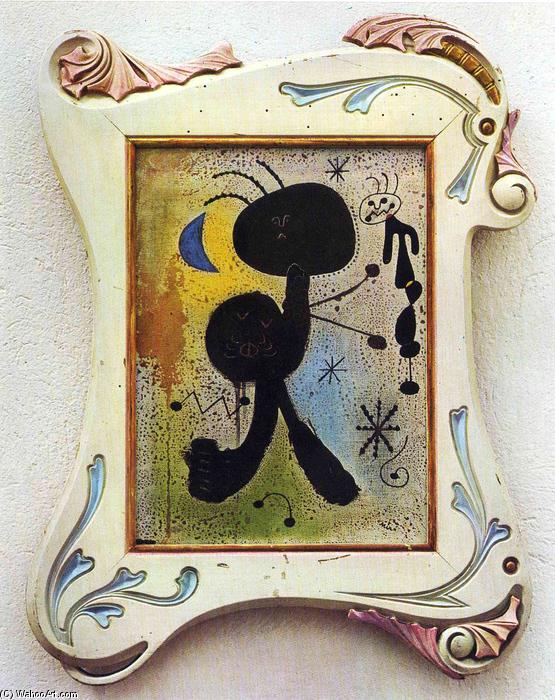
A Reflection Within Reflections: Joan Miró’s ‘Painting’ (1943)
Joan Miró's “Painting,” created in 1943, is more than simply a depiction of a frame and its contents; it’s an intricate meditation on perception, memory, and the layered nature of artistic representation itself. This captivating work, rendered in a stark black and white palette, immediately draws the viewer into a world where boundaries blur and meaning shifts with every glance. The image presents a painting within a picture frame, a classic motif that Miró masterfully exploits to create a sense of infinite regression – an invitation to question what is ‘real’ and what is merely a constructed illusion.
- Subject Matter: At the heart of this piece lies a solitary female figure, presented in a dynamic pose with outstretched arms. This evocative gesture suggests movement, action, or perhaps even a yearning – emotions that resonate deeply within the viewer’s own experience.
- Style & Technique: Miró's signature style is powerfully evident here. The work leans heavily into his mature period, characterized by biomorphic forms, playful abstraction, and a deliberate rejection of representational accuracy. The application of paint is loose and gestural, creating a textured surface that adds to the painting’s tactile quality. The use of black and white amplifies this effect, stripping away any distraction from the core shapes and allowing for a heightened focus on form and composition.
Historical Context & Catalan Identity
Created in 1943, during a period of significant upheaval – including the Second World War – “Painting” reflects Miró’s ongoing engagement with themes of displacement and resilience. Born in Barcelona in 1893, Miró was deeply rooted in Catalan culture and identity, which he consistently explored through his art. The influence of Antoni Gaudí's organic architectural forms is subtly present, suggesting a connection to the rich artistic heritage of Catalonia. This piece can be seen as a quiet assertion of cultural pride amidst global conflict, a testament to the enduring power of local traditions.
- Miró’s Barcelona: Miró's early life in Barcelona was formative, exposing him to the city’s vibrant artistic scene and its unique architectural style. This influence is palpable in his work, particularly in the use of curved lines and organic shapes.
- Thematic Resonance: The image’s exploration of movement and gesture aligns with Miró's broader concerns about human experience – the search for meaning, the struggle against adversity, and the importance of intuition.
Symbolism & Emotional Impact
The nested frames within “Painting” are laden with symbolic weight. They represent not just a picture within a picture, but also layers of interpretation, memory, and consciousness. The central female figure can be interpreted as an archetype – a representation of the feminine principle, a symbol of hope, or perhaps even a self-portrait reflecting Miró’s own artistic journey. The stark monochrome palette contributes to the work's emotional intensity, evoking feelings of introspection, mystery, and quiet contemplation. The overall effect is one of profound stillness, inviting viewers to lose themselves in its intricate details.
- Infinite Regression: The repeated framing creates a sense of infinite regression, prompting questions about the nature of reality and the limits of perception.
- Emotional Resonance: The work’s ambiguity allows for multiple interpretations, fostering a deeply personal connection between the viewer and the artwork.
A Timeless Masterpiece – A ArtsDot Reproduction
This exceptional reproduction captures every nuance of Miró's original vision, utilizing archival-quality materials and meticulous hand-painting techniques to ensure lasting beauty and authenticity. Whether adorning a gallery wall or enhancing your interior design, this artwork offers a unique opportunity to own a piece of art history – a testament to Joan Miró’s genius and his profound exploration of the human condition. Contact ArtsDot today to commission your bespoke reproduction.
Obras Relacionadas


Biografia do Artista
A Catalan Visionary: The Life and Art of Joan Miró
Joan Miró i Ferrà, born in Barcelona in 1893, stands as one of the most significant figures in 20th-century art. His journey was not merely a progression through styles but an exploration of inner worlds, translating dreams, memories, and Catalan identity onto canvas with a uniquely poetic visual language. From humble beginnings marked by illness and initial parental reservations about his artistic pursuits, Miró persevered, driven by an innate need to express the intangible—the emotions, sensations, and subconscious currents that lie beneath the surface of reality. His early life was steeped in the traditions of Barcelona, a city brimming with architectural marvels thanks to Antoni Gaudí, whose organic forms would subtly influence Miró’s later abstractions. The goldsmithing profession of his father instilled an appreciation for meticulous craftsmanship, while the rugged Catalan landscape became a recurring motif and source of inspiration throughout his career.Early Influences and the Path to Surrealism
Miró's formal artistic training began at La Llotja in Barcelona, where he honed his skills in traditional techniques. However, it was exposure to the avant-garde movements sweeping through Paris that truly ignited his creative evolution. The vibrant colors of Fauvism and the fragmented forms of Cubism resonated deeply, prompting him to move to Paris in 1920. This period proved pivotal as he encountered artists like Pablo Picasso and began experimenting with increasingly abstract compositions. Yet, Miró didn’t simply adopt these styles; he synthesized them, forging a path toward his own distinctive aesthetic. He sought to distill forms to their essence, stripping away representational details in favor of symbolic shapes and evocative colors. This exploration led him to the Surrealist group in 1924, aligning him with artists such as Max Ernst and Salvador Dalí. While embracing the Surrealist interest in the subconscious, Miró maintained a unique sensibility—his work was less about shocking imagery or Freudian symbolism than it was about creating a world of playful forms and poetic suggestion. He believed that art should be free from rational constraints, allowing for spontaneous expression and imaginative exploration.The Language of Symbols: Key Works and Artistic Innovations
Throughout the 1920s and 30s, Miró developed his signature visual vocabulary—a universe populated by biomorphic shapes, floating forms, and vibrant colors. The Farm (1922), often considered a cornerstone of his oeuvre, exemplifies this transition. It’s not merely a depiction of rural life but an evocation of Catalan identity and a symbolic representation of the natural world. The painting utilizes earthy tones contrasted with bursts of crimson and yellow—colors that mirror the vibrancy of the Catalan countryside and imbue the scene with a sense of primal energy. His collaborative spirit led to innovative techniques like *grattage*, pioneered with Max Ernst in 1926 for designs intended for Sergei Diaghilev's ballet, where textures were revealed by scraping paint across canvas. This technique allowed Miró to liberate forms from conventional representation, emphasizing surface qualities and creating a tactile experience for the viewer. The Dutch Interiors (1928) series demonstrated his ability to reinterpret the Old Masters through a distinctly modern lens, transforming domestic scenes into dreamlike abstractions. He approached Rembrandt’s portraits with an eye attuned to the subtleties of emotion and gesture, distilling them into simplified geometric shapes—a bold departure from traditional portraiture. Painting (1933), with its striking palette and dynamic composition, encapsulates Miró’s exploration of the subconscious and his rejection of conventional artistic boundaries. The painting's swirling lines and amorphous forms convey a sense of movement and disorientation, mirroring the anxieties of the era while simultaneously celebrating the boundless potential of imagination. Beyond painting, Miró fearlessly experimented with sculpture, ceramics, and printmaking, expanding his creative horizons and demonstrating a remarkable versatility.Legacy and Enduring Influence
Joan Miró's impact on 20th-century art is undeniable. He wasn’t simply a painter; he was a visionary who challenged the very definition of artistic expression. His work paved the way for abstract expressionism and continues to inspire artists across disciplines. He established two foundations—the Fundació Joan Miró in Barcelona (1975) and the Fundació Pilar i Joan Miró in Palma de Mallorca (1981)—ensuring that his legacy would endure, providing spaces for artistic exploration and education. Throughout his long career, he remained committed to pushing boundaries, questioning conventions, and exploring the depths of human imagination. Miró’s art is a testament to the power of abstraction, symbolism, and poetic expression—a vibrant celebration of life, dreams, and the enduring spirit of Catalan culture. His work continues to resonate with audiences worldwide, inviting us to enter a world where anything is possible and the boundaries between reality and fantasy blur into a captivating dance of color and form. He died in Palma de Mallorca in 1983, leaving behind an unparalleled body of work that remains a beacon of creativity and innovation.
Joan Miró
1893 - 1983 , Espanha
Informações Rápidas
- Artistic Movement Or Style: Surrealismo
- Artists Who Influenced This Artist:
- Pablo Picasso
- Van Gogh
- Date Of Birth: 20 Abril 1893
- Date Of Death: 25 Dezembro 1983
- Full Name: Joan Miró i Ferrà
- Nationality: Espanhol
- Notable Artworks:
- A Fazenda
- La Poetisa
- Dutch Interiors
- Place Of Birth: Barcelona, Espanha

