

- 63.0 x 52.0 cm


The picture follows your choices: , .
Descrição do Item
 Ler mais
Biografia do Artista
Jacques-Louis David: Mestre do Neoclassicismo francês, capturou revoluções e glórias napoleônicas em obras icônicas como 'Juramento dos Horátios'. Um artista de grande impacto histórico e artístico.
Reprodução em Óleo Feita à Mão
Óleo sobre tela pintado à mão no tamanho e moldura de sua escolha, feito sob encomenda pelos nossos artistas. ( Alternar para Impressão Alternar para Imagem Digital)
More about this painting
 Visualizar na parede
 Compartilhar
 Compartilhar
 Detalhes
 Guia
Guia

 Baixar imagem
 Semelhantes
 Raio X
 Ver diaporama
 Q&A
Q&A Estatísticas
Order your painting in four simple steps
Take your time. You can change any answer; the price in your order card follows each choice.
1 Step one of four
Which size would you like?
These sizes keep the proportions of the original painting. The drawing shows your choice on a wall, above a two-metre sofa.
Or give your own measurements
Escolha entre os nossos tamanhos pré-definidos que respeitam as proporções originais da obra de arte.

Insira a largura e a altura desejadas para se ajustarem à sua moldura ou parede. Como esta obra é pintada à mão, para um tamanho com proporções diferentes, o artista poderá pintar um pouco mais ao redor da imagem ou reduzir ligeiramente a composição — você escolhe. Enviamos uma maquete digital para sua aprovação antes de iniciar a pintura. A imagem exibida nesta página não representa o resultado real — apenas a maquete mostra o resultado final.
2 Step two of four
How should it be prepared: rolled, stretched or framed?
The prices below are for the size you chose in step one.
Choose the edges of the stretched canvas
Choose your frame

White €1

Blurside €1

Extended €1

P118B €10

P118H €10

P118W €10

P438Z €10

P508JH €12

P508YH €12

P805H €10

P805Z €10

P919BZ €10

P919G €10

P919XJ €10

P959ZH €10

P968JZ €12

W106C €8

W218G €10

W218JH €8

W218Y €10

W307PJ €10

W316G €10

W316PJ €8

W316Y €10

W398PJ €8

W4111J €10

W500HY €15

W500JH €15

W692G €12

W849H €8

W940BG €15

W953PJ €8

H24-GOLD €30

H24-SILVER €30

H36-GOLD €45

H36-SILVER €45
Com moldura
Moulding: . Overall size with the frame: .
3 Step three of four
Would you like anything changed in the painting?
Most people answer no. Because each painting is made by hand, our artist can also adapt it for you.
After order, ArtsDot.com team will email client for instructions and provide a mockup preview
4 Step four of four
A few finishing options
All of them are optional. The answers already selected cost nothing extra.
Who paints it?
Entrega mundial () em 3 a 4 semanas, em vez das 5 semanas padrão. (2 Novembro). Sem comprometer a qualidade.
A nameplate, as in a museum?
Detalhes da Placa de Bronze Gravada
This elegant plaque features the artist's name and the title of the artwork, finely engraved for a timeless presentation.
It is made from bronze with a refined, elegant finish. The text is precisely laser-engraved for a sharp and permanent result. Measuring 9x2 cm, the plaque is compact yet easy to read. It's built to be durable and scratch-resistant, offering a professional, museum-quality look. Mounting is simple thanks to the included adhesive backing.
Detalhes da Placa de Acrílico Transparente
The plaque includes essential engraved details such as the artist's name, the title of the artwork, the date it was created, the type of media used-like oil on canvas or watercolor-a brief description of the piece, and a QR code that links to the complete artwork information.
It is crafted from clear acrylic, offering a sleek, modern appearance. The text is UV-engraved in black to ensure strong visual contrast. With a size of 10x15 cm, it ensures optimal readability. It comes equipped with two metal hooks for secure wall mounting. The plaque is designed to be weather-resistant, making it suitable for various environments, and it includes interactive features that work seamlessly with smartphone scanning.
Detalhes da Placa de Acrílico Preto
This elegant plaque includes engraved information such as the artist's name, the title of the artwork, the date it was created, the type of media used (like oil on canvas or watercolor), a short description of the artwork, and a QR code for quick access to more information.
The plaque itself is made from refined black acrylic with a premium finish. The text is laser-engraved in white for high contrast and readability. Its size is 10x15 cm, designed to be easy to read. It comes with two metal hooks for professional mounting. The design is sleek and fits any interior style. It is also weather-resistant and durable, with built-in digital integration for mobile compatibility.
A protective varnish?
When do you need it?
✓ Check and order
Your painting, as you ordered it

Self-Portrait
Técnica de Reprodução
Tamanho da Reprodução
-

Artista Sênior de Elite
Mais detalhes, refinamento e tempo de produção adicional
-

Moldura para Reprodução
-
-
Para obras de arte ou reproduções com mais de 105 cm (aproximadamente 41 polegadas) em qualquer um dos lados, a moldura será enviada como um kit desmontado. Este método garante uma entrega segura e evita danos durante o transporte.
Montagem profissional necessária — este não é um produto DIY (faça você mesmo).
O kit deve ser montado e a tela esticada por um profissional de molduraria experiente, utilizando cola de madeira (não inclusa), um alicate de esticar tela e grampos para manter as travessas alinhadas enquanto a cola seca. A montagem incorreta ou a tensão desigual da tela podem danificar permanentemente a obra de arte e não estão cobertas pela nossa garantia.
 Para obras de arte ou reproduções com mais de 105 cm (aproximadamente 41 polegadas) em qualquer um dos lados, a moldura será enviada como um kit desmontado. Este método garante uma entrega segura e evita danos durante o transporte.
Todas as barras de madeira maciça estão incluídas, precisamente cortadas ao tamanho certo.
Montado com os parafusos fornecidos, além de cola para madeira para as junções dos cantos, que não está inclusa e deve ser providenciada pelo seu moldurista.
São necessárias ferramentas profissionais não incluídas: um alicate de estiramento de tela (esticador) e grampos para manter as ripas alinhadas enquanto a cola seca.
Importante:
As junções dos cantos requerem cola para madeira, as ripas devem ser mantidas com grampos até que a cola esteja completamente seca, e o estiramento da tela na moldura montada requer um alicate de esticar tela. Nenhum destes itens está incluído no kit. Por favor, certifique-se de contar com um profissional de molduraria experiente antes de encomendar este tamanho.

Etiqueta de identificação
-
-

Verniz de Proteção
Verniz brilhante (realça as cores e protege contra a luz e a umidade)
-

Personalizar minha obra
Exemplos de alterações possíveis: Substituir o rosto por uma foto do cliente; Adicionar um animal de estimação (ex.: substituir gato por cachorro); Incluir uma mensagem oculta no fundo; Alterar a paisagem ou os elementos do fundo.
-

Urgente
Entrega mundial () em 3 a 4 semanas, em vez das 5 semanas padrão. (2 Novembro). Sem comprometer a qualidade.
-
Envio Expresso
Entrega mundial para em 5 semanas. (9 Novembro).
Com envio incluído
Preço Total
€ 234
A opção de vidro está disponível apenas para tamanhos inferiores a 110 cm
Included with every order
- Envio expresso gratuito para todo o mundo
- Tela de Linho de Alta Qualidade
- Seguro de transporte completo
- Garantia de Reembolso de Impostos Alfandegários
- Garantia de Fidelidade Cromática
- Política de Devolução em 100 Dias (Apenas para Defeitos)
- Garantia de reembolso de 100%
- Oferta de desconto por quantidade


A Portrait of Quiet Intensity: Jacques-Louis David’s Self-Portrait (1790)
Jacques-Louis David's Self-Portrait, painted in 1790, is not merely a likeness rendered on canvas; it’s a carefully constructed statement about an artist grappling with the seismic shifts of his time. This intimate work, measuring a modest 63 x 52 cm, offers a rare glimpse into the mind of a man poised on the precipice of revolution – a man who would become one of its most ardent and controversial figures. The painting immediately draws the viewer in with an arresting directness; David stares out from the canvas, his gaze unwavering and imbued with a subtle melancholy that belies the confident brushwork evident throughout.
The composition is rooted firmly in Neoclassical principles, a stylistic shift David championed after his early apprenticeship under François Boucher. The dark background, almost entirely devoid of detail, serves to amplify the figure’s presence, forcing us to confront his solemn expression and the carefully chosen details of his attire. He wears a meticulously tailored suit, indicative of the late 18th century, yet the wig – a deliberate stylistic choice – subtly nods towards an earlier, more formal era, creating a fascinating tension between tradition and modernity. The pipe in his hand isn’t simply a prop; it speaks to a contemplative nature, suggesting a man accustomed to quiet reflection amidst the clamor of artistic creation.
The Shadow of Revolution
Painted just two years before the execution of Louis XVI, this self-portrait is inextricably linked to the turbulent events unfolding in France. David’s early career had been marked by a flirtation with Rococo aesthetics, but he quickly embraced the ideals of Neoclassicism – an artistic movement that sought inspiration from the art and philosophy of ancient Greece and Rome. This shift reflected a broader cultural yearning for order, reason, and virtue, values increasingly championed in response to the perceived excesses of the Ancien Régime. The somber palette and restrained gestures within this portrait foreshadow the austere aesthetic that would define David’s most famous works during the Revolution – particularly his monumental depictions of heroic figures like *The Death of Marat* and *The Oath of the Horatii*.
Interestingly, the painting also hints at a personal struggle. The slight asymmetry in David's face, a physical characteristic he had dealt with since childhood, is subtly emphasized here. It’s as if he’s acknowledging his own imperfections while simultaneously projecting an image of unwavering self-assurance. This duality – vulnerability and strength – resonates deeply within the artwork and speaks to the complexities of a man navigating a period of profound social and political upheaval.
Technique and Detail: A Master's Hand
David’s technical skill is undeniable in this portrait. The meticulous rendering of fabric, particularly the texture of the suit and the folds of the wig, demonstrates his mastery of chiaroscuro – the dramatic use of light and shadow to create depth and form. Note the subtle gradations of tone, achieved through careful layering of paint, that give the figure a remarkable sense of volume. The artist’s attention to detail extends to the rendering of the hands, which are clasped together in a gesture of quiet contemplation.
- The precise brushwork reveals a deliberate control and an unwavering focus on capturing the likeness with accuracy.
- David's use of color is restrained, favoring muted tones that contribute to the overall sense of seriousness and introspection.
- The subtle modeling of the face – particularly around the eyes and mouth – conveys a remarkable degree of psychological depth.
Symbolism and Emotional Resonance
Beyond its technical brilliance, Self-Portrait is rich in symbolic meaning. The dark background can be interpreted as representing the uncertainties and anxieties of the era, while the figure’s direct gaze invites a sense of intimacy and engagement. The pipe, again, suggests a contemplative spirit, perhaps reflecting David's own internal struggles as he grappled with his role in shaping the future of France. This portrait isn’t simply a representation of a man; it’s an embodiment of the ideals – and the anxieties – of a nation on the brink of transformation. A reproduction offers a powerful way to connect with this pivotal moment in art history, bringing David's introspective gaze into your own space.
Perguntas e Respostas
Quais são as dimensões da obra original "Self-Portrait", de Jacques-Louis David?
"Self-Portrait" mede 63 x 52 cm em sua forma original. As dimensões originais são uma referência útil ao escolher o tamanho de uma reprodução.
Em que ano foi criado "Self-Portrait", de Jacques-Louis David?
"Self-Portrait", de Jacques-Louis David foi criado em 1790.
Existe um guia para "Self-Portrait", de Jacques-Louis David?
O guia para "Self-Portrait" é a página de Ficha informativa da obra — uma ficha informativa imprimível que apresenta a obra com sua legenda, autoria e tabela de identificação (artista, datas, técnica, tamanho original, coleção).
Obras Relacionadas


Jacques-Louis David
1748 - 1800, França
Biografia do Artista
A Brushstroke Across Revolution: The Life and Art of Jacques-Louis David
Jacques-Louis David, born in Paris in 1748, was more than just a painter; he was a visual chronicler of an era defined by upheaval, idealism, and the relentless pursuit of new orders. His life mirrored the dramatic shifts unfolding across France – from the waning opulence of the Rococo to the austere clarity of Neoclassicism, and ultimately, through the tumultuous years of revolution and Napoleonic glory. A childhood marked by the early loss of his father and a facial impediment that initially hindered his speech seemed only to sharpen his observational skills and fuel an unwavering dedication to artistic mastery. Though initially apprenticed to François Boucher, David quickly found himself drawn to the more morally resonant work of Joseph-Marie Vien, whose emphasis on history painting and classical subjects resonated with a burgeoning sense of purpose within the young artist. His early attempts to win the prestigious Prix de Rome were fraught with frustration, yet these repeated setbacks only intensified his resolve, forging a relentless perfectionism that would characterize his entire career.The Birth of Neoclassical Drama
David’s artistic evolution wasn't merely a stylistic shift; it was a philosophical statement. He rejected the frivolous ornamentation and playful themes of the Rococo, embracing instead the clarity, order, and moral seriousness inherent in classical antiquity. This commitment was profoundly influenced by archaeological discoveries at Pompeii and Herculaneum, which unveiled a world of Roman art and architecture previously lost to time. These ruins ignited within him a profound respect for the rationalism and civic virtue of the ancient republic, inspiring a desire to emulate their ideals in his own work. His breakthrough came with “Oath of the Horatii” (1784), a painting that transcended mere artistic skill to become an emblem of civic virtue and patriotic sacrifice. The stark composition, dramatic lighting – carefully calculated to emphasize the figures’ musculature and emotional intensity – and precise draftsmanship were revolutionary, signaling a decisive break from the past. It wasn't simply *what* he painted but *how* – a deliberate construction designed to evoke powerful emotional responses and inspire contemplation on themes of duty, honor, and self-sacrifice. The figures are rendered with an almost sculptural quality, their bodies idealized according to classical principles, reflecting David’s deep study of Roman sculpture. This work didn't just announce a new style; it foreshadowed the ideological currents that would soon sweep across France.Revolution and Remembrance: Art as Political Weapon
As the French Revolution erupted in 1789, David was not merely an observer but an active participant. A fervent supporter of the revolutionary cause and a close associate of Maximilien Robespierre, he saw art as a powerful tool for shaping public opinion and immortalizing the ideals of the new republic. He believed that art could serve as a moral compass, guiding society towards virtue and justice. His paintings during this period became potent symbols of revolutionary martyrdom and republican fervor. Perhaps his most iconic work from this era is “The Death of Marat” (1793), a hauntingly realistic depiction of the assassinated journalist, transformed into a secular saint. The painting’s stark simplicity – the pale body, the makeshift desk, the poignant letter clutched in Marat's hand – elevates the scene to a level of profound emotional resonance. David deliberately chose this subject matter to honor the revolutionary hero and inspire further acts of sacrifice for the cause. He meticulously researched the event, relying on eyewitness accounts and seeking to capture the raw emotion of the moment with unflinching realism. “The Death of Marat” wasn’t just a portrait; it was a carefully constructed propaganda piece designed to galvanize support for the revolution.From Revolution to Empire: Serving Napoleon
The fall of Robespierre marked another turning point in David's career. With remarkable adaptability, he navigated the shifting political landscape and aligned himself with Napoleon Bonaparte, becoming the First Consul’s official court painter. This new patronage ushered in a period of grand-scale commissions designed to glorify Napoleon’s victories and achievements. “Napoleon Crossing the Alps” (1801-1805) is perhaps the most famous example – a masterful piece of propaganda that presents Napoleon as a heroic, almost mythical figure conquering both nature and adversity. The dramatic lighting, the dynamic composition, and the carefully chosen details all contribute to the image’s powerful effect. David skillfully employed classical motifs—the hero in a heroic pose, battling against the elements—to elevate Napoleon's status and associate him with the grandeur of antiquity. “The Coronation of Napoleon” (1807), an immense canvas capturing the opulence and grandeur of the imperial ceremony, further cemented David’s position as the preeminent artist of the Napoleonic era. During this time, his palette subtly shifted, incorporating warmer Venetian colors while maintaining the precision and clarity that defined his style.Exile, Legacy, and Enduring Influence
The Bourbon Restoration in 1814 brought renewed peril for David, whose association with the fallen Napoleon made him a target of persecution. He chose exile in Brussels in 1816, where he continued to paint and teach until his death on December 29, 1825. Despite facing hardship and political isolation, David remained committed to his art, producing works that reflected his evolving philosophical views. Even in exile, his influence remained profound. He trained numerous pupils, including Jean-Auguste-Dominique Ingres, who would become one of the most important neoclassical painters of the 19th century. David’s emphasis on draftsmanship, composition, and historical accuracy left an indelible mark on French art. *His legacy extends beyond mere imitation*; his expressive distortions of form and space even foreshadowed the innovations of later artists like Henri Matisse and Pablo Picasso. Jacques-Louis David was not simply a painter of his time; he *defined* it, capturing its spirit of revolution, ambition, and enduring ideals on canvas for generations to come.- Major Achievements: Established Neoclassicism as the dominant style in French painting.
- Historical Significance: Created iconic images that captured the spirit of the French Revolution and the Napoleonic era.
- Influence: Trained a generation of influential artists who carried on his legacy.


Artigos Relacionados

Anne-Louis Girodet: Bridging Neoclassicism & Romanticism with Emotional Truth
Explore the captivating world of Anne-Louis Girodet, a pivotal figure bridging Neoclassicism & Romanticism. Discover his masterpieces and unique artistic vision with ArtsDot.

Illuminating the Enlightenment: A Comprehensive Exploration of 18th-Century Painting
Explore the captivating world of 18th-century painting! Discover Rococo's playful elegance & Neoclassicism’s Enlightenment ideals with expert insights into Fragonard, David, and more. A comprehensive guide for art enthusiasts.
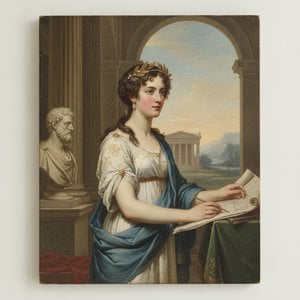
The Revival of Antiquity: Exploring Ideals of Beauty & Power in Neoclassical Portraiture
Explore the captivating world of Neoclassical portraiture! Discover the power & ideals behind masterpieces by David, Girodet & more. Expert analysis, custom reproductions & art appraisal at ArtsDot.