

 Visualizar na parede
 Compartilhar
 Compartilhar
 Detalhes
 Guia
Guia

 Baixar imagem
 Semelhantes
 Raio X
 Ver diaporama
 Q&A
Q&A Estatísticas
Minerva

- 214.0 x 120.0 cm


 Ler mais
Giclée / Impressão de Arte
Impressão giclée ou em tela de qualidade de museu, com produção rápida e opções flexíveis de acabamento. ( Comprar pintura feita à mão Alternar para Imagem Digital)




P118B €10

P118H €10

P118W €10

P438Z €10

P508JH €12

P508YH €12

P805H €10

P805Z €10

P919BZ €10

P919G €10

P919XJ €10

P959ZH €10

P968JZ €12

W106C €8

W218G €10

W218JH €8

W218Y €10

W307PJ €10

W316G €10

W316PJ €8

W316Y €10

W398PJ €8

W4111J €10

W500HY €15

W500JH €15

W692G €12

W849H €8

W940BG €15

W953PJ €8




Escolha entre os nossos tamanhos pré-definidos que respeitam as proporções originais da obra de arte.

Insira a largura e a altura desejadas para se ajustarem à sua moldura ou parede. Uma impressão pode ser apenas cortada, nunca ampliada além da imagem original; portanto, um tamanho com proporções diferentes resultará na perda de parte da imagem. Enviamos uma maquete digital para sua aprovação antes de realizarmos a impressão. A imagem exibida nesta página não mostra o corte real — apenas a maquete o faz.
Entrega mundial () em 2 semanas, em vez das 4/5 semanas padrão. (2 Novembro)

Envio expresso gratuito para todo o mundo

Tela de Linho de Alta Qualidade

Seguro de transporte completo

Garantia de Reembolso de Impostos Alfandegários

Garantia de Fidelidade Cromática

Política de Devolução em 100 Dias (Apenas para Defeitos)

Garantia de reembolso de 100%

Oferta de desconto por quantidade
 A opção de vidro está disponível apenas para tamanhos inferiores a 110 cm

Minerva
Giclée / Impressão de Arte
Tamanho da Reprodução
-


Preço Total
€ 55
Minerva - A Trio of Renaissance Idealism
For centuries these three paintings – Minerva, Mercury and Hercules – have represented an inseparable triad within the artistic landscape of Northern Mannerism. Yet their creation unfolded across several years, reflecting the evolving tastes and ambitions of a particular era. Hendrick Goltzius’s masterful depiction of Minerva and Mercury in 1611 established a foundational aesthetic, followed by Hercules and Cacus completed in 1613, likely commissioned by Johan Colterman Junior – a young man embodying youthful vigor and intellectual prowess. This artwork distinguishes itself subtly from its predecessors; its dimensions differ slightly, and its original frame bore a distinct character, hinting at meticulous attention to detail and preservation of artistic heritage. The earliest documented sighting of the trio hanging together dates back to 1671, where they resided within the home of Colterman Junior’s descendants – a testament to their enduring appeal and significance as emblems of humanist education.- Subject Matter: The painting portrays a woman seated gracefully, her hand resting confidently on her hip—a posture conveying poise and authority. Alongside her stands a man wielding a spear and shield, symbolizing strength and protection. Complementing this dynamic duo are two additional figures positioned strategically within the composition, adding depth and narrative complexity to the scene.
- Style & Technique: Goltzius’s approach exemplifies Northern Mannerism, characterized by dramatic lighting, stylized forms, and an emphasis on emotional expression. He skillfully employs “swelling line,” a technique that enhances visual impact and contributes to the painting's overall sense of grandeur. The artist meticulously renders textures—particularly in Minerva’s drapery—demonstrating exceptional draughtsmanship.
- Historical Context: Created during the early Baroque period, this artwork reflects the humanist ideals prevalent at the time – a belief that contemplation (Mercury) and action (Minerva) cultivate wisdom and virtue. Hercules's triumph over Cacus serves as a powerful allegory for overcoming obstacles and achieving excellence.
Symbolism & Attributes: Minerva’s Embrace of Knowledge
Minerva, the goddess of wisdom and patron saint of the arts, is depicted leaning upon her shield—a device emblazoned with the head of Medusa, symbolizing vigilance against evil and fearlessness in confronting challenges. At her feet lie symbolic objects – books representing erudition, a portfolio signifying artistic creativity, a pen and penholder embodying intellectual discourse, a weaver’s shuttle symbolizing craftsmanship, and a lute representing musical artistry. These attributes collectively underscore the painting's central theme: the harmonious balance between intellect and practice—a cornerstone of Renaissance humanism.The Portrait of Youthful Power
The depiction of Hercules is particularly noteworthy. Goltzius skillfully captures the youthful dynamism of Johan Colterman Junior, portraying him as a figure radiating confidence and vitality. This portrayal aligns perfectly with the humanist aspiration to cultivate virtue through active engagement—a concept powerfully conveyed by Hercules’s victory over Cacus, representing triumph over adversity and unwavering determination.A Legacy Enduring Through Time
The painting's enduring fascination stems from its masterful execution and profound symbolic resonance. Its meticulous detail, combined with Goltzius’s innovative technique and the artwork’s connection to a pivotal moment in humanist thought, ensures that Minerva—and her companions—continue to inspire admiration and contemplation centuries after their creation. It stands as an exceptional example of Renaissance artistic achievement, inviting viewers to engage with its beauty and contemplate its enduring message.Perguntas e Respostas
Posso ver "Minerva", de Hendrik Goltzius sob diferentes luzes?
"Minerva" pode ser examinado camada por camada na página Raio X da obra, um visualizador inspirado em uma mesa de luz de conservação com onze leituras ópticas da imagem.
Quais são as dimensões da obra original "Minerva"?
A obra original "Minerva", de Hendrik Goltzius mede 214 x 120 cm.
"Minerva", de Hendrik Goltzius, está em domínio público? E por quê?
"Minerva", de Hendrik Goltzius está em em domínio público — seus direitos autorais expiraram. O período de direitos autorais conta a partir do falecimento do artista, ocorrido em 1617.
Obras Relacionadas


Biografia do Artista
Early Life and Training
Hendrik Goltzius, a figure of immense importance in the history of Dutch art, emerged from the vibrant cultural landscape of Braunschweig, Germany, in 1558. His early years were steeped in artistic tradition; his family’s lineage included painters who had worked in Venlo, and his father, Jan Goltz II, was a skilled glass painter in Duisburg. This familial connection to art provided him with an initial foundation, but it was the guidance of Dirck Volckertszoon Coornhert, a renowned printmaker and polymath residing nearby, who truly shaped his artistic trajectory. Coornhert’s workshop in Xanten became Goltzius's first formal training ground, where he immersed himself in the intricacies of copperplate engraving – a technique that would become synonymous with his name. A defining moment occurred when he was just three years old; an accident involving fire left him with a permanently deformed right hand. Remarkably, this physical challenge didn’t hinder his artistic development but instead fostered a unique dexterity and control over the burin, contributing to the distinctive “swelling line” technique that would characterize his work. His ambition and determination led him to become ambidextrous, mastering both left and right-hand engraving with equal skill.Artistic Career and Influences
In 1577, Goltzius embarked on a pivotal chapter of his life by relocating to Haarlem, the thriving center of the Dutch Republic, alongside Coornhert. This move marked the beginning of his independent career as an engraver and print publisher. Initially, he worked for established printers like Philips Galle, Maarten de Vos, and Johannes Stradanus, producing prints based on designs from various masters – a period where he meticulously honed his skills by replicating the styles of Albrecht Dürer, Lucas van Leyden, and others. However, his ambition quickly led him to establish his own workshop, allowing him to pursue his own creative vision. His artistic style was profoundly influenced by the Mannerist movement, drawing inspiration from Italian artists like Bartholomeus Spranger and Annibale Carracci, whose dynamic compositions and dramatic use of light and shadow resonated deeply with Goltzius. He wasn’t merely a copyist; he skillfully integrated elements of classicism and archaic styles into his work, creating a unique synthesis that distinguished him within the Dutch art scene. His patronage extended to prominent figures across Europe, including the Holy Roman Emperor Rudolf II, who recognized and championed his talent.Technique and Innovation
Hendrik Goltzius’s contribution to engraving is marked by several groundbreaking innovations. Perhaps most notably, he developed what became known as the “swelling line” technique – a masterful manipulation of the burin that allowed him to create varying thicknesses of lines, generating a remarkable sense of tonal depth and volume from a distance. This technique, combined with his pioneering use of the "dot and lozenge" method—strategically placed dots within lozenge-shaped spaces created through cross-hatching—further refined his ability to render shading and texture with unparalleled precision. His command of the burin was often compared to that of Albrecht Dürer, a testament to his exceptional skill and artistry. He frequently undertook the challenging task of engraving works by other artists, notably Bartholomeus Spranger’s paintings, significantly elevating their fame and solidifying his own reputation as a leading printmaker.Legacy and Recognition
Throughout his career, Goltzius produced an astonishing output – approximately 500 drawings and around 50 paintings, alongside over 160 individual prints featuring both original designs and collaborative projects. His works are now housed in major museums worldwide, including the Rijksmuseum in Amsterdam, the British Museum in London, the Metropolitan Museum of Art in New York, and the Los Angeles County Museum of Art. Despite facing periods of relative obscurity following his death in 1617, Goltzius’s legacy has experienced a remarkable resurgence in recent decades. He is now widely recognized as one of the most important printmakers of the Northern Renaissance, celebrated for his technical brilliance, innovative techniques, and profound influence on subsequent generations of artists. His distinctive style continues to captivate art lovers and scholars alike, cementing his place as a pivotal figure in the history of European art.
Hendrik Goltzius
1558 - 1617 , Alemanha
Dados Rápidos
- Artistic Movement Or Style: Manerismo e gravura Barroca
- Artists Or Movements Influenced By This Artist: ['Jacques Bellange']
- Artists Who Influenced This Artist: ['Dirck Volckertszoon Coornhert']
- Date Of Birth: Janeiro/Fevereiro 1558
- Date Of Death: 1 de Janeiro 1617
- Full Name: Hendrik Goltzius
- Nationality: Holandês
- Notable Artworks:
- Adoração dos Pastores
- Paisagem Arcádica
- Cabeça de Sirene
- Place Of Birth: Braunschweig, Itália
Artigos Relacionados

Hendrick Goltzius: Master Engraver & the Flourishing of Dutch Mannerism
Explore the life & art of Hendrick Goltzius, a master engraver of Dutch Mannerism. Discover his innovative techniques, iconic engravings like 'Jahel', and lasting influence on Baroque art. Learn about collecting Goltzius today.

The Enduring Legacy of Fine Art Prints: Technique, History & Aesthetic Impact
Explore the rich history & techniques of fine art prints. Discover investment potential, assess authenticity, and learn how to preserve your collection with expert guidance. Trusted insights for discerning collectors.

Giclée Prints: Archival Quality & Aesthetic Nuances for the Discerning Collector
Explore the world of giclée prints with ArtsDot. Learn about archival quality, aesthetic nuances & investment potential. Expert guidance for discerning art collectors seeking museum-quality reproductions and lasting value.
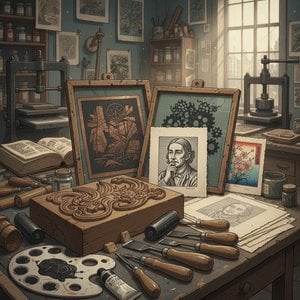
The Enduring Legacy of Printmaking: Techniques, Themes & Artistic Innovation Across Centuries
Explore the rich history of printmaking with ArtsDot. Discover techniques from intaglio to lithography, learn about collecting valuable prints & find museum-quality reproductions. Expert insights for art enthusiasts and collectors.

Echoes of Time: Exploring the Enduring Appeal & Historical Context of Vintage Art Prints
Explore the captivating world of vintage art prints! Discover their history, collecting tips & enduring appeal. Expert insights on chromolithography and building a legacy collection with ArtsDot.
