

 Visualizar na parede
 Compartilhar
 Compartilhar
 Detalhes
 Guia
Guia

 Baixar imagem
 Semelhantes
 Raio X
 Ver diaporama
 Q&A
Q&A Estatísticas
Annunciation

- 216.0 x 166.0 cm


 Ler mais
Giclée / Impressão de Arte
Impressão giclée ou em tela de qualidade de museu, com produção rápida e opções flexíveis de acabamento. ( Comprar pintura feita à mão Alternar para Imagem Digital)




P118B €10

P118H €10

P118W €10

P438Z €10

P508JH €12

P508YH €12

P805H €10

P805Z €10

P919BZ €10

P919G €10

P919XJ €10

P959ZH €10

P968JZ €12

W106C €8

W218G €10

W218JH €8

W218Y €10

W307PJ €10

W316G €10

W316PJ €8

W316Y €10

W398PJ €8

W4111J €10

W500HY €15

W500JH €15

W692G €12

W849H €8

W940BG €15

W953PJ €8




Escolha entre os nossos tamanhos pré-definidos que respeitam as proporções originais da obra de arte.

Insira a largura e a altura desejadas para se ajustarem à sua moldura ou parede. Uma impressão pode ser apenas cortada, nunca ampliada além da imagem original; portanto, um tamanho com proporções diferentes resultará na perda de parte da imagem. Enviamos uma maquete digital para sua aprovação antes de realizarmos a impressão. A imagem exibida nesta página não mostra o corte real — apenas a maquete o faz.
Entrega mundial () em 2 semanas, em vez das 4/5 semanas padrão. (2 Novembro)

Envio expresso gratuito para todo o mundo

Tela de Linho de Alta Qualidade

Seguro de transporte completo

Garantia de Reembolso de Impostos Alfandegários

Garantia de Fidelidade Cromática

Política de Devolução em 100 Dias (Apenas para Defeitos)

Garantia de reembolso de 100%

Oferta de desconto por quantidade
 A opção de vidro está disponível apenas para tamanhos inferiores a 110 cm

Annunciation
Giclée / Impressão de Arte
Tamanho da Reprodução
-


Preço Total
€ 55
The Annunciation: A Renaissance Dialogue of Faith and Form
This exquisite hand-painted reproduction captures the profound moment depicted in Giorgio Vasari’s “Annunciation,” completed in 1564. Measuring 216 x 166 cm, this artwork transcends a simple biblical scene; it is a meticulously crafted meditation on faith, communication, and the divine presence within the human realm. Vasari, a pivotal figure of the Italian Renaissance, masterfully employs the tenets of early Mannerism to create an image brimming with layered meaning and emotional resonance.
- Subject Matter: The painting portrays the iconic Annunciation – the moment the Archangel Gabriel announces to Mary that she will conceive and bear a son, Jesus Christ.
- Style & Technique: Vasari’s approach aligns with the burgeoning Mannerist style of the mid-16th century. Characterized by elongated figures, complex spatial arrangements, and an emphasis on emotional expression over strict realism, this piece showcases his ability to imbue religious subjects with a heightened sense of drama and psychological depth. The application of paint is remarkably detailed, utilizing thin glazes layered upon one another to achieve a luminous quality and subtle gradations of color – a hallmark of Florentine painting at the time.
- Historical Context: Created during a period of intense religious fervor and artistic innovation in Florence, this “Annunciation” reflects the ongoing dialogue between humanism and faith that defined the Renaissance. Vasari’s work was influenced by the artistic currents circulating within the Medici court, where patronage fueled experimentation and encouraged artists to push the boundaries of traditional representation.
Symbolic Layers: Birds, Light, and the Divine
Beyond the immediate narrative, “The Annunciation” is rich in symbolic detail. The presence of birds – scattered throughout the composition, particularly near the upper left corner – is a recurring motif in Renaissance art, often representing the Holy Spirit or divine messengers. Their placement subtly directs the viewer’s eye and reinforces the spiritual significance of the scene. The use of light is equally deliberate; Vasari employs *chiaroscuro*—the dramatic contrast between light and dark—to highlight Mary's face and body, emphasizing her vulnerability and receptiveness to the divine message. The soft, diffused light suggests a heavenly realm, further elevating the spiritual atmosphere.
- Mary’s Pose: Her seated posture, with hands gently folded in prayer, embodies humility and acceptance of God's will.
- Gabriel’s Gesture: The Archangel Gabriel’s outstretched hand signifies his offering of the divine news – a gesture both formal and profoundly intimate.
- Color Palette: The predominantly cool tones—blues, greens, and purples—evoke a sense of serenity and contemplation, while subtle warmer hues highlight key elements like Mary's garments.
Vasari’s Legacy & Emotional Impact
Giorgio Vasari’s “Annunciation” stands as a testament to his artistic skill and his commitment to celebrating the achievements of past masters. This reproduction captures not only the visual beauty of the original but also its profound emotional impact. The scene invites viewers to contemplate themes of faith, obedience, and divine grace. Vasari's meticulous attention to detail and his masterful use of color and composition create a work that is both aesthetically pleasing and spiritually evocative. It’s a piece that speaks across centuries, reminding us of the enduring power of art to connect us with our deepest beliefs.
Size:** 216 x 166 cm Date:** 1564 Artist:** Giorgio Vasari (1511-1574)Perguntas e Respostas
Qual é a cor predominante de "Annunciation", de Giorgio Vasari?
A cor que mais se destaca em "Annunciation" é Rosy Brown (#cfb090). A cor dominante é útil ao combinar uma obra de arte com um ambiente interno.
"Annunciation" está disponível como uma impressão fine art?
"Annunciation" está disponível como uma impressão fine art em tela de algodão ou papel canvas de arquivo. Os pedidos podem ser feitos na página de Impressão Fine Art, no tamanho de sua escolha.
De que forma o estilo de "Annunciation" se relaciona com a época de seu criador?
"Annunciation", de Giorgio Vasari insere-se no movimento Italian Renaissance, dentro da era Renascimento de seu criador.
Obras Relacionadas


Biografia do Artista
A Life Woven into the Renaissance Fabric
Giorgio Vasari, born in Arezzo, Tuscany, on July 30, 1511, was more than simply a painter; he was a quintessential embodiment of the Italian Renaissance spirit. His life unfolded as a vibrant tapestry woven with threads of artistic creation, architectural innovation, insightful historical writing, and an unwavering dedication to celebrating the masters who came before him. From his earliest training under Guglielmo da Marsiglia, a skilled artisan in stained glass, young Giorgio’s path was steered towards visual artistry. However, it was his move to Florence at sixteen that truly ignited his potential. Immersing himself within the dynamic circle of Andrea del Sarto and absorbing the influences of Rosso Fiorentino and Jacopo Pontormo, Vasari began a journey that would see him become one of the most influential figures of his era. His formative years were also deeply marked by the patronage and friendship of the powerful Medici family, a relationship that would shape both his career and his perspective on art’s role in society.The Artist's Hand and Eye
Vasari’s artistic style is often categorized as Mannerist, reflecting the prevailing aesthetic trends of the mid-16th century. His paintings are characterized by elongated figures, dynamic compositions, and a sophisticated use of color—qualities highly admired during his lifetime. While perhaps not achieving the same level of enduring fame as some of the artists he chronicled, Vasari’s skill was undeniable. Notable works such as *The Studio of the Painter*, a fresco housed in Casa Vasari in Arezzo, offer a fascinating glimpse into the artistic practices of the time. The sheer scale and ambition of his frescoes for the Palazzo Vecchio in Florence, undertaken between 1555 and 1572, demonstrate his mastery of large-scale decorative schemes. His final monumental undertaking, *The Last Judgement*, adorning the cupola of Florence Cathedral—completed after his death by Federico Zuccari—stands as a testament to his unwavering commitment to grand artistic visions. Beyond painting, Vasari’s architectural contributions were equally significant. He designed the elegant loggia of the Palazzo degli Uffizi, transforming it into a public piazza and creating a vital link within Florence's urban landscape. Perhaps most famously, he conceived and oversaw the construction of the Vasari Corridor, a secret passageway connecting the Uffizi Gallery with the Palazzo Pitti—a feat of engineering and architectural ingenuity that continues to captivate visitors today.A Historian Forging a Legacy
However, it is arguably as an art historian that Giorgio Vasari secured his most lasting legacy. His monumental work, *Lives of the Most Excellent Painters, Sculptors, and Architects*, published in 1550 (with a revised edition in 1568), revolutionized the way art was understood and appreciated. This groundbreaking text wasn’t merely a collection of biographies; it established a narrative framework for the development of Italian Renaissance art, tracing its evolution from the early masters like Cimabue and Giotto to his contemporaries Michelangelo and Raphael. Vasari's work introduced the very concept of the “Renaissance” – a rebirth of classical ideals—and laid the foundation for modern art history as a discipline. While acknowledging that Vasari’s accounts are not without their biases and inaccuracies, particularly concerning artists predating his own time, the impact of *Lives* remains profound. It provided a crucial historical context for artistic creation, elevating the status of artists from skilled craftsmen to intellectual figures worthy of scholarly attention.Influences and Enduring Significance
Vasari’s artistic development was profoundly shaped by his exposure to the works of Renaissance masters. His visit to Rome in 1529, where he studied the art of Raphael and other High Renaissance artists, proved pivotal. He absorbed their principles of composition, anatomical accuracy, and idealized beauty, incorporating them into his own style. Michelangelo, whom Vasari greatly admired, exerted a particularly strong influence on both his painting and architecture. The grandeur and dynamism characteristic of Michelangelo’s work are evident in many of Vasari’s projects. Beyond specific artists, the broader intellectual currents of the Renaissance—humanism, classical learning, and a renewed interest in empirical observation—also informed Vasari's approach to art and history. Giorgio Vasari died on June 27, 1574, in Florence, leaving behind a multifaceted legacy that continues to resonate today. He was not only a talented artist and architect but also a pioneering historian whose writings shaped our understanding of one of the most transformative periods in Western art history. His work remains essential for anyone seeking to explore the rich cultural heritage of the Italian Renaissance.Major Achievements
- Frescoes: *The Studio of the Painter* (Arezzo), frescoes in the Palazzo Vecchio, Florence.
- Architecture: Design of the Uffizi Gallery, Vasari Corridor (Florence), church and monastery complex for the Cavalieri di San Stefano (Pisa).
- Writing: *Lives of the Most Excellent Painters, Sculptors, and Architects* (1550 & 1568) – a foundational text in art history.
Key Relationships
Mentors: Guglielmo da Marsiglia, Andrea del Sarto. Patrons: The Medici family (Cosimo I de’ Medici, Francesco I de’ Medici). Influenced by: Michelangelo, Raphael.
Giorgio Vasari
1511 - 1574 , Itália
Dados Rápidos
- Artistic Movement Or Style: Mannerismo
- Artists Or Movements Influenced By This Artist: ['Renascimento']
- Artists Who Influenced This Artist:
- Michelangelo
- Andrea del Sarto
- Date Of Birth: 30 de julho de 1511
- Date Of Death: 27 de junho de 1574
- Full Name: Giorgio Vasari
- Nationality: Italiano
- Notable Artworks:
- Estúdio do Pintor
- Julgamento Final
- Place Of Birth: Arezzo, Itália
Artigos Relacionados

Giotto di Bondone: As 25 Obras-Primas que Definiram a Arte Renascentista | ArtsDot
Descubra as 25 obras-primas de Giotto di Bondone, o mestre da Renascença! Explore a história por trás dos afrescos icônicos, cores vibrantes e emoção atemporal. Reproduções de arte exclusivas para decorar sua casa com elegância em ArtsDot.com.

Jacob Henricus Maris: A Master of Dutch Atmospheric Realism & the Intimate Landscape
Explore the captivating world of Jacob Henricus Maris, a leading figure of the Dutch Hague School. Discover his atmospheric landscapes, signature brushstrokes & lasting influence on 19th-century art. Learn more at ArtsDot.

Fra Angelico: As 25 Obras-Primas que Definem a Arte Renascentista | ArtsDot
Descubra as 25 obras-primas de Fra Angelico, o mestre renascentista da arte sacra. Explore a beleza dos afrescos e pinturas que inspiram fé e contemplação. Reproduções de alta qualidade em ArtsDot.com!

Sacred Narratives on Canvas: Exploring Religious Painting Through History
Explore the rich history of religious painting with ArtsDot.com! Discover iconic artworks, symbolism & techniques from antiquity to the Renaissance. Enhance your art appreciation today.
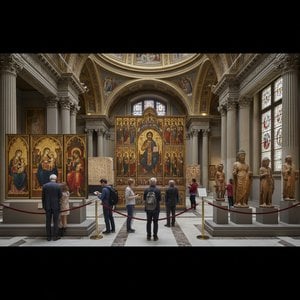
Sacred Narratives Embodied: A Comprehensive Exploration of Religious Iconography in Art History
Explore the rich history of religious iconography in art! Discover symbolism, movements & masterpieces from Byzantine to Renaissance periods. Expert insights for collectors and enthusiasts at ArtsDot.


