


 Visualizar na parede
 Compartilhar
 Compartilhar
 Detalhes

 Baixar imagem
 Semelhantes
 Raio X
 Slideshow
Curiosity
 Oil
Oil- WallArt
- Dutch Golden Age
 1660
1660 76.0 x 62.0 cm
 Museu Metropolitano de Arte
 Ler mais
Reprodução em Óleo Feita à Mão
Óleo sobre tela pintado à mão no tamanho e moldura de sua escolha, feito sob encomenda pelos nossos artistas. ( Comprar impressão Comprar imagem)




P118B $10

P118H $10

P118W $10

P438Z $10

P508JH $12

P508YH $12

P805H $10

P805Z $10

P919BZ $10

P919G $10

P919XJ $10

P959ZH $10

P968JZ $12

W106C $8

W218G $10

W218JH $8

W218Y $10

W307PJ $10

W316G $10

W316PJ $8

W316Y $10

W398PJ $8

W4111J $10

W500HY $15

W500JH $15

W692G $12

W849H $8

W940BG $15

W953PJ $8




Escolha entre os nossos tamanhos pré-definidos que respeitam as proporções originais da obra de arte.

Pode inserir as suas próprias dimensões para se adequar a uma moldura ou espaço específico. Se o tamanho selecionado não corresponder às proporções da imagem original, iremos cortar a obra de arte ou estender a pintura com elementos adicionais pintados à mão. Um esboço digital será enviado para sua aprovação antes do início da produção.
Tenha em atenção que a pré-visualização no ecrã não reflete o corte ou extensão real. Apenas o esboço mostrará com precisão a composição final.
Embora tamanhos personalizados estejam disponíveis, recomendamos selecionar uma dimensão da lista predefinida para preservar as proporções originais.
Após o pedido, a equipa ArtsDot.com enviará um e-mail ao cliente para solicitar instruções e fornecer uma prévia do esboço.
Entrega mundial () em 3 a 4 semanas, em vez das 5 semanas padrão. (27 Agosto). Sem comprometer a qualidade.

Envio expresso gratuito para todo o mundo

Tela de Linho de Alta Qualidade

Seguro de transporte completo

Garantia de Reembolso de Impostos Alfandegários

Garantia de Fidelidade Cromática

Política de Devolução em 60 Dias (Apenas para Defeitos)

Garantia de reembolso de 100%

Oferta de desconto por quantidade
 A opção de vidro está disponível apenas para tamanhos inferiores a 110 cm

Curiosity
Técnica de Reprodução
Tamanho da Reprodução
-


Preço Total
$ 263
The Enigmatic Gaze: Gerard ter Borch’s ‘Curiosity’
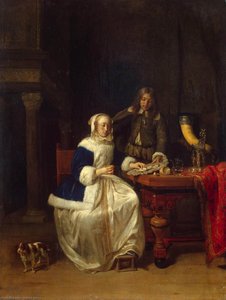
Gerard ter Borch's “Curiosity,” painted around 1660-62, isn’t a grand historical scene or a dramatic portrait; instead, it offers a profoundly intimate glimpse into the quiet domesticity of the Dutch Golden Age. This remarkable work, measuring just 76 x 62 cm, immediately draws the viewer in with its masterful use of light and shadow, creating an atmosphere of subtle tension and unspoken connection. The painting depicts three women – a seamstress meticulously working at her needle, a lady absorbed in a book, and a third figure observing them from a distance – within a modestly furnished room. It’s a scene brimming with understated observation, capturing the nuances of human interaction with remarkable psychological depth.
Ter Borch was a pioneer of Dutch genre painting, renowned for his ability to portray everyday life with an unparalleled level of realism and emotional sensitivity. Unlike many of his contemporaries who favored heroic subjects or elaborate compositions, Ter Borch focused on the ordinary – the moments of quiet contemplation, the subtle gestures, and the unspoken relationships that define human experience. “Curiosity” exemplifies this approach perfectly; it’s not about showcasing wealth or status but rather exploring the complexities of female companionship and the quiet drama of domestic life.
A Symphony of Light and Texture
The painting's power lies in Ter Borch’s extraordinary technical skill. He employs a technique known as ‘chiaroscuro,’ dramatically contrasting areas of light and shadow to create a sense of depth and volume. Notice how the soft, diffused light illuminates the women’s faces and hands, while the background remains shrouded in darkness, drawing our attention to their immediate presence. The textures are equally compelling – the delicate weave of the seamstress's dress, the smooth surface of the book, the rough fabric of the chair—all rendered with painstaking detail.
Ter Borch’s meticulous approach is evident in his rendering of fabrics and drapery. He doesn’t simply depict them; he captures their tactile quality, allowing us to almost feel the weight and texture of each garment. This attention to detail extends to every element of the scene, creating a remarkably immersive experience for the viewer. The subtle variations in tone and shading contribute significantly to the painting's overall sense of realism and immediacy.
Symbolism and Psychological Resonance
The composition itself is laden with symbolic meaning. The seamstress, focused on her work, represents diligence and industry – a valued trait in 17th-century Dutch society. The lady reading suggests intellectual pursuits and a connection to the wider world beyond the domestic sphere. And the woman observing them from afar—a figure often interpreted as the artist’s wife, Gesina ter Borch—hints at a subtle power dynamic and perhaps a hint of melancholy. Her averted gaze invites speculation about her thoughts and feelings.
The inclusion of the dog adds another layer of complexity to the scene. It represents loyalty, companionship, and the simple pleasures of domestic life. The dog’s presence further emphasizes the intimacy of the setting and the close-knit relationships between the women. “Curiosity” isn't merely a portrait; it’s a carefully constructed tableau that invites us to contemplate the mysteries of human connection and the quiet beauty of everyday moments.
Bringing ‘Curiosity’ Home
ArtsDot offers exquisite, hand-painted reproductions of Gerard ter Borch’s “Curiosity,” meticulously crafted by our team of skilled artists using traditional techniques. Each reproduction captures the original painting's luminous quality and psychological depth, allowing you to bring this remarkable work into your home or office. Available in a range of sizes, our high-quality prints are perfect for collectors, interior designers, and anyone who appreciates the beauty and artistry of Dutch Golden Age painting. Explore our selection today and experience the timeless allure of “Curiosity.”
Obras Relacionadas




Biografia do Artista
Um pioneiro da pintura de gênero holandesa
Gerard ter Borch, uma figura proeminente da Idade de Ouro holandesa, deixou uma marca indelével no mundo da arte com suas pinturas de gênero. Nascido em dezembro de 1617 e falecido em 8 de dezembro de 1681, a vida de Ter Borch foi um verdadeiro testemunho de sua destreza artística.Primeiros anos e influências
Embora os primeiros anos de Ter Borch não estejam bem documentados, sabe-se que ele viajou extensivamente pela Europa, incluindo Londres, Alemanha, França, Espanha e Itália. Essa exposição ampliou seus horizontes artísticos, influenciando seu estilo único. Sua irmã, Gesina ter Borch, também seguiu uma carreira na pintura, consolidando ainda mais as inclinações artísticas da família.Obras e conquistas notáveis
- A Carta: uma obra-prima que demonstra a habilidade de Ter Borch em capturar texturas e luz.
- A Conversa Galante: gravada por Johann Georg Wille, esta peça exemplifica a capacidade do artista de transmitir emoções sutis.
- Homem a Cavalo (1634): uma obra de juventude que demonstra o talento emergente de Ter Borch.
- A Chegada de Adrian Pauw em Münster (1646): uma peça significativa que destaca as capacidades narrativas do artista.
Museus e coleções que apresentam a obra de Ter Borch
- The Hermitage: com seis de suas obras, possui uma das maiores coleções dedicadas ao artista.
- Museu de Berlim: apresenta seis peças, demonstrando o apelo internacional de Ter Borch.
- Getty Center: três de suas pinturas fazem parte desta estimada coleção.
Legado e impacto
A influência de Ter Borch sobre pintores holandeses como Gabriel Metsu, Gerrit Dou, Eglância van der Neer e Johannes Vermeer é bem documentada. Sua abordagem inovadora à pintura de gênero tornou-o uma figura fundamental na história da arte.- Para saber mais sobre a vida e as obras de Ter Borch, visite https://ArtsDot.com/@/gerard-ter-borch
- Explore o Museu Boijmans van Beuningen em Roterdã, Países Baixos, que apresenta alguns dos contemporâneos de Ter Borch em https://ArtsDot.com/@@/a@d3arrk-museum-boijmans-van-beuningen-rotterdam-netherlands
- Saiba mais sobre a Idade de Ouro holandesa e seus artistas notáveis em https://en.wikipedia.org/wiki/dutch_golden_age

Gerard ter Borch
1617 - 1681 , Países Baixos
Dados Rápidos
- Artistic Movement Or Style: Pintura de gênero
- Artists Or Movements Influenced By This Artist: ['Pintura holandesa']
- Artists Who Influenced This Artist:
- Gabriel Metsu
- Johannes Vermeer
- Date Of Birth: 1617-12-01
- Date Of Death: 1681-12-08
- Full Name: Gerard ter Borch
- Nationality: Holandês
- Notable Artworks:
- A Carta
- A Conversa Graciosa
- Place Of Birth: Zwolle, Netherlands
Artigos Relacionados

Gerard ter Borch: Intimacy & Light in the Dutch Golden Age
Explore the captivating world of Gerard ter Borch, a master of Dutch Golden Age genre painting. Discover his intimate scenes, masterful light, and lasting influence on art history. Learn more at ArtsDot.

Golden Age Reflections: Dutch Baroque Painting & Cultural Innovation
Explore the Dutch Golden Age of painting! Discover key artists like Vermeer & ter Borch, their innovative techniques, and the rich cultural context behind these Baroque masterpieces. Learn about collecting & appreciating this iconic art period.
Illuminating Realism: Exploring the Dutch Golden Age of Painting (1600-1700)
Explore the Dutch Golden Age of painting (1600-1700) with ArtsDot. Discover Rembrandt, Vermeer & other masters. Learn about techniques, history & find museum-quality reproductions.

Genre Painting: A Window into Daily Life & Societal Values of the Dutch Golden Age
Explore the captivating world of Dutch Golden Age genre painting! Discover realistic depictions of daily life, masterful artists like Ostade & Metsu, and hidden symbolism. Learn about this influential art movement with ArtsDot.

Scenes of Daily Life: A Comprehensive Exploration of Genre Painting Through History
Explore the rich history of genre painting! Discover Dutch Masters & European artists who captured everyday life with stunning realism. Learn about symbolism, techniques & lasting influence.



