


 Visualizar em escala
 Enviar
 Compartilhar
 Ver detalhes
 Guia de Obras do Aluno

 Baixar imagem
 Semelhantes
 Raio X
 Apresentação de slides
 Estatísticas
Drawing


 Ver mais
A obra de arte exibida nesta página é protegida por leis de direitos autorais, o que significa que não podemos criar ou vender legalmente uma reprodução idêntica. Esta proteção é aplicada por meio de acordos internacionais, tais como a Convenção de Berna e pelas leis nacionais, incluindo as estabelecidas por Lei de Direitos Autorais dos EUA - Título 17.
Como uma alternativa respeitosa e legal, oferecemos obras de arte personalizadas e pintadas à mão, inspiradas na obra original. Nossos artistas profissionais e experientes estudam cuidadosamente o estilo, a atmosfera e a essência artística da obra original para criar uma peça nova e única que evoque a mesma sensação — permanecendo como uma criação original por direito próprio.
Este método cumpre plenamente as regulamentações de direitos autorais, pois não envolve a cópia ou duplicação da obra protegida. Em vez disso, trata-se de uma reinterpretação criativa — uma nova pintura que é influenciada pela original, mas não idêntica a ela.
Reprodução em Óleo Feita à Mão
Óleo sobre tela pintado à mão no tamanho e moldura de sua escolha, feito sob encomenda pelos nossos artistas. ( Alternar para Impressão Ver Imagem Digital)




P118B €10

P118H €10

P118W €10

P438Z €10

P508JH €12

P508YH €12

P805H €10

P805Z €10

P919BZ €10

P919G €10

P919XJ €10

P959ZH €10

P968JZ €12

W106C €8

W218G €10

W218JH €8

W218Y €10

W307PJ €10

W316G €10

W316PJ €8

W316Y €10

W398PJ €8

W4111J €10

W500HY €15

W500JH €15

W692G €12

W849H €8

W940BG €15

W953PJ €8




Escolha entre os nossos tamanhos pré-definidos que respeitam as proporções originais da obra de arte.

Digite a largura e a altura de que necessita, para se ajustar à sua moldura ou à sua parede. Esta obra é pintada à mão, por isso, para um tamanho com uma proporção diferente, o artista pode pintar um pouco mais ao redor da imagem ou cortar um pouco — você escolhe. Enviamos-lhe uma maquete digital para aprovação antes de a pintura começar. A imagem exibida nesta página não mostra o resultado real — apenas a maquete mostra.
Após o pedido, a equipa ArtsDot.com enviará um e-mail ao cliente para solicitar instruções e fornecer uma prévia do esboço.
Entrega mundial () em 3 a 4 semanas, em vez das 5 semanas padrão. (23 Outubro). Sem comprometer a qualidade.

Envio expresso gratuito para todo o mundo

Tela de Linho Premium

Seguro de transporte total

Garantia de Reembolso de Impostos Alfandegários

Garantia de Fidelidade de Cor

Política de Devolução em 100 Dias (Apenas para Defeitos)

Garantia de reembolso de 100%

Desconto para múltiplas unidades
 A opção de vidro está disponível apenas para tamanhos inferiores a 110 cm

Drawing
Técnica de Reprodução
Dimensões da Reprodução
-


Preço Total
€ 231
The Intricate Dance of Fabric: An Exploration of Georgia O’Keeffe’s “Drawing”
Georgia O’Keeffe’s 1916 drawing, a deceptively simple depiction of a curtain, is far more than a mere study in drapery. It's a masterful exercise in observation, texture, and the subtle interplay of light and shadow – hallmarks of the artist’s burgeoning modernist style. The image, rendered in charcoal on paper, immediately draws the eye into its complex folds, each layer suggesting depth and inviting the viewer to lose themselves within the fabric’s intricate geometry. Unlike the bold, often monumental scale of her later landscapes, this drawing is intimate, a quiet meditation on form and surface. It represents a pivotal moment in O'Keeffe’s artistic development, a conscious shift away from purely representational art towards a more subjective and emotionally resonant approach – heavily influenced by Arthur Wesley Dow’s teachings emphasizing personal expression and the harmonious balance of line and color.

A Study in Dow’s Principles: Line and Light
O’Keeffe’s early exposure to Arthur Wesley Dow proved transformative. Dow advocated for a direct approach to art, urging artists to focus on the essential elements of line, color, and value – not replicating reality but capturing its essence through careful observation and deliberate arrangement. This principle is strikingly evident in “Drawing.” The artist meticulously renders each fold and crease with precise lines, creating an illusion of three-dimensionality that belies the two-dimensional surface of the paper. Notice how O’Keeffe uses varying line weights to suggest depth – heavier lines for areas in shadow, lighter ones for those catching the light. This masterful control of line is a key element of her developing style and demonstrates her growing understanding of Dow's philosophy.
- Line Weight Variation: Creates a sense of volume and spatial depth.
- Value Contrast: Highlights the interplay of light and shadow, adding to the drawing’s realism.
- Simplified Forms: O'Keeffe reduces complex drapery into essential shapes, focusing on their underlying structure.
Contextualizing the Drawing: 1916 and Modernism
“Drawing” was created in 1916, a period of immense artistic ferment as modernism began to challenge traditional conventions. O’Keeffe was experimenting with abstraction and exploring new ways of representing the world around her. This drawing can be seen as a stepping stone towards her later, more iconic works – particularly her explorations of flowers and landscapes. The inclusion of two small figures in the background adds an intriguing layer of complexity to the composition. They are not sharply defined, almost ghostly presences, suggesting a narrative or scene beyond the immediate subject matter of the curtain. Their presence invites speculation about their relationship to the fabric and the overall space depicted.
Symbolism and Emotional Resonance
While seemingly straightforward, “Drawing” possesses a subtle emotional resonance. The curtain itself can be interpreted as a symbol of privacy, concealment, or perhaps even transformation – a barrier between worlds. The layering of fabrics evokes a sense of mystery and intrigue, mirroring the complexities of human experience. O’Keeffe's ability to distill such profound ideas into a simple charcoal drawing is a testament to her artistic genius and her deep understanding of the power of visual language. It’s a piece that rewards careful observation and invites repeated viewing, revealing new nuances with each encounter.
Perguntas e Respostas
Qual é o nível de popularidade de "Drawing" dentro do Early Modernism?
"Drawing" de Georgia O'Keeffe é classificada como Iconic e pertence ao movimento Early Modernism.
Posso ver "Drawing" como um slideshow em tela cheia?
"Drawing" de Georgia O'Keeffe pode ser visualizada como um slideshow na página de Apresentação de slides da obra.
O que explica a situação dos direitos autorais de "Drawing" de Georgia O'Keeffe?
O status de direitos autorais de "Drawing" - ainda protegido por direitos autorais - decorre do falecimento do artista em 1986.
Obras Relacionadas


Biografia do Artista
Early Life and Artistic Foundations
Georgia Totto O’Keeffe, a name synonymous with American modernism, emerged from the unassuming landscape of Sun Prairie, Wisconsin, in 1887. Born into a family of Irish and Hungarian descent engaged in dairy farming, young Georgia displayed an artistic inclination early on, deciding by age ten that she would dedicate her life to art. This determination was nurtured through lessons with local watercolorist Sara Mann, followed by formal studies at the School of the Art Institute of Chicago from 1905 to 1906 and later at the University of Virginia. However, it was her encounter with Arthur Wesley Dow’s principles – emphasizing personal expression and a harmonious balance of color and line – that truly ignited her artistic path. Dow's teachings steered O’Keeffe away from strict realism toward a more subjective and emotionally resonant approach to art, an approach that would define her career. These formative years weren’t without their challenges; periods of illness and dissatisfaction led her to temporarily abandon painting, but the creative impulse always drew her back, evolving with each new experience and influence.New York and the Stieglitz Circle
A pivotal moment arrived in 1916 when O’Keeffe’s abstract charcoal drawings were discovered by Alfred Stieglitz, a renowned photographer and art dealer. He exhibited her work without her prior knowledge, sparking a dialogue that would profoundly shape both their lives and the course of American art. Stieglitz recognized an exceptional talent in O'Keeffe, one that resonated with his own modernist sensibilities. He invited her to New York City in 1918, providing not only professional support but also fostering a deep personal connection. Their relationship blossomed into marriage in 1924, creating a dynamic artistic partnership and intellectual exchange. Stieglitz championed O’Keeffe’s work, showcasing it at his gallery “291” and promoting her as a leading figure in the American avant-garde. During this period, she began to develop her signature style – bold, simplified forms and intensely saturated colors – initially expressed through depictions of New York skyscrapers and, most famously, magnified flower paintings. These floral works, often interpreted (though consistently denied by O’Keeffe herself) as veiled representations of female anatomy, challenged conventional notions of beauty and sexuality in art.The Allure of the Southwest
While New York provided a crucial platform for her early success, it was the landscapes of the American Southwest that truly captured O’Keeffe’s imagination and profoundly influenced her artistic vision. Her first visit to New Mexico in 1929 marked the beginning of a lifelong love affair with the region's stark beauty, vibrant colors, and unique cultural heritage. The vastness of the desert, the dramatic rock formations, and the ancient Pueblo architecture resonated deeply within her, inspiring a new series of paintings that reflected the spirit of the land. Works like *Cow’s Skull: Red, White, and Blue* (1931) and *Summer Days* (1936) are powerful testaments to this influence, transforming seemingly mundane objects into iconic symbols of the American West. She eventually settled permanently in New Mexico in 1949 following Stieglitz’s death, establishing a home and studio in Abiquiu that became integral to her artistic process and identity.Style and Technique
O'Keeffe’s style evolved significantly throughout her career. Initially influenced by Arthur Dow’s emphasis on abstraction and color harmony, she later developed a distinctive approach characterized by monumental scale, simplified forms, and intense colors. Her flower paintings, in particular, are renowned for their close-up perspective, which transforms ordinary blossoms into captivating symbols of beauty and fragility. She often employed a limited palette – primarily reds, blues, yellows, and greens – to create striking visual effects. Furthermore, O’Keeffe experimented with various media, including oil paint, watercolor, casein, and collage, adapting her techniques to suit the subject matter and desired effect. Her work is notable for its emotional intensity and its ability to evoke a sense of wonder and contemplation.Legacy and Enduring Influence
Georgia O'Keeffe continued to paint prolifically throughout her life, experimenting with new subjects and pushing the boundaries of abstraction. Her later works included aerial views of clouds and skies, reflecting a fascination with the vastness and ethereal quality of the natural world. She remained fiercely independent and uncompromising in her artistic vision, refusing to be categorized or defined by prevailing art movements. O’Keeffe’s impact on American art is immeasurable. She paved the way for future generations of female artists, challenging societal norms and asserting her own unique voice in a male-dominated field. Her paintings continue to captivate audiences with their bold simplicity, emotional depth, and evocative power. The establishment of the Georgia O'Keeffe Museum in Santa Fe in 1997 further solidified her legacy, preserving her art and providing a space for ongoing scholarship and appreciation. In 2014, *Jimson Weed/White Flower No. 1* sold for $44.4 million, setting a record price for a work by a female artist – a testament to the enduring value and significance of her artistic contribution. O’Keeffe's influence extends beyond painting; she became an icon of American individualism and self-reliance, inspiring countless artists and admirers with her unwavering commitment to her craft and her unique perspective on the world. Her work remains a powerful reminder of the transformative power of art and the enduring beauty of the natural world.Key Works & Museum Presence
- Red Canna: Exemplifies her early exploration of floral abstraction.
- Cow’s Skull: Red, White, and Blue (1931): A powerful symbol of the American Southwest and a meditation on mortality.
- Summer Days (1936): Captures the essence of the New Mexico landscape with its vibrant colors and simplified forms.
- Jimson Weed/White Flower No. 1: A monumental floral painting that showcases her mastery of scale and composition.
- Georgia O'Keeffe Museum (Santa Fe)
- Museum of Modern Art (New York)
- Art Institute of Chicago
- National Gallery of Art (Washington, D.C.)

Georgia O'Keeffe
1887 - 1986 , Estados Unidos da América
Informações Rápidas
- Artistic Movement Or Style: Modernismo, Precisionismo
- Artists Or Movements Influenced By This Artist: ['Expressionismo']
- Artists Who Influenced This Artist:
- Arthur Dow
- Alfred Stieglitz
- Date Of Birth: 15 de novembro de 1887
- Date Of Death: 6 de março de 1986
- Full Name: Georgia Totto O'Keeffe
- Nationality: Americana
- Notable Artworks:
- Red Canna
- Crânio de vaca
- Flores-brancas
- Place Of Birth: Sun Prairie, EUA
Artigos Relacionados
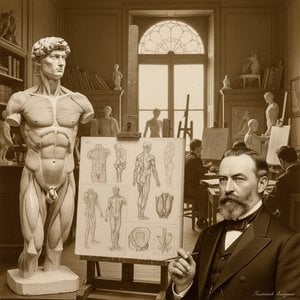
Frederick Bridgman: Anatomical Mastery & the Evolution of Figure Drawing Instruction
Explore the anatomical mastery of George B. Bridgman & his revolutionary figure drawing techniques. Discover how his methods transformed art instruction and continue to inspire artists today. Learn more at ArtsDot.

As 10 Pinturas Mais Famosas em Tons de Carvão: Arte e Decoração
Descubra as 10 pinturas mais icônicas em tons de carvão, explorando a história e o impacto de artistas como Rembrandt e Goya. Encontre reproduções de arte clássica para transformar sua decoração. Explore a coleção completa na ArtsDot.com!

The Nuances of Graphite: Exploring Emotional Depth & Technical Mastery in Pencil Drawing
Explore the captivating world of graphite drawing! Discover its rich history, master essential techniques like chiaroscuro, and learn how artists evoke emotion through this timeless medium. Expert insights for art enthusiasts.

The Enduring Power of Line: Exploring Themes & Techniques in Drawing Across Art History
Explore the rich history of drawing! Discover key techniques like linear perspective & iconic artists from the Renaissance to modern times. Enhance your art appreciation with ArtsDot.

Georgia O'Keeffe: Redefining Modernism Through Symbolism & the American Landscape
Explore the captivating world of Georgia O'Keeffe! Discover her groundbreaking flower paintings, New Mexico landscapes & lasting impact on American Modernism. Expert analysis and insights.


