

- 280.0 x 450.0 cm


A imagem segue as suas escolhas: , .
Descrição do Item
Featuring inverted figures and bold chromatic harmonies, Georg Baselitz's Supper in Dresden captures a powerful Neo-Expressionist moment that invites you to explore the depths of this monumental masterpiece.
 Ler mais
Biografia do Artista
Explore the powerful & provocative work of Georg Baselitz (b. 1938), a leading Neo-Expressionist known for his upside-down figures, challenging perspectives on German history, destruction, and the artifice of painting. Discover his sculptures & graph
Reprodução em Óleo Feita à Mão
Óleo sobre tela pintado à mão no tamanho e moldura de sua escolha, feito sob encomenda pelos nossos artistas. ( Alternar para Impressão Alternar para Imagem Digital)
Esta obra está protegida por direitos autorais
A obra de arte exibida nesta página é protegida por leis de direitos autorais, o que significa que não podemos criar ou vender legalmente uma reprodução idêntica. Esta proteção é aplicada por meio de acordos internacionais, tais como a Convenção de Berna e pelas leis nacionais, incluindo as estabelecidas por Lei de Direitos Autorais dos EUA - Título 17.
Como uma alternativa respeitosa e legal, oferecemos obras de arte personalizadas e pintadas à mão, inspiradas na obra original. Nossos artistas profissionais e experientes estudam cuidadosamente o estilo, a atmosfera e a essência artística da obra original para criar uma peça nova e única que evoque a mesma sensação — permanecendo como uma criação original por direito próprio.
Este método cumpre plenamente as regulamentações de direitos autorais, pois não envolve a cópia ou duplicação da obra protegida. Em vez disso, trata-se de uma reinterpretação criativa — uma nova pintura que é influenciada pela original, mas não idêntica a ela.
Saiba mais sobre esta pintura
 Visualizar na parede
 Compartilhar
 Compartilhar
 Detalhes
 Guia
Guia

 Baixar imagem
 Semelhantes
 Raio X
 Ver diaporama
 Perguntas e Respostas
 Estatísticas
Encomende a sua pintura em quatro passos simples
Não tenha pressa. Você pode alterar qualquer resposta; o preço no seu carrinho de compras será atualizado conforme cada escolha.
1 Passo um de quatro
Qual tamanho você gostaria?
Estes tamanhos mantêm as proporções da pintura original. A ilustração mostra a sua escolha numa parede, acima de um sofá de dois metros.
Ou informe suas próprias medidas
Escolha entre os nossos tamanhos pré-definidos que respeitam as proporções originais da obra de arte.

Insira a largura e a altura desejadas para se ajustarem à sua moldura ou parede. Como esta obra é pintada à mão, para um tamanho com proporções diferentes, o artista poderá pintar um pouco mais ao redor da imagem ou reduzir ligeiramente a composição — você escolhe. Enviamos uma maquete digital para sua aprovação antes de iniciar a pintura. A imagem exibida nesta página não representa o resultado real — apenas a maquete mostra o resultado final.
2 Passo dois de quatro
Como deve ser preparado: enrolado, esticado ou emoldurado?
Os preços abaixo referem-se ao tamanho escolhido na primeira etapa.
Escolha as bordas da tela esticada
Escolha sua moldura

Branco €1

Bordas esfumaçadas €1

Bordas estendidas €1

P118B €10

P118H €10

P118W €10

P438Z €10

P508JH €12

P508YH €12

P805H €10

P805Z €10

P919BZ €10

P919G €10

P919XJ €10

P959ZH €10

P968JZ €12

W106C €8

W218G €10

W218JH €8

W218Y €10

W307PJ €10

W316G €10

W316PJ €8

W316Y €10

W398PJ €8

W4111J €10

W500HY €15

W500JH €15

W692G €12

W849H €8

W940BG €15

W953PJ €8

H24-GOLD €30

H24-SILVER €30

H36-GOLD €45

H36-SILVER €45
Com moldura
Moldura: . Dimensões totais com a moldura: .
3 Passo três de quatro
Gostaria de alterar algo na pintura?
A maioria das pessoas responde que não. Como cada pintura é feita à mão, nosso artista também pode adaptá-la para você.
Após o pedido, a equipe da ArtsDot.com enviará um e-mail ao cliente para instruções e fornecerá uma prévia da montagem
4 Passo quatro de quatro
Algumas opções de acabamento
Todos eles são opcionais. As respostas já selecionadas não têm custo adicional.
Quem o pintou?
Entrega mundial () em 3 a 4 semanas, em vez das 5 semanas padrão. (8 Novembro). Sem comprometer a qualidade.
Uma placa de identificação, como em um museu?
Detalhes da Placa de Bronze Gravada
This elegant plaque features the artist's name and the title of the artwork, finely engraved for a timeless presentation.
It is made from bronze with a refined, elegant finish. The text is precisely laser-engraved for a sharp and permanent result. Measuring 9x2 cm, the plaque is compact yet easy to read. It's built to be durable and scratch-resistant, offering a professional, museum-quality look. Mounting is simple thanks to the included adhesive backing.
Detalhes da Placa de Acrílico Transparente
The plaque includes essential engraved details such as the artist's name, the title of the artwork, the date it was created, the type of media used-like oil on canvas or watercolor-a brief description of the piece, and a QR code that links to the complete artwork information.
It is crafted from clear acrylic, offering a sleek, modern appearance. The text is UV-engraved in black to ensure strong visual contrast. With a size of 10x15 cm, it ensures optimal readability. It comes equipped with two metal hooks for secure wall mounting. The plaque is designed to be weather-resistant, making it suitable for various environments, and it includes interactive features that work seamlessly with smartphone scanning.
Detalhes da Placa de Acrílico Preto
This elegant plaque includes engraved information such as the artist's name, the title of the artwork, the date it was created, the type of media used (like oil on canvas or watercolor), a short description of the artwork, and a QR code for quick access to more information.
The plaque itself is made from refined black acrylic with a premium finish. The text is laser-engraved in white for high contrast and readability. Its size is 10x15 cm, designed to be easy to read. It comes with two metal hooks for professional mounting. The design is sleek and fits any interior style. It is also weather-resistant and durable, with built-in digital integration for mobile compatibility.
Um verniz protetor?
Para quando você precisa?
✓ Verifique e peça
A sua pintura, conforme encomendada

Supper in Dresden
Técnica de Reprodução
Tamanho da Reprodução
-

Artista Sênior de Elite
Mais detalhes, refinamento e tempo de produção adicional
-

Moldura para Reprodução
-
-
Para obras de arte ou reproduções com mais de 105 cm (aproximadamente 41 polegadas) em qualquer um dos lados, a moldura será enviada como um kit desmontado. Este método garante uma entrega segura e evita danos durante o transporte.
Montagem profissional necessária — este não é um produto DIY (faça você mesmo).
O kit deve ser montado e a tela esticada por um profissional de molduraria experiente, utilizando cola de madeira (não inclusa), um alicate de esticar tela e grampos para manter as travessas alinhadas enquanto a cola seca. A montagem incorreta ou a tensão desigual da tela podem danificar permanentemente a obra de arte e não estão cobertas pela nossa garantia.
 Para obras de arte ou reproduções com mais de 105 cm (aproximadamente 41 polegadas) em qualquer um dos lados, a moldura será enviada como um kit desmontado. Este método garante uma entrega segura e evita danos durante o transporte.
Todas as barras de madeira maciça estão incluídas, precisamente cortadas ao tamanho certo.
Montado com os parafusos fornecidos, além de cola para madeira para as junções dos cantos, que não está inclusa e deve ser providenciada pelo seu moldurista.
São necessárias ferramentas profissionais não incluídas: um alicate de estiramento de tela (esticador) e grampos para manter as ripas alinhadas enquanto a cola seca.
Importante:
As junções dos cantos requerem cola para madeira, as ripas devem ser mantidas com grampos até que a cola esteja completamente seca, e o estiramento da tela na moldura montada requer um alicate de esticar tela. Nenhum destes itens está incluído no kit. Por favor, certifique-se de contar com um profissional de molduraria experiente antes de encomendar este tamanho.

Etiqueta de identificação
-
-

Verniz de Proteção
Verniz brilhante (realça as cores e protege contra a luz e a umidade)
-

Personalizar minha obra
Exemplos de alterações possíveis: Substituir o rosto por uma foto do cliente; Adicionar um animal de estimação (ex.: substituir gato por cachorro); Incluir uma mensagem oculta no fundo; Alterar a paisagem ou os elementos do fundo.
-

Urgente
Entrega mundial () em 3 a 4 semanas, em vez das 5 semanas padrão. (8 Novembro). Sem comprometer a qualidade.
-
Envio Expresso
Entrega mundial para em 5 semanas. (15 Novembro).
Com envio incluído
Preço Total
€ 235
A opção de vidro está disponível apenas para tamanhos inferiores a 110 cm
Incluído em todos os pedidos
- Envio expresso gratuito para todo o mundo
- Tela de Linho de Alta Qualidade
- Seguro de transporte completo
- Garantia de Reembolso de Impostos Alfandegários
- Garantia de Fidelidade Cromática
- Política de Devolução em 100 Dias (Apenas para Defeitos)
- Garantia de reembolso de 100%
- Oferta de desconto por quantidade


A Masterpiece of Inversion: Reimagining History in Baselitz's Supper in Dresden
In the vast, commanding expanse of Supper in Dresden, viewers are invited into a world where reality is turned on its head—quite literally. This monumental oil on canvas, stretching over four meters in length, serves as a profound testament to the genius of Georg Baselitz, one of the most provocative voices of the Neo-Expressionist movement. At first glance, the painting presents a chaotic, almost feverish gathering around a long dining table, yet beneath this surface of disundress lies a deeply layered exploration of identity and artistic heritage. The composition oscillates between recognizable figuration and robust, chromatic harmonies, where striking shades of pink, blue, and black collide to create a sense of restless energy that captures the eye and refuses to let go.
The technique employed by Baselitz in this 1983 masterpiece is nothing short of revolutionary. By famously inverting his subjects, he de-emphasizes the literal content of the scene to bring the raw materiality of painting—the brushstroke, the texture, and the color—to the forefront. This deliberate subversion forces the viewer to look past the "what" of the image and instead experience the "how." The central figure, with eyes and mouth agapped in a silent, haunting cry, dominates the canvas, acting as an emotional anchor amidst the surrounding figures who seem to drift toward the edges of the frame. This tension between the central focus and the peripheral movement creates a psychological depth that makes the work feel alive, breathing with a nervous, almost agonized vitality.
Historical Echoes and Symbolic Depth
Beyond its striking visual impact, Supper in Dresden is steeped in historical symbolism and personal reflection. While the motif of a shared meal evokes the sacred tradition of the Last Supper, Baselitz uses this framework to pay homage to the birth of German Expressionism. The painting serves as a spectral gathering of the Die Brücke group; specifically, it depicts the meeting of Expressionists in 1905 that gave rise to this influential artistic movement. Within this chaotic feast, one can identify the nervous, agonized-looking figure on the left as Ernst Ludwig Kirchner, while the dominant central figure is said to represent Karl Schmidt-Rotluff. In a surreal twist of form, the two close friends Otto Müller and Erich Heckel appear on the right, sharing a single body.
This layering of history allows the painting to function as both a personal memoir and a cultural monument. For collectors and enthusiasts, the work offers more than just visual spectacle; it provides a window into the fractured order of a post-war society. Baselitz, who grew up amidst the literal and metaphorical rubble of World War II, uses this inversion to mirror a world that had been turned upside down by conflict. The painting captures the very essence of reconstruction—the attempt to find meaning and form in the midst of displacement and destruction.
An Essential Addition for Discerning Spaces
For interior designers and art collectors seeking to anchor a room with intellectual weight and dramatic flair, Supper in Dresden offers unparalleled presence. Its massive scale and bold, contrasting palette make it an ideal centerpiece for grand galleries, sophisticated lofts, or contemporary executive suites. The work does not merely decorate a wall; it commands the atmosphere of a space, inviting conversation and deep contemplation.
Whether you are drawn to the raw, expressive power of the Neo-Expressionist movement or the complex historical narratives woven into every brushstroke, a high-quality reproduction of this masterpiece brings a sense of prestige and profound emotion to any environment. It is an investment in a piece of art history that continues to challenge our perceptions of reality, making it a timeless choice for those who appreciate art that is as intellectually stimulating as it is visually breathtaking.
Perguntas e Respostas
As cores de "Supper in Dresden" são vibrantes ou suaves?
As cores de "Supper in Dresden", de Georg Baselitz apresentam uma saturação Balanced Soft com uma intensidade Balanced.
Qual é a luminância de "Supper in Dresden", de Georg Baselitz?
"Supper in Dresden", de Georg Baselitz possui uma luminância Soft Shadow. A luminância descreve quanta luz as cores parecem refletir.
De que forma o estilo de "Supper in Dresden" se relaciona com a época de seu criador?
"Supper in Dresden", de Georg Baselitz insere-se no movimento Neo-Expressionism, dentro da era Modern de seu criador.
Obras Relacionadas


Georg Baselitz
1938 -
Biografia do Artista
A Life Forged in the Shadows of History
Born Hans-Georg Bruno Kern on January 23, 1938, in the small German village of Deutschbaselitz, the artist who would become known to the world as Georg Baselitz was a child of profound transition and upheaval. Growing up in the Upper Lusatia region amidst the literal and metaphorical rubble of World War II, his early consciousness was inextricably linked to themes of destruction, displacement, and the fractured order of a shattered society. This formative environment—marked by the loss of community and the lingering trauma of occupation—became the bedrock of his artistic vision. The devastation he witnessed did not merely provide subject matter; it instilled in him an urgent, lifelong need to question established conventions and to explore the very nature of perception through the lens of a world that had been turned upside down.
His early artistic inclinations were nurtured by a deep intellectual curiosity and significant cultural encounters. The influence of his father, an elementary school teacher, fostered a disciplined approach to observation, while the profound writings of Jakob Böhme provided a spiritual and philosophical complexity to his worldview. A pivotal moment in his development occurred when he encountered Louis-Ferdinand von Rayski’s Wermsdorfer Wald at a local school assembly. This masterpiece of realism ignited a fascination with capturing visual truth, leading him to produce portraits, religious subjects, and landscapes that, even in his youth, hinted at a more futuristic and unsettling vision.
The Revolution of Inversion and Neo-Expressionism
As the art world moved toward the sterile intellectualism of Minimalism and Conceptual Art in the 1960s, Baselitz staged a visceral rebellion. He became a leading voice of Neo-Expressionism, a movement that sought to reclaim the raw power and emotional intensity of figurative painting. However, his contribution was far from a simple return to tradition. In 1969, Baselitz introduced one of the most radical innovations in modern art: the technique of painting his subjects upside down. This deliberate inversion was not a mere gimmick; it was a profound attempt to strip the subject of its representational, content-driven character. By turning the figure on its head, he forced the viewer to confront the artifice of the painting itself—to look past the "what" of the image and focus instead on the texture, color, and the physical reality of the paint on canvas.
This period saw the emergence of works that challenged the very boundaries of the medium. His compositions often oscillated between recognizable figuration and a chaotic, feverish energy. In monumental pieces like Supper in Dresden, he reimagined historical narratives through a lens of disarray and chromatic collision, using striking shades of pink, blue, and black to create a sense of restless, uncontainable energy. His work during this era functioned as an excavation of the human condition, utilizing distortion to express vulnerability and the inherent instability of memory and identity.
A Lasting Legacy of Provocation
Throughout his prolific career, Baselitz’s artistic language has been a complex tapestry woven from myriad influences, ranging from the starkness of Socialist Realism and the dramatic tension of Mannerism to the primal rhythms of African sculpture. This eclectic synthesis allowed him to create a body of work that feels both deeply rooted in German history and universally resonant in its exploration of existential struggle. Whether through his commanding oil paintings, his evocative sculptures, or his intricate graphic works, Baselitz has remained steadfast in his commitment to a style characterized by unsettling honesty.
The historical significance of Georg Baselitz lies in his ability to transform the trauma of the past into a revolutionary aesthetic for the future. He did not merely document destruction; he used it as a tool to rebuild the language of painting. His achievements include:
- Redefining Figuration: Breaking the reliance on narrative content through the radical use of inversion.
- Mastery of Neo-Expressionism: Leading a global revival of emotional, visceral painting in an era of conceptual dominance.
- Exploration of Identity: Using distorted forms to grapple with the complexities of post-war German identity and the fragility of the human form.
- Technical Innovation: Integrating diverse cultural influences into a singular, unmistakable artistic voice that continues to influence generations of painters and sculptors.
Today, Baselitz stands as one of the most influential figures of the twentieth century, a painter whose work remains a powerful testament to the resilience of creativity in the face of chaos.
Artigos Relacionados
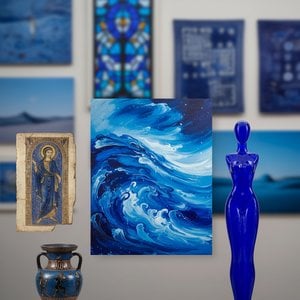
The Allure of Azure: Exploring the Symbolic & Aesthetic Depths of Blue in Art History
Explore the rich history of blue in art! Discover its symbolism, from ancient pigments to modern masterpieces by Kandinsky & Seurat. Uncover the psychological impact and cultural meanings behind this captivating hue.

As 10 Pinturas Mais Famosas em Tons de Rosa Claro: Uma Ode à Luz e Cor
Descubra as 10 pinturas mais famosas em tons de rosa claro, de Monet a Renoir! Explore a história, técnica e beleza atemporal dessas obras-primas. Encontre reproduções de arte exclusivas e ideias para decoração com cores pastel na ArtsDot.com.

As 10 Obras Mais Famosas em Tons de Azul Ardósia | ArtsDot.com
Descubra as 10 pinturas mais emblemáticas em tons de azul ardósia! Explore a história, artistas como Monet e Van Gogh, e o significado da cor na arte. Encontre reproduções de alta qualidade para decorar sua casa com ArtsDot.com.