


 Visualizar em escala
 Enviar
 Compartilhar
 Ver detalhes
 Guia
Guia

 Baixar imagem
 Semelhantes
 Raio X
 Apresentação de slides
 Estatísticas
Forest Landscape
 Oil On Canvas
- WallArt
- Pseudo-Italianate landscapes
 1690
1690- Early Modern
 81.0 x 117.0 cm
 Museu Hermitage
 Ver mais
Reprodução em Óleo Feita à Mão
Óleo sobre tela pintado à mão no tamanho e moldura de sua escolha, feito sob encomenda pelos nossos artistas. ( Alternar para Impressão Ver Imagem Digital)




P118B $10

P118H $10

P118W $10

P438Z $10

P508JH $12

P508YH $12

P805H $10

P805Z $10

P919BZ $10

P919G $10

P919XJ $10

P959ZH $10

P968JZ $12

W106C $8

W218G $10

W218JH $8

W218Y $10

W307PJ $10

W316G $10

W316PJ $8

W316Y $10

W398PJ $8

W4111J $10

W500HY $15

W500JH $15

W692G $12

W849H $8

W940BG $15

W953PJ $8




Escolha entre os nossos tamanhos pré-definidos que respeitam as proporções originais da obra de arte.

Pode inserir as suas próprias dimensões para se adequar a uma moldura ou espaço específico. Se o tamanho selecionado não corresponder às proporções da imagem original, iremos cortar a obra de arte ou estender a pintura com elementos adicionais pintados à mão. Um esboço digital será enviado para sua aprovação antes do início da produção.
Tenha em atenção que a pré-visualização no ecrã não reflete o corte ou extensão real. Apenas o esboço mostrará com precisão a composição final.
Embora tamanhos personalizados estejam disponíveis, recomendamos selecionar uma dimensão da lista predefinida para preservar as proporções originais.
Após o pedido, a equipa ArtsDot.com enviará um e-mail ao cliente para solicitar instruções e fornecer uma prévia do esboço.
Entrega mundial () em 3 a 4 semanas, em vez das 5 semanas padrão. (21 Setembro). Sem comprometer a qualidade.

Envio expresso gratuito para todo o mundo

Tela de Linho Premium

Seguro de transporte total

Garantia de Reembolso de Impostos Alfandegários

Garantia de Fidelidade de Cor

Política de Devolução em 100 Dias (Apenas para Defeitos)

Garantia de reembolso de 100%

Desconto para múltiplas unidades
 A opção de vidro está disponível apenas para tamanhos inferiores a 110 cm

Forest Landscape
Técnica de Reprodução
Dimensões da Reprodução
-


Preço Total
$ 263
A Symphony of Verdant Serenity
In the quiet depths of Cornelis Huysmans’s Forest Landscape, one finds more than just a depiction of nature; one encounters a profound meditation on peace. Painted around 1690, this masterpiece invites the viewer into a secluded woodland sanctuary where time seems to have surrendered to the rhythmic pulse of the earth. The composition is a lush tapestry of arboreal grandeur, where towering trees reach toward an unseen canopy, their branches interlaced to create a cathedral of foliage. Amidst this emerald expanse, life unfolds in its most gentle forms. Scattered throughout the glade, cattle graze with a heavy, contented grace, while sheep wander through the dappity light, their presence adding a layer of pastoral innocence to the scene. The atmosphere is one of absolute stillness, a captured moment of pastoral idyll that resonates with the soothing whispers of a world untouched by the chaos of urban existence.
The emotional resonance of this work lies in its ability to evoke a sense of profound nostalgia and tranquility. For the discerning collector or interior designer, this painting serves as an anchor of calm, offering a window into a primordial Eden. The way the light filters through the leaves—a technique Huysmans mastered through his study of both Mannerist precision and Baroque expression—creates a play of shadow and luminosity that breathes life into every blade of grass and every curve of a grazing animal's back. It is an evocative piece that does not merely decorate a room but transforms it, imbuing a space with the restorative power of the natural world.
The Mastery of Light and Transition
To understand the technical brilliance of this landscape, one must look to Huysmans’s unique position in art history. As a pivotal figure bridging the meticulous, detailed traditions of Mannerism and the more emotive, atmospheric ideals of the Dutch Baroque, Huysmans possessed a rare dual capability. He could render the intricate textures of bark and leaf with scientific accuracy, yet he also understood how to use light as an expressive tool to guide the eye through the composition. In this work, his brushwork achieves a seamless synthesis; there is a palpable weight to the animals and a tangible density to the forest, all unified by a sophisticated handling of color palettes that range from deep, earthy umbers to vibrant, sun-drenched greens.
This technical prowess was forged in the great artistic hubs of Europe. Having trained under Gaspar de Witte in Antwerp and likely honing his decorative sensibilities in the studio of Jacques d'Arthois in Brussels, Huysmans brought a cosmopolitan sophistication to his Flemish roots. His ability to balance the "pseudo-Italianate" grandeur—often featuring dramatic vistas and mountainous backdrops—with the intimate, localized charm of a Belgian woodland is what makes this particular piece so captivating. It is a masterclass in composition, where every element, from the wandering livestock to the shifting shadows, is placed with intentionality to create a harmonious and enduring visual experience.
A Timeless Legacy for the Modern Collector
For those seeking to curate an environment of elegance and intellectual depth, Forest Landscape offers an unparalleled opportunity. This painting is not merely a relic of the late 17th century; it is a living testament to the enduring human desire for connection with the wild and the serene. Its subject matter—the pastoral landscape—has remained a cornerstone of fine art because it speaks to a universal longing for harmony. As an investment in high-quality reproduction, this work brings the prestige of the Hermitage-level mastery into the private home or professional gallery.
Integrating such a piece into a modern interior allows for a striking dialogue between historical grandeur and contemporary design. Whether placed as a focal point in a minimalist study or used to add warmth to a classical salon, the painting’s rich textures and deep tonal range provide a sophisticated foundation. It invites conversation, inspires reflection, and serves as a permanent retreat into the timeless beauty of the Flemish masters.
Obras Relacionadas


Biografia do Artista
Cornelis Huysmans: A Flemish Landscape Master
- Born: Antwerp, Belgium (1648)
- Died: 1727
Early Life and Training
- Cornelis Huysmans was baptized on April 2, 1648, in Antwerp. His parents were Hendrik Huysmans and Catharina van der Meyden.
- His father's profession is described as either a master builder or a craftsman in the mint.
- Following his parent’s early death, he was sent to study under the landscape painter Gaspar de Witte.
- He later moved to Brussels to further his studies and may have worked as an assistant in the studio of Jacques d'Arthois.
- Around 1675, he collaborated with Adam Frans van der Meulen in Maastricht.
Career and Artistic Development
- In 1675, Huysmans became an independent master of the Guild of Saint Luke in Brussels.
- He spent time in London from approximately 1686 to 1688, creating landscapes for prominent members of society.
- Around 1688, he settled in Mechelen and married Maria Anna Scheppers.
- In 1690, he created a significant altarpiece, "The Road to Emmaus," for the Onze-Lieve-Vrouw-over-de-Dijle church in Mechelen.
- He returned to Antwerp in 1706 and was admitted as a master in the local guild of Saint Luke.
- Huysmans eventually returned to Mechelen, where he continued working until his death in 1727.
Artistic Style and Influences
- Huysmans is primarily known for his landscape paintings, though he also created religious and history works.
- His style is characterized by detailed observations of nature, particularly forests and trees.
- He was significantly influenced by Jacques d'Arthois, evident in the decorative compositions depicting forest edges with sandy banks.
- Huysmans incorporated a "pseudo-Italianate" aesthetic, featuring mountains and vegetation reminiscent of Italy.
- His use of dramatic light contrasts between roads and tree shadows created a striking visual effect.
- He often employed diagonal lines within his compositions to create depth and perspective.
Legacy and Historical Significance
- Cornelis Huysmans held a prominent position in Flemish landscape painting during the late 17th and early 18th centuries.
- His works demonstrate a transition from earlier, more detailed styles towards a more decorative and atmospheric approach to landscape art.
- He influenced younger artists, including his son Pieter Balthasar Huysmans and his brother Jan Baptiste Huysmans.
- Huysmans's paintings are represented in numerous museum collections worldwide, including the Louvre, the Hermitage Museum, and various museums in Belgium and elsewhere.
- His ability to capture both the realism of nature and a sense of idealized beauty contributed to his lasting reputation as a significant Flemish landscape painter.

Cornelis Huysmans
1648 - 1727 , Belgium
Informações Rápidas
- Artistic Movement Or Style: Pseudo-Italianate landscapes
- Artists Or Movements Influenced By This Artist:
- Pieter Balthasar Huysmans
- Jan Baptiste Huysmans
- Artists Who Influenced This Artist:
- Nicolas Poussin
- Jacques d'Arthois
- Date Of Birth: 1648
- Date Of Death: 1727
- Full Name: Cornelis Huysmans
- Nationality: Flemish
- Place Of Birth (City And Country): Antwerp, Belgium
Artigos Relacionados

Jacob van Ruisdael: Master of Dutch Landscape & the Evocation of National Identity
Explore the life & work of Jacob van Ruisdael, the preeminent Dutch landscape painter. Discover his technical brilliance, symbolic depth, and lasting influence on art history. Learn about collecting Ruisdael's masterpieces.

Jan van Goyen: Master of Dutch Landscape & Atmospheric Perspective
Discover Jan van Goyen, the master of Dutch landscape painting. Explore his subtle technique, atmospheric realism & lasting influence on art history. Learn about this 17th-century pioneer at ArtsDot.
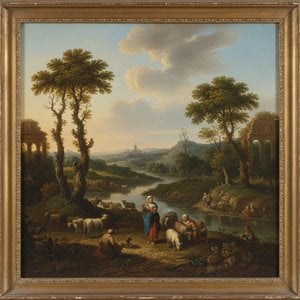
Nicolaes Berchem: Dutch Golden Age Pastoralism & the Evolution of Landscape Painting
Explore the captivating world of Nicolaes Berchem, a leading Dutch Golden Age painter. Discover his idyllic landscapes, masterful technique & lasting influence on art history. Learn more at ArtsDot.

Golden Light & Dutch Skies: Bringing the Magic of Dutch Golden Age Landscapes into Your Home
Transform your home with the breathtaking light of Dutch Golden Age landscapes. Discover how hand-painted oil reproductions of masterworks like Ruisdael and Vermeer bring timeless elegance, atmosphere, and soulful texture to modern interiors. Elevate your space with museum-quality art.
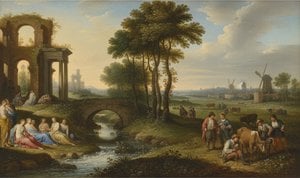
Cornelis van Poelenburch: Bridging Mannerism & the Dutch Baroque Landscape
Discover Cornelis van Poelenburch, a pivotal Dutch Baroque landscape painter bridging Mannerism & Italianate styles. Explore his life, key works, and lasting influence on 17th-century art with ArtsDot.