


 Visualizar na parede
 Compartilhar
 Compartilhar
 Detalhes
 Guia
Guia

 Baixar imagem
 Semelhantes
 Raio X
 Ver diaporama
 Estatísticas
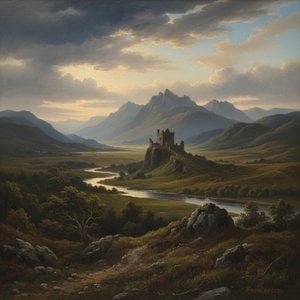
Penarth Head
 Romanticism
 1833
1833 73.0 x 122.0 cm
 Ler mais
Reprodução em Óleo Feita à Mão
Óleo sobre tela pintado à mão no tamanho e moldura de sua escolha, feito sob encomenda pelos nossos artistas. ( Alternar para Impressão Alternar para Imagem Digital)




































Escolha entre os nossos tamanhos pré-definidos que respeitam as proporções originais da obra de arte.

Insira a largura e a altura desejadas para se ajustarem à sua moldura ou parede. Como esta obra é pintada à mão, para um tamanho com proporções diferentes, o artista poderá pintar um pouco mais ao redor da imagem ou reduzir ligeiramente a composição — você escolhe. Enviamos uma maquete digital para sua aprovação antes de iniciar a pintura. A imagem exibida nesta página não representa o resultado real — apenas a maquete mostra o resultado final.
Após o pedido, a equipa ArtsDot.com enviará um e-mail ao cliente para solicitar instruções e fornecer uma prévia do esboço.
Entrega mundial () em 3 a 4 semanas, em vez das 5 semanas padrão. (28 Outubro). Sem comprometer a qualidade.

Envio expresso gratuito para todo o mundo

Tela de Linho de Alta Qualidade

Seguro de transporte completo

Garantia de Reembolso de Impostos Alfandegários

Garantia de Fidelidade Cromática

Política de Devolução em 100 Dias (Apenas para Defeitos)

Garantia de reembolso de 100%

Oferta de desconto por quantidade
 A opção de vidro está disponível apenas para tamanhos inferiores a 110 cm

Penarth Head
Técnica de Reprodução
Tamanho da Reprodução
-


Preço Total
€ 276
Obras Relacionadas


Biografia do Artista
The Weaver of Words and Wings
The story of Alexander Wilson is one of profound transformation, a journey that began in the rhythmic clatter of Scottish looms and culminated in the breathtaking discovery of the American wilderness. Born in Paisley, Scotland, in 1766, Wilson’s early years were steeped in the grit and toil of the Industrial Revolution. As a young man apprenticed to the weaving trade, his spirit was not merely occupied by the mechanical precision of cloth, but by the lyrical beauty of verse. Heavily influenced by the soulful dialect poetry of Robert Burns, Wilson found his voice in the struggles of his community. His early literary works were far from gentle; they were sharp, satirical, and often dangerous. The publication of poems that critiqued the harsh realities of mill life led to legal turbulence and even imprisonment, a period of upheaval that ultimately acted as the catalyst for his departure from his homeland.
In 1794, driven by a desire for new horizons and perhaps a reprieve from the shadows of controversy, Wilson emigrated to America. This migration marked the transition from a poet of social unrest to a pioneer of natural science. Settling in Pennsylvania, he initially sought stability through teaching, yet his true calling lay in the observation of the living world around him. It was during this period that the seeds of ornithology began to germinate. Influenced by the legendary naturalist William Bartram, Wilson moved beyond the written word of poetry into the visual and scientific documentation of North American fauna. He possessed a rare duality of talent: the meticulous eye of a scientist and the evocative soul of an artist, allowing him to perceive the intricate details of avian life with unprecedented clarity.
A Legacy in Ink and Feather
The true magnitude of Wilson’s contribution to science and art is crystallized in his monumental achievement, American Ornithology. This ambitious nine-volume work, published between 1808 and 1814, stands as a cornerstone of natural history. Unlike many of his predecessors, Wilson did not merely describe birds; he brought them to life through a combination of rigorous field observation and exquisite illustration. His travels across the vast American continent were driven by an insatiable hunger to document species that were previously unknown to European science. Through his painstaking efforts, he successfully described dozens of new species, providing a foundational text that would later inspire even more famous figures like John James Audubon.
The significance of Wilson's work extends far beyond the boundaries of biological classification. His illustrations served as a bridge between the raw, untamed frontier of the New World and the established scientific academies of Europe. In his plates, one finds a marriage of accuracy and aesthetic grace, where the texture of a feather or the curve of a beak is rendered with such devotion that the viewer feels the pulse of the living creature. His life’s work represents a pivotal moment in the development of American identity—a period when the continent began to define its own natural heritage through the eyes of those who lived within it.
Reflecting on his enduring impact, several key elements define his historical importance:
- The Father of American Ornithology: His systematic documentation established the groundwork for all subsequent avian studies in North America.
- Artistic and Scientific Synthesis: He pioneered a method of combining detailed biological description with high-quality visual art, setting a new standard for natural history publications.
- Cultural Bridge: His transition from a Scottish weaver to an American naturalist symbolizes the transformative power of the immigrant experience and the expansion of scientific frontiers.
- Literary Roots: The precision and passion found in his scientific work were deeply informed by his early training in the emotive and rhythmic traditions of Scottish poetry.

Alexander Wilson
1766 - 1813 , United Kingdom
Dados Rápidos
- Full Name: Alexander Wilson
- Nationality: Scottish-American
- Date Of Birth: 1766
- Date Of Death: 1813
- Place Of Birth: Paisley, United Kingdom
- Notable Artworks:
- Cardiff from the North Road
- Penarth Head
- Aberdare
- Artistic Movement Or Style: Romanticism
- Artists Who Influenced This Artist:
- Robert Burns
- William Bartram
Artigos Relacionados

John Varley I: Intimate Observation & the British Romantic Landscape
Explore the serene landscapes of John Varley I, a key figure in British Romanticism. Discover his unique watercolour style, collaboration with William Blake & lasting artistic legacy. Learn about collecting Varley's work.
Alexander Nasmyth: Picturing Scotland's Romantic Landscape – Innovation & Identity
Explore the life & art of Alexander Nasmyth, a pivotal figure in Scottish Romantic landscape painting. Discover his iconic works, including portraits of Robert Burns, and learn about his lasting influence on national identity. Fine art reproductions available.

Os 10 Mestres da Paisagem Romântica: Arte para Inspirar a Sua Casa
Descubra os 10 quadros mais emblemáticos da Paisagem Romântica! Explore a história de Turner, Friedrich e outros mestres. Encontre reproduções de arte exclusivas para inspirar sua decoração em ArtsDot.com.

Richard Wilson: Deconstructing Landscape & Memory in Contemporary Installation Art
Explore Richard Wilson's groundbreaking landscape paintings & his enduring influence on contemporary installation art. Discover investment opportunities, provenance insights & the materiality of memory in this expert analysis.

Evoking Nature's Sublime: A Comprehensive Exploration of 19th-Century Landscape Painting
Explore the captivating world of 19th-century landscape painting! Discover renowned artists like Friedrich & Monet, key movements, and find the perfect artwork to bring nature's serenity into your home. Expert insights at ArtsDot.