


 Visualizar em escala
 Enviar
 Compartilhar
 Ver detalhes

 Baixar imagem
 Semelhantes
 Raio X
 Apresentação de slides
 Estatísticas
Tennessee


 Ver mais
Giclée / Impressão de Arte
Impressão giclée ou em tela de qualidade de museu, com produção rápida e opções flexíveis de acabamento. ( Encomendar reprodução pintada à mão Ver Imagem Digital)




P118B $10

P118H $10

P118W $10

P438Z $10

P508JH $12

P508YH $12

P805H $10

P805Z $10

P919BZ $10

P919G $10

P919XJ $10

P959ZH $10

P968JZ $12

W106C $8

W218G $10

W218JH $8

W218Y $10

W307PJ $10

W316G $10

W316PJ $8

W316Y $10

W398PJ $8

W4111J $10

W500HY $15

W500JH $15

W692G $12

W849H $8

W940BG $15

W953PJ $8




Escolha entre os nossos tamanhos pré-definidos que respeitam as proporções originais da obra de arte.

Você pode inserir suas próprias dimensões para se ajustar a uma moldura ou espaço específico. Se o tamanho selecionado não corresponder às proporções da imagem original, iremos recortar a obra de arte ou estender a imagem com uma borda espelhada ou preenchimento sólido. Um mockup digital será enviado para sua aprovação antes do início da produção.
Por favor, observe que a visualização na tela não reflete o recorte ou a extensão real. Apenas o mockup mostrará com precisão a composição final.
Embora tamanhos personalizados estejam disponíveis, recomendamos selecionar uma dimensão da lista predefinida para preservar as proporções originais.
Entrega mundial () em 2 semanas, em vez das 4/5 semanas padrão. (19 Setembro)

Envio expresso gratuito para todo o mundo

Tela de Linho Premium

Seguro de transporte total

Garantia de Reembolso de Impostos Alfandegários

Garantia de Fidelidade de Cor

Política de Devolução em 100 Dias (Apenas para Defeitos)

Garantia de reembolso de 100%

Desconto para múltiplas unidades
 A opção de vidro está disponível apenas para tamanhos inferiores a 110 cm

Tennessee
Giclée / Impressão de Arte
Dimensões da Reprodução
-


Preço Total
$ 62
A Poet of the American Landscape: Unveiling “Tennessee” by Alexander Helwig Wyant
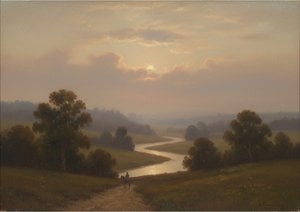
Alexander Helwig Wyant’s “Tennessee,” painted in 1866, isn't merely a depiction of a river valley; it’s an immersive experience, a carefully constructed evocation of mood and atmosphere. Wyant, a pivotal figure bridging the romanticism of the Hudson River School with the nascent tonalism movement, possessed a rare gift: he translated the subtle poetry of nature into visual form, imbuing his canvases with a profound sense of introspection. This particular work captures a fleeting moment in the Tennessee countryside – perhaps late afternoon, judging by the diffused light and the muted palette – yet it transcends simple representation to become a meditation on solitude, memory, and the enduring beauty of the American wilderness.
The painting immediately draws the eye into its heart: a broad river, rendered with a delicate wash of blues and greens, snakes through a gently rolling landscape. Mountains, hazy in the distance, provide a dramatic backdrop, their peaks softened by atmospheric perspective – a technique borrowed from the masters of light and color like J.M.W. Turner. Scattered amongst the trees are hints of human presence, a small figure near the riverbank suggesting a quiet observer, lost in contemplation. Wyant’s brushstrokes are loose and expressive, avoiding sharp outlines and favoring instead a blending of tones that creates an almost dreamlike quality. This deliberate ambiguity invites the viewer to project their own emotions and experiences onto the scene.
The Tonalist Vision: Light, Shadow, and Emotion
Wyant’s approach aligns perfectly with the principles of tonalism, a movement that sought to capture not just the appearance of objects but also the *feeling* they evoked. Unlike the Hudson River School's emphasis on detailed realism and dramatic lighting, Wyant favored subtle gradations of tone – variations in light and shadow – to create an atmosphere of mood and emotion. He achieved this through a layering technique, applying thin washes of paint that gradually built up to form the final image. The absence of strong color contrasts contributes to the painting’s sense of quiet melancholy, while the diffused light suggests a timelessness, as if the scene exists outside of specific time or place.
The choice of subject matter – a rural landscape – is also significant. Wyant was deeply interested in exploring the relationship between humanity and nature, often depicting scenes that evoked feelings of nostalgia and longing for simpler times. “Tennessee” embodies this theme perfectly, inviting us to pause and reflect on our connection to the natural world.
Historical Context: A Painter’s Journey
Wyant's artistic development was shaped by a series of transformative experiences. Initially influenced by George Inness, he later traveled extensively in Europe, studying with Hans Gude in Düsseldorf and Karlsruhe. These journeys exposed him to new techniques and perspectives, broadening his understanding of landscape painting. However, it was his return to America and the challenges posed by a stroke that ultimately led him to refine his style – forcing him to adapt and innovate, using only his left hand to create works of remarkable sensitivity and depth.
The painting’s creation coincided with a period of profound change in American history. The Civil War was raging, and the nation was grappling with issues of identity and division. Wyant's work reflects this turmoil, capturing a sense of uncertainty and melancholy that resonates deeply within the viewer. Despite the somber mood, there is also an underlying current of hope – a belief in the enduring beauty and resilience of the American landscape.
Symbolism and Emotional Resonance
Beyond its technical merits, “Tennessee” is rich in symbolism. The river itself represents the flow of time and life, while the mountains symbolize strength and permanence. The solitary figure suggests a yearning for connection and belonging. The overall effect is one of quiet contemplation – an invitation to lose oneself in the beauty of nature and reflect on our place within it. “Tennessee” isn’t just a painting; it's a portal into a world of feeling, a testament to Wyant’s extraordinary ability to capture the essence of the American spirit.
Obras Relacionadas


Biografia do Artista
Alexander Helwig Wyant (1836-1892): A Poet of Atmospheric Landscapes
Alexander Helwig Wyant, born in 1836 in Port Washington, Ohio, occupies a fascinating transitional space in American art history. He wasn’t merely a painter *of* landscapes; he was a poet *with* landscapes, translating the subtle moods of nature onto canvas with an increasingly refined sensitivity. His journey began humbly, sketching along the banks of the Ohio River near Cincinnati, but quickly blossomed into a dedicated pursuit fueled by encounters with pivotal figures and transformative experiences. A crucial moment arrived in 1857 when Wyant encountered the work of George Inness, whose influence would profoundly shape his artistic trajectory. This meeting spurred him to relocate to New York City, seeking mentorship and formal training at the National Academy of Design, generously supported by the patronage of Nicholas Longworth. A subsequent journey to Europe in 1860 further broadened his horizons, exposing him to diverse artistic traditions in Germany and brief sojourns in England and Ireland. These early experiences laid the foundation for a career that would bridge the detailed realism of the Hudson River School with the evocative subtleties of Tonalism.Early Influences and Artistic Formation
Wyant’s formative years were marked by exposure to the dominant artistic currents of his time, primarily the Hudson River School. Initially captivated by its meticulous depictions of natural scenes—the majestic Catskill Mountains, the serene Ohio Valley—he absorbed the school's conviction that art should strive for accuracy and grandeur. However, Wyant wasn’t simply replicating established conventions; he possessed an innate curiosity about capturing intangible qualities – light, atmosphere, emotion – which would soon propel him toward a more experimental path. This fascination began to coalesce around 1857 with his encounter with George Inness, whose groundbreaking tonal landscapes served as a catalyst for Wyant's artistic evolution. Recognizing Inness’s masterful ability to convey mood and feeling through subtle color gradations and diffused light, Wyant sought guidance from the master in New York City, securing invaluable training at the National Academy of Design – an institution bolstered by the generosity of Nicholas Longworth. This formative period instilled within him a deep appreciation for observation combined with artistic intuition—a duality that would characterize his entire oeuvre.A European Awakening and Expanding Horizons
The year 1860 witnessed Wyant’s first significant foray into Europe, marking a pivotal moment in his intellectual and artistic development. Driven by an ambition to immerse himself in the artistic traditions of Germany and England, he embarked on a journey that would reshape his understanding of art history and inspire him to synthesize diverse influences. In Paris, he encountered the paintings of Jean-Baptiste Camille Corot and Jules Dupré—artists who championed *plein air* painting and prioritized capturing the ephemeral beauty of natural light—leaving an indelible impression upon Wyant’s sensibilities. He continued his explorations eastward, spending time in Düsseldorf and Karlsruhe, Germany, where he studied under Hans Fredrik Gude – a Norwegian painter whose landscapes embodied the principles of Barbizon painting. This immersion in European artistic culture fostered a profound appreciation for tonal values and atmospheric perspective—techniques that would become central to Wyant’s distinctive style. Furthermore, his brief visits to England and Ireland exposed him to the landscapes of Constable and Turner—artists who revolutionized painting with their innovative use of light and color—solidifying his commitment to pushing artistic boundaries.The Emergence of Tonalism: A Shift Towards Emotional Resonance
By the mid-1860s, Wyant’s artistic vision began to diverge from the prevailing realism of the Hudson River School, signaling a decisive step toward the burgeoning aesthetic of Tonalism. Recognizing that mere representation was insufficient to convey the profound emotional impact of nature—a conviction shared by many artists of his generation—he sought ways to express inner feelings through visual language. This pursuit led him to adopt techniques championed by Barbizon painters: prioritizing tonal gradations over precise color palettes, emphasizing diffused light and atmospheric haze, and rejecting academic conventions in favor of spontaneity and intuition. The stroke that afflicted Wyant in 1873 – paralyzing his right arm – served as an unexpected impetus for this stylistic transformation. Forced to adapt to physical limitations, he honed his skills with his left hand—a challenge that paradoxically deepened his understanding of artistic expression and solidified his commitment to capturing the elusive beauty of natural landscapes.Mature Style and Legacy: Landscapes Filled With Feeling
Wyant’s mature style is characterized by an extraordinary sensitivity to atmospheric conditions and a masterful command of tonal values—qualities that distinguish his paintings from those of many contemporaries. He excelled at depicting woodland glades, rolling hills, and mountain vistas with breathtaking subtlety—capturing not just the visual appearance of these landscapes but also their emotional resonance. His canvases glow with diffused light, imbued with shades of gray, white, and earthy tones—a deliberate rejection of the bold color palettes favored by Impressionists and a steadfast adherence to the Barbizon tradition. Notable works like *Mohawk Valley* exemplify this aesthetic—demonstrating Wyant’s ability to transform observation into poetic interpretation. His final paintings – particularly those created in Arkville, New York – reflect a profound connection to the American landscape and embody the spirit of his artistic credo: to capture not merely what is seen but what is felt. Alexander Helwig Wyant's legacy resides in his pioneering contribution to Tonalism—a movement that elevated landscape painting beyond mere visual representation into a vehicle for conveying emotion and capturing the sublime beauty of nature. He remains an artist whose work continues to inspire admiration for its understated elegance and profound psychological depth.- George Inness: His mentor, who instilled in him a passion for tonal landscapes and atmospheric perspective.
- Hudson River School: Initially influenced by its meticulous realism, Wyant ultimately rejected it in favor of Tonalism’s expressive qualities.
- Hans Fredrik Gude: A Norwegian painter whose Barbizon style served as inspiration for Wyant's artistic explorations.
- John Constable & J.M.W. Turner: British landscape painters who championed innovative use of light and color—influences that shaped Wyant’s evolving aesthetic.

Alexander Helwig Wyant
1836 - 1892 , Estados Unidos
Informações Rápidas
- Artistic Movement Or Style: Hudson River School / Tonalismo
- Artists Or Movements Influenced By This Artist:
- Sociedade Americana de Pintura em Aquarela
- Movimento Barbizon
- Artists Who Influenced This Artist:
- George Inness
- John Constable
- Turner
- Date Of Birth: Janeiro 11, 1836
- Date Of Death: Novembro 29, 1892
- Full Name: Alexander Helwig Wyant
- Nationality: Americano
- Notable Artworks:
- Vale do Mohawk
- Paisagem Outono Arkville
- O Canal
- Place Of Birth: Port Washington, EUA
Artigos Relacionados

George Elbert Burr: A Pioneer of American Tonalism & Evocative Landscape Painting
Explore the captivating landscapes of George Elbert Burr, a pioneer of American Tonalism. Discover his masterful etchings, drypoints & watercolors – and learn about collecting this influential artist's work.
Atmospheric Visions: Exploring Tonalism in American Painting
Explore the captivating world of American Tonalism! Discover its history, key artists like Whistler & Inness, techniques, and lasting influence on art. Expert insights for collectors & enthusiasts.

George Inness: Transcendental Landscapes & the American Search for Spiritual Harmony
Explore the profound landscapes of George Inness, a leading American artist-philosopher. Discover his spiritual approach to painting, influences, and lasting legacy with ArtsDot.

Evocations of Place: A Historical Journey Through Landscape Art
Explore the rich history of landscape art with ArtsDot. Discover renowned artists, movements like Impressionism & Romanticism, and expert guidance for collecting timeless pieces. Find your perfect serene escape today!

Grant Wood & American Regionalism: Identity, Myth & the Rural Landscape
Explore the world of Grant Wood & American Regionalism with ArtsDot. Discover the symbolism behind 'American Gothic', recurring themes, and the movement's lasting impact on art history. High-quality reproductions available.