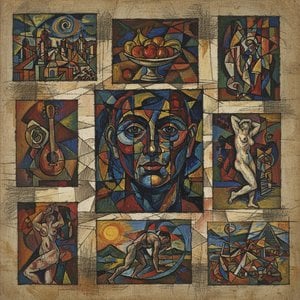
A Quiet Presence in Polish Art
Zbigniew Sękowski lived and worked during a period of significant transition in the late nineteenth century. His presence in the art world is marked by a specific, focused output that reflects the sensibilities of his era. While much of the historical record remains quiet regarding his personal life, his hand is clearly visible in the works that survived him, offering a glimpse into the creative impulses of the time.
His activity is documented between 1876 and 1900. During these years, he applied oil to various surfaces, including oak wood, to capture his subjects. His work often leaned toward the intimate and the provocative, exploring themes that challenged the social norms of the late 1800s.
The Language of Oil and Wood
The technical choices Sękowski made reveal a preference for materials that demand precision. Working on oak wood requires a certain level of discipline, as the grain of the wood becomes a silent partner to the paint itself. His approach was not one of grand scale, but rather of concentrated detail. His known works suggest a fascination with the human form and the complexities of desire.
His artistic output includes:
- The use of oil on oak wood as a primary medium.
- A focus on erotic art as a specific genre.
- A signature style that includes dating and signing works directly on the surface.
A Lasting Impression
One of his most notable contributions is the 1885 painting titled Is Kabbalah telling the truth? This work, which explores themes of mysticism and human nature, found its way into the National Museum in Warsaw. It was gifted to the museum by Stanisław Leszczyński around the turn of the century, ensuring that Sękowski's vision would be preserved for future generations.
Though his name may not be spoken in every gallery, his contribution to the history of Polish painting remains intact. He remains a figure of interest for those studying the intersection of private passion and public art in the late nineteenth century.
Pytania i odpowiedzi
Czy mogę przeglądać dzieła Zbigniew Sękowski według nastroju?
Prace Zbigniew Sękowski można przeglądać według nastroju na stronie Sztuka według nastroju, która grupuje dzieła artysty według ich przypisanego nastroju.
Gdzie mogę zobaczyć dzieła Zbigniew Sękowski w porządku chronologicznym?
Strona Chronologia dzieł prezentuje dzieła Zbigniew Sękowski uporządkowane chronologicznie, rok po roku.
Gdzie można znaleźć dzieła Zbigniew Sękowski pogrupowane według słów kluczowych?
Aby znaleźć dzieła artysty Zbigniew Sękowski o konkretnej tematyce, skorzystaj ze strony Według słów kluczowych, która grupuje prace według słów kluczowych.
W jakich nurtach tworzył Zbigniew Sękowski?
Nurty, w których tworzył/a Zbigniew Sękowski, można zobaczyć na stronie Wszystkie nurty artystyczne artysty, gdzie dzieła są pogrupowane według nurtów.