A Maritime Observer
Born in 1774, William Dixon lived through an era defined by the movement of wind and water. As a British painter and watercolorist, his focus remained fixed upon the sea, capturing the heavy presence of naval vessels and the restless energy of the ocean. His work reflects a period when the maritime world was the lifeblood of global commerce and conflict, documented through the precise eye of a man who understood the mechanics of a ship in motion.
His technical approach often involved oil on canvas, a medium that allowed him to render the weight of timber and the churning texture of waves. In his 1795 work, he utilized a clever detail, signing and dating the piece on a fragment of flotsam within the composition itself. This choice suggests a painter deeply attuned to the physical reality of his subject matter.
The Language of the Sea
Dixon’s output provides a window into the naval architecture and the atmospheric conditions of the late eighteenth and early nineteenth centuries. His compositions often centered on the tension between man-made structures and the natural elements. His catalog includes notable depictions such as:
- 'View of Mr Perry's Yard, Blackwall' (1798)
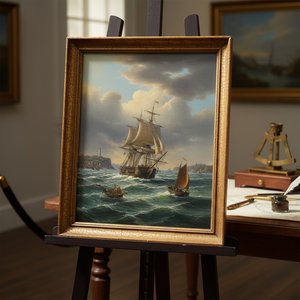
- 'Man of War', and other vessels in choppy seas (1795)
The depiction of a "Man of War" in choppy seas demonstrates his ability to handle the chaotic movement of water. These scenes are not merely static portraits of ships but studies of how a vessel reacts to the environment. The scale of his works, such as a piece measuring 10.5 by 30 inches, suggests a preference for the panoramic, allowing the viewer to experience the breadth of the horizon.
A Quiet Legacy
By the time of his death in 1827, Dixon had established a visual record of a specific maritime epoch. His paintings, held in collections like the National Maritime Museum in London, offer more than simple illustration; they provide a historical perspective on the vessels that once dominated the seas. He remains a painter of the nautical, a chronicler of the wood, sail, and salt that defined his era.
Pytania i odpowiedzi
Jakie inne pseudonimy lub nazwy stosuje William Dixon?
William Dixon występuje również pod innymi nazwiskami: William, I Dixon, William Dixon I.
Gdzie mogę znaleźć statystyki dotyczące dzieł William Dixon?
Strona Statystyki odwiedzin artysty William Dixon przedstawia statystyki obliczone na podstawie dzieł tego artysty wymienionych w niniejsza strona.
Gdzie można znaleźć dzieła William Dixon pogrupowane według palety barw?
Strona Według palet kolorystycznych grupuje dzieła William Dixon według ich palet kolorystycznych.
Jak znaleźć dzieła William Dixon o konkretnej tematyce?
Aby znaleźć dzieła artysty William Dixon o konkretnej tematyce, skorzystaj ze strony Według słów kluczowych, która grupuje prace według słów kluczowych.