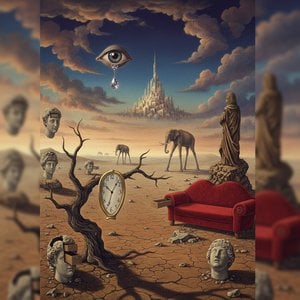
The Quiet Form of the Unconscious
Václav Tikal began his path in the small village of Ptetin, within the Plzeň Region. His hands learned the discipline of the Academy of Fine Arts in Prague, guided by the instruction of Vratislav Nechleba and Jakub Obrovsky. During the years of the second world war, the closure of Czech universities forced a shift in how art was practiced. It became something handled in the shadows, a private language shared among those who sought to understand the depths of the mind. Tikal found himself moving through these clandestine circles, connecting with the surrealist movement through the influence of works by Salvador Dalí and Giorgio de Chirico. He did not merely observe these ideas; he absorbed them into a way of seeing that would define his life's work.
His practice was not limited to the canvas. He moved between the fluid possibilities of painting and the tactile, grounded nature of ceramics. This duality allowed him to explore form in both two and three dimensions. His work often felt like a visual recording of the subconscious, capturing imagery that seemed to emerge from a dream state. In pieces like Camouflage or Eté, there is a sense of something hidden just beneath the surface of the visible world.
A Life of Form and Shadow
The development of his style was marked by a deep engagement with the surrealist groups of his time, including the RA group and the circle surrounding Karel Teige. His involvement in the resistance during the war added a layer of weight to his existence, a reality that contrasted with the dreamlike qualities of his art. By the time he completed his studies in 1946, he was already a part of the artistic fabric of Prague, eventually becoming a member of the Mánes Association of Visual Artists.
His output was varied, spanning several decades of shifting political and social landscapes. He worked with gouache, watercolor, and oil, often producing works that felt intimate and immediate. His ability to translate the irrational into a tangible medium made him a significant figure in the Czech surrealist tradition. He remained active in this pursuit until his death in Prague in 1965.
Pytania i odpowiedzi
Gdzie mogę zobaczyć dzieła Václav Tikal w wirtualnej galerii 3D?
Wirtualna Galeria 3D artysty Václav Tikal to strona prezentująca jego dzieła w wirtualnej galerii trójwymiarowej.
Jakie nastroje wyrażają dzieła Václav Tikal?
Prace Václav Tikal można przeglądać według nastroju na stronie Sztuka według nastroju, która grupuje dzieła artysty według ich przypisanego nastroju.
Gdzie mogę zobaczyć wszystkie dzieła Václav Tikal?
Wszystkie dzieła Václav Tikal dostępne w niniejsza strona można przeglądać na stronie Wszystkie dzieła artysty.
Jak znaleźć wszystkie dzieła Václav Tikal wykonane w danej technice?
Dzieła artysty Václav Tikal można przeglądać według techniki na stronie Wszystkie techniki artysty.