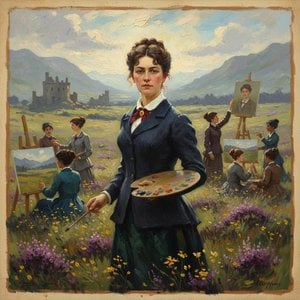
A Life in Color and Tradition
Stansmore Dean was a Scottish artist known for her oil paintings. Born in Glasgow, she studied at the Glasgow School of Art between 1883 and 1889. During her studies, she was the first female student to win the School's Haldane Travelling Scholarship, which allowed her to travel to Paris to study under Gustave Courtois at the Académie Colarossi. Her work often captured the essence of traditional life, particularly during her time in the artists' colony at Volendam. There, she created oil sketches, drawings, and portraits of men and women in traditional costumes, such as the distinctive Dutch kraplap chemise and peaked lace hat seen in her 1895 painting Byway, Old Holland.
Exhibitions and Artistic Legacy
Throughout her career, Dean exhibited her work at various venues, including the Glasgow Institute, the Walker Art Gallery in Liverpool, the Royal Scottish Academy, and the International Society in London. Her painting Pensive was accepted at the salon of the Société Nationale des Beaux-Arts in Paris in 1899. A member of the Glasgow Society of Lady Artists' Club, she was also involved in the design of the Club's premises, selecting Charles Rennie Mackintosh for the task. In her later years, she lived in Montreuil-sur-Mer, France, and later in Kirkcudbrightshire, where she painted until her eyesight began to fail.
Pytania i odpowiedzi
Jak znaleźć dzieła Stansmore Dean o konkretnej tematyce?
Dzieła artysty Stansmore Dean można przeglądać według słów kluczowych na stronie Według słów kluczowych. Każde słowo kluczowe grupuje powiązane ze sobą dzieła.
Gdzie mogę zobaczyć wszystkie dzieła Stansmore Dean?
Wszystkie dzieła Stansmore Dean dostępne w niniejsza strona można przeglądać na stronie Wszystkie dzieła artysty.
Czy mogę przeglądać dzieła Stansmore Dean według nastroju?
Strona Sztuka według nastroju artysty Stansmore Dean pozwala przeglądać dzieła uporządkowane według nastroju.
Gdzie mogę zobaczyć dzieła Stansmore Dean w porządku chronologicznym?
Oś czasu prac Stansmore Dean jest dostępna na stronie Chronologia dzieł, gdzie dzieła zostały uporządkowane według daty ich powstania.