Philips Wouwerman: A Master of Dutch Dynamism
Philips Wouwerman, born in Haarlem in 1619 and tragically passing away in the same city in 1668, stands as a pivotal figure within the vibrant tapestry of the Dutch Golden Age. More than just a painter, he was a keen observer of human life – a chronicler of bustling marketplaces, spirited hunts, and the quiet dramas unfolding amidst landscapes both familiar and fantastical. His prolific output, encompassing over a thousand works (though many attributed to his numerous followers), reveals an artist constantly evolving, yet always rooted in the traditions of Haarlem and deeply influenced by the artistic currents of his time.
Early Influences and Artistic Training
Wouwerman’s early life offers intriguing glimpses into his formative years. Born into a family connected to the art world – his father, Pouwels Joostsz Wouwerman, was a painter specializing in historical scenes – he likely received some initial instruction from his father. However, details regarding his formal training remain somewhat elusive. A significant influence on his early work appears to have been the *bamboccianti* tradition, a movement originating in Rome that focused on depicting everyday life and genre scenes populated by peasants, soldiers, and laborers. Artists like Pieter van Laer (1592/99–after 1642), known for his lively depictions of tavern scenes and street life, undoubtedly shaped Wouwerman’s initial approach to composition and subject matter. It's believed that he also studied under Frans Hals (1581/85–1666), a prominent Haarlem portraitist, though the direct impact of Hals’ distinctive style on Wouwerman’s mature work is subtle.
The Emergence of a Unique Style
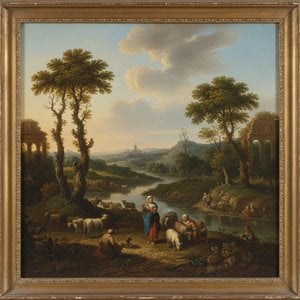
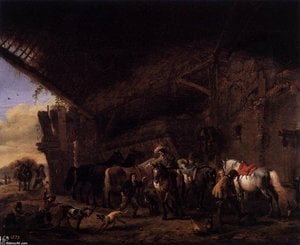
Wouwerman's artistic development witnessed a remarkable transformation throughout his career. Initially emulating the *bamboccianti*, he gradually developed a distinctly personal style, characterized by a masterful command of light and shadow, dynamic compositions, and an unparalleled ability to render horses in motion. A key element of this evolution was the introduction of the diagonal slope of land – often featuring a strategically placed tree acting as a repoussoir (a device used to create depth and drama) – which became a hallmark of his landscapes. His mid-career works are particularly notable for their carefully constructed scenes, populated by figures engaged in various activities: hunting parties, military encampments, festive gatherings of peasants, and travelers pausing at inns. These compositions were not merely static representations; they conveyed a sense of movement, energy, and narrative complexity.
Mastery of the Horse and Expanding Subject Matter
Perhaps Wouwerman’s most enduring legacy lies in his extraordinary skill as an equestrian painter. He possessed an almost uncanny ability to capture the power, grace, and dynamism of horses – from majestic warhorses charging into battle to spirited hunters pursuing their quarry. Art historian Frederik J. Duparc famously declared him “undoubtedly the most accomplished and successful 17th-century Dutch painter of horses,” a testament to his meticulous observation, anatomical accuracy, and understanding of equine movement. Beyond his equestrian paintings, Wouwerman broadened his subject matter considerably, venturing into landscapes with travelers, cavalry battles, military encampments, and even depictions of everyday life – all rendered with remarkable detail and a keen eye for storytelling. His later works often featured a softer palette and a more subdued atmosphere, reflecting a shift in artistic sensibilities.
Historical Significance and Lasting Influence
Philips Wouwerman’s paintings enjoyed immense popularity during his lifetime, securing him a prominent place within the Dutch art market. His work was highly sought after by collectors throughout Europe, including princely houses in Dresden and St. Petersburg, demonstrating its enduring appeal. The fact that many of his works were copied and imitated by artists like Jan van Huchtenburgh and Pieter van Bredael underscores his significant influence on subsequent generations of painters. Wouwerman’s legacy extends beyond individual masterpieces; he represents a pivotal moment in the development of Dutch painting – a synthesis of observation, technique, and narrative skill that continues to captivate viewers today. His paintings offer a vibrant window into the social, cultural, and artistic landscape of the Dutch Golden Age.
Pytania i odpowiedzi
Ile dzieł Philips Wouwermański można przejrzeć w katalogu?
Możesz przeglądać 155 dzieł sztuki dzieł autorstwa Philips Wouwermański na stronie Wszystkie dzieła sztuki.
Czy mogę przeglądać dzieła Philips Wouwermański według spektrum kolorów?
Indeks barwny artysty Philips Wouwermański to strona, która porządkuje dzieła artysty według ich kolorów.
Czy mogę odwiedzić wirtualne muzeum dzieł Philips Wouwermański?
Dzieła Philips Wouwermański można podziwiać w galerii 3D na stronie Muzeum 3D artysty.
What aliases or alternate names does Philips Wouwermański have?
Philips Wouwermański appears under the alternate names Wouwermans, Wouwerman, Wolfermann.
Gdzie mogę zobaczyć profil kolorystyczny twórczości Philips Wouwermański?
Genom Palety artysty Philips Wouwermański to strona prezentująca profil kolorystyczny całego dorobku twórczego tego artysty.
Gdzie można znaleźć dzieła Philips Wouwermański pogrupowane według nurtów artystycznych?
Strona Wszystkie nurty grupuje dzieła Philips Wouwermański według nurtów artystycznych.
Jak mogę znaleźć dzieła artysty Philips Wouwermański w konkretnej palecie barw?
Aby znaleźć prace artysty Philips Wouwermański w konkretnej palecie barw, skorzystaj ze strony Według palet kolorystycznych poświęconej temu artyście.
Które dzieła Philips Wouwermański są najczęściej oglądane?
Statystyki dotyczące dzieł artysty Philips Wouwermański są dostępne na jego stronie Statystyki.