The Lens of Political Reality
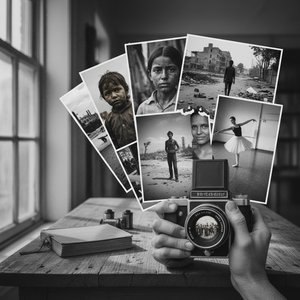
Oraldo Norvel Britos captures the friction of Argentine history through a documentary lens. His work exists in the stark contrasts of black and white photography, documenting the weight of authority and the pulse of social movements. In 1968, his camera records the tension at the Ministry of Education, where police presence defines the atmosphere of the era. These images do not merely observe; they freeze moments of institutional pressure and political struggle.
The frames often focus on the mechanics of power and labor. One particular image from 1979 depicts General Andrada Serpa during a ministerial meeting, stripping away the gloss of politics to reveal the formal, monochromatic reality of governance. His photography functions as a visual record of the Argentine political landscape, focusing on the intersection of state action and social consequence.
A Life in the Labor Movement
Beyond the camera, Britos lived the very history he documented. Born in Argentina in 1933, his path was forged within the railway sector as a member of the Unión Ferroviaria. He operated within the intense atmosphere of the Peronist Resistance following the 1955 coup. This period of upheaval shaped his perspective on the structures of labor and state control.
His career moved between the streets of union activism and the halls of legislative power:
- He served as a National Senator for San Luis province during several terms, including 1973, 1983, 1986, and 1995.
- In 1981, he held the position of interim governor of San Luis during the military dictatorship.
- He reached the height of executive influence in 2002 when he was appointed Minister of Labor under the presidency of Adolfo Rodríguez Saá.
Legislative Legacy and Social Impact
The work of Britos in the Senate and Chamber of Deputies focused on the tangible protections of the working class. He directed his legislative energy toward specific social safeguards, including prenatal allowances and disability protection. His efforts were instrumental in the creation of the National Institute of Social Security and the establishment of guarantee funds for labor credits.
His influence extended to the recognition of those impacted by conflict, advocating for laws that provided special pensions for families of disappeared persons and protections for Malvinas War veterans. Through his roles as President of the Committee on Labor and Social Welfare and Vice President of the Senate, he navigated the complexities of labor legislation and public accounts, leaving a documented imprint on the social welfare framework of Argentina.
Pytania i odpowiedzi
Czy mogę sortować dzieła Oraldo Norvel Britos według koloru?
Strona Indeks barwny grupuje dzieła Oraldo Norvel Britos według kolorów.
Czy mogę przeglądać dzieła Oraldo Norvel Britos według tematyki?
Strona Atlas tematów prezentuje dzieła Oraldo Norvel Britos pogrupowane według tematów.
Gdzie mogę zobaczyć dzieła Oraldo Norvel Britos w porządku chronologicznym?
Strona Oś czasu dzieł prezentuje dzieła Oraldo Norvel Britos uporządkowane chronologicznie, rok po roku.