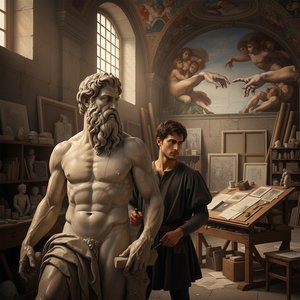
The Master of Light and Line: The Life of Sani ol-Molk
In the vibrant tapestry of nineteenth-century Persian art, few names resonate with as much elegance and transformative power as Mirza Abolhassan Khan Ghaffari. Known to history by his illustrious title, Sani ol-Molk, this master painter emerged from the artistic lineage of Kashan to redefine the visual language of the Qajar era. Born around 1814, Ghaffari was not merely an artist but a bridge between worlds, standing at the intersection of traditional Persian aesthetics and the burgeoning influence of European realism. His journey began under the tutelage of the great Master Mehr-Ali Esfahani, where he honed a delicate touch that would eventually capture the very essence of the Persian court.
The early years of Ghaffari’s career were marked by an ascent toward royal recognition. By the age of twenty-nine, his talent had become so undeniable that he was granted the profound honor of painting a portrait of Mohammad Shah Qajar. This achievement catapulted him into the role of naqqashbashi, or grand painter, of the court. His work during this period reflected a deep reverence for his heritage, yet there was an unmistakable evolution in his technique—a growing fascination with depth, shadow, and the subtle nuances of human expression that hinted at a much larger artistic hunger.
A Journey Through the Renaissance Heart of Europe
Driven by an insatiable desire to refine his craft, Ghaffari embarked on a transformative pilgrimage to Italy, seeking the secrets held within the great academies and museums of the West. This period of travel was perhaps the most defining chapter of his life, as he immersed himself in the breathtaking landscapes of Rome, Florence, and Venice. Wandering through the halls of the Vatican, he studied the divine compositions of the Renaissance masters, particularly the works of Raphael. By making meticulous copies of European masterpieces, such as the Madonna di Foligno, Ghaffari did not merely mimic Western styles; he internalized their principles of light and anatomical precision.
This cross-cultural dialogue allowed him to bring a new dimension back to Persia. He began to blend the intricate, decorative beauty of Persian miniature traditions with the volumetric realism of European oil painting. His ability to manipulate light—to make it dance across silk fabrics or settle softly upon skin—gave his portraits an unprecedented lifelike quality. This synthesis of East and West became his hallmark, creating a style that felt both intimately Persian and cosmopolitally sophisticated.
Legacy and the Art of Storytelling
Upon his return to Iran, Ghaffari found himself in a landscape undergoing significant social shifts under the reign of Naser o Din Shah. He applied his evolved mastery to new mediums, most notably through his breathtaking illustrations for the One Thousand and One Nights. In these works, he achieved a brilliant feat of artistic characterization: using contemporary Persian personalities to breathe life into ancient, mythical figures. This technique bridged the gap between legend and reality, making the fantastical stories feel immediate and profoundly human.
The historical significance of Mirza Abolhassan Khan Ghaffari extends far beyond his own canvases. He laid the foundational stones for a new school of Persian painting, influencing subsequent generations of artists, including his famous nephew, Kamal-ol-Molk. His life remains a testament to the power of artistic curiosity and the beauty that arises when different cultures meet in a shared pursuit of perfection. Though he passed away in 1866, the luminous legacy of Sani ol-Molk continues to shine, reminding us of a time when art was the ultimate language of diplomacy and discovery.
Pytania i odpowiedzi
Gdzie można znaleźć dzieła Mirza Abolhassan Khan Ghaffari pogrupowane według tematów?
Dzieła artysty Mirza Abolhassan Khan Ghaffari można przeglądać według tematów na stronie Atlas tematów.
W jakich nurtach tworzył Mirza Abolhassan Khan Ghaffari?
Strona Wszystkie nurty artystyczne grupuje dzieła Mirza Abolhassan Khan Ghaffari według nurtów artystycznych.
Do jakiej epoki należał/a Mirza Abolhassan Khan Ghaffari?
Mirza Abolhassan Khan Ghaffari tworzył w okresie 19th Century. Epoka ta osadza twórczość artysty w kontekście historycznym.