The Form and the Figure
Milan Johanides was a man of lines and structural depth, a painter whose presence was felt through the deliberate weight of his compositions. Born in Budimír, his artistic path was shaped by a rigorous formal education, beginning at SŠUP in Bratislava and continuing at VŠVU under the guidance of professor D. Milly. It was here that he refined his understanding of monumental painting, a discipline that would inform the scale and gravity of his later works. His practice was not limited to a single medium; he moved with ease between the precision of a draftsman and the expressive freedom of a graphic artist.
His work often sought to find order within the landscape and the human form. He did not merely observe the world; he reconstructed it through a lens of figurative composition. Whether working on a large scale or a more intimate drawing, his focus remained on the essential architecture of his subjects. His career was deeply rooted in the artistic life of Prešov, where he lived and worked, contributing to the visual language of the region through a diverse range of technical applications.
Technical Breadth and Subject Matter
The scope of Johanides's output reflects a commitment to the fundamental elements of visual art. His technical repertoire included:
- Painting: Exploring color and form in both landscape and figurative settings.
- Drawing: Utilizing draftsmanship to define structure and movement.
- Graphic Art: Applying a graphic sensibility to various print and drawing media.
- Monumentalism: Applying large-scale compositional logic to his works.
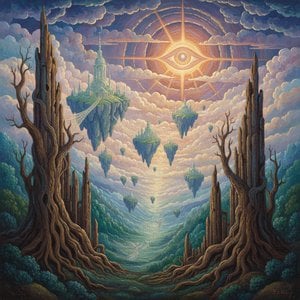
His output during the late 1970s and 1980s demonstrates a steady evolution in how he approached space. In 1978, his work Foggy Morning II was held by the Šariš Gallery in Prešov, suggesting an early interest in the atmospheric qualities of the landscape. By 1981, his piece Beskydy I further explored these natural themes. As his career progressed into the late 1980s, works like Dream II, held in the Vychodoslovenské Galéria in Košice, showed a continued engagement with the interplay of form and imagination.
A Life of Composition
The passing of Johanides in Eperjes marked the end of a career defined by a steady, disciplined approach to the canvas. He was a painter who understood that a landscape or a figure was a problem of geometry and light to be solved. His legacy is found in the collections of regional galleries, where his studies of the natural world and the human silhouette remain preserved. He left behind a body of work that prioritizes the structural integrity of the image, a quality that remains evident in his surviving compositions.
Pytania i odpowiedzi
Gdzie mogę zobaczyć dzieła Milan Johanides pogrupowane według nastroju?
Strona Sztuka według nastroju artysty Milan Johanides pozwala przeglądać dzieła uporządkowane według nastroju.
Jak zmieniała się twórczość Milan Johanides na przestrzeni lat?
Osiągnięcia artystyczne artysty Milan Johanides to interaktywna oś czasu, która prezentuje dzieła w porządku chronologicznym, pogrupowane w rozdziały odpowiadające poszczególnym etapom jego kariery.
Gdzie można znaleźć dzieła Milan Johanides pogrupowane według nurtów artystycznych?
Dzieła artysty Milan Johanides można przeglądać według nurtów na stronie Wszystkie nurty artystyczne.
Jak popularne są dzieła artysty Milan Johanides?
Strona Statystyki odwiedzin artysty Milan Johanides przedstawia statystyki obliczone na podstawie dzieł tego artysty wymienionych w niniejsza strona.