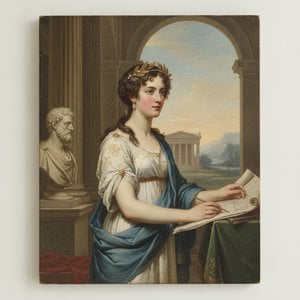
Marie Constance Mayer: Life and Artistic Journey
Born in France around 1774, Marie Constance Mayer lived a life marked by artistic talent, personal struggles, and complex relationships within the Neoclassical art world. Her career, often described as "brilliant but bitter," reflects both her successes as a woman artist in post-Revolutionary France and the challenges she faced due to gender bias and dependence on male colleagues.
Early Training and Influences
Mayer's artistic training began with established artists of the time. She initially studied under Jean-Baptiste Greuze, known for his genre scenes and portraits. This early instruction provided her with a foundation in traditional painting techniques and an understanding of popular subject matter. Her style was influenced by the Neoclassical movement, characterized by its emphasis on clarity, order, and idealized forms.
Collaboration and Dependence on Pierre-Paul Prud'hon
A significant portion of Mayer’s artistic development occurred through her long association with Pierre-Paul Prud'hon, a leading French painter. Their relationship was complex, involving both collaboration and dependence. He sketched designs and compositions, while she executed the paintings. Many works were exhibited under her name, but later attributed to Prud'hon when they entered public collections. This practice blurred the lines of authorship and contributed to confusion regarding their individual contributions.
- Collaborative Process: Prud’hon sketched designs; Mayer painted them.
- Attribution Issues: Works initially exhibited under Mayer's name were later attributed to Prud'hon in public collections.
Major Achievements and Artistic Style
Despite the challenges of attribution, Mayer achieved recognition for her artistic skill. Her style was characterized by Neoclassical principles, with a focus on clarity, idealized forms, and refined execution. She excelled in portraiture, genre scenes, and miniature paintings.
- Portraiture: She created portraits of individuals from various social backgrounds.
- Genre Scenes: Mayer painted scenes depicting everyday life and popular activities.
- Miniature Paintings: She was skilled in creating small-scale paintings with intricate detail.
Later Years, Personal Struggles, and Historical Significance
Mayer’s later years were marked by personal struggles and a sense of unfulfilled potential. Her dependence on Prud'hon and the subsequent attribution issues hindered her recognition as an independent artist. She died in 1821, leaving behind a legacy complicated by questions of authorship and gender bias.
- Unrecognized Contributions: Her individual contributions were often overshadowed by Prud’hon's reputation.
- Historical Significance: Mayer represents the challenges faced by women artists in post-Revolutionary France, who sought to make progress despite gender bias and limited opportunities.
Legacy and Recognition
In recent years, there has been renewed interest in Mayer’s life and work. Art historians are reevaluating her contributions and seeking to clarify the complex relationship between her and Prud'hon. Her story serves as a reminder of the importance of recognizing the achievements of women artists throughout history.
Pytania i odpowiedzi
Jak zmieniała się twórczość Marie Constance Mayer na przestrzeni lat?
Chronologiczne zestawienie twórczości Marie Constance Mayer można znaleźć na stronie Osiągnięcia artystyczne, gdzie dzieła prezentowane są w kolejności ich powstania, podzielone na poszczególne etapy kariery.
Czy mogę przeglądać dzieła Marie Constance Mayer według tematyki?
Atlas tematów artysty Marie Constance Mayer to strona, która grupuje dzieła artysty według ich tematyki.
W jakim mieście i kraju urodził(a) się Marie Constance Mayer?
Marie Constance Mayer urodził się w Paris w France.