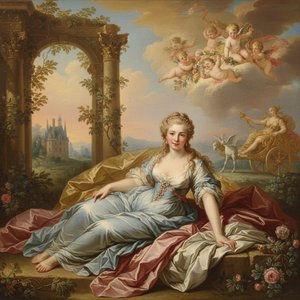
A Legacy of Rococo Splendor
Jean Baptiste André Gautier d'Agoty, often referred to by the noble title Le Chevalier Dagoty, remains a captivating figure of the late 18th-century French art scene. Born into a family deeply rooted in the craft of printmaking, he was the son of the renowned engraver Jacques Gautier d'Agoty. This lineage provided him with a foundational mastery of line and texture that would later define his unique approach to portraiture. His artistic journey was not a solitary one; he was part of a remarkable family of creators, with four of his brothers—Honoré-Louis, Jean-Fabien, Édouard, and Arnauld-Éloi—also pursuing paths within the arts.
His work is most intimately connected to the opulent and often theatrical atmosphere of the French court. While he may not have enjoyed universal popularity among the aristocracy, his career was marked by significant moments of royal connection. Most notably, Queen Marie Antoinette herself commissioned a portrait from him as a gift for her mother, the Empress Maria Theresa. This commission placed his work in the very heart of Versailles, even if its presentation in the Hall of Mirrors met with some critical mockery due to its perceived artificiality—a reflection of the shifting aesthetic tides toward more naturalistic styles during that era.
Technique and the Art of the Tableau
The artistry of Gautier d'Agoty is characterized by a profound command over the delicate nuances of the Rococo style. He possessed a singular ability to create tableaux vivants—living pictures—that captured the essence of romanticism and elegance. His technique often involved complex processes, such as color etching, wash manner, and stipple engraving, sometimes even incorporating gold leaf and silver paint on silk satin to achieve an unparalleled luminosity.
In his most celebrated works, such as Marie-Antoinette in front of the Temple of Love, one can observe a masterful use of:
- Soft, Pastel Palettes: The use of pale pinks, blues, and greens to evoke an atmosphere of lightness and pleasure.
- Curving Lines and Floral Motifs: A composition dominated by organic shapes that blur the boundaries between the human figure and the surrounding landscape.
- Luminous Layering: The application of thin glazes of paint to build depth and a tactile, shimmering surface.
Historical Significance and Artistic Vision
Beyond mere portraiture, Gautier d'Agoty’s work serves as a window into the psychological and social landscape of pre-revolutionary France. His paintings often functioned as much more than simple likenesses; they were carefully constructed narratives. Whether depicting the ethereal presence of a Queen in her private retreat at the Petit Trianon or capturing the quiet intimacy of a woman embroidering, his art explored themes of romantic fulfillment, personal desire, and the delicate balance between artifice and nature.
Though some of his ambitious projects, such as his portrait series Gallery of famous men and women who have appeared in France and The French Monarchy, remained unfinished, his contribution to the visual language of the 18th century is undeniable. His ability to blend the technical precision of engraving with the sensual grace of painting ensures his place in the history of French Rococo art, leaving behind a legacy of beauty that continues to fascinate scholars and art lovers alike.
Pytania i odpowiedzi
W jakiej epoce historycznej tworzył/a Jean Baptiste André Gautier D'Agoty?
Jean Baptiste André Gautier D'Agoty tworzył w okresie – Wczesna nowożytność. Epoka ta osadza twórczość artysty w kontekście historycznym.
W jaki sposób kariera Jean Baptiste André Gautier D'Agoty jest podzielona na okresy?
Chronologiczne zestawienie twórczości Jean Baptiste André Gautier D'Agoty można znaleźć na stronie Kronika, gdzie dzieła prezentowane są w kolejności ich powstania, podzielone na poszczególne etapy kariery.
Gdzie i w którym roku urodził(a) się Jean Baptiste André Gautier D'Agoty?
Jean Baptiste André Gautier D'Agoty urodził się w Aix-en-Provence w 1716.