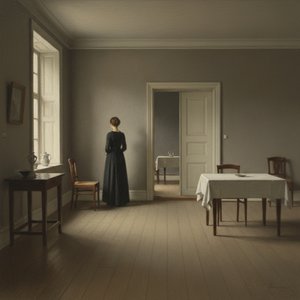
The Hand and the Clay
In the quiet corners of Estonian art, the life of Helmi Herman unfolded through a deep connection to both form and surface. Born in 1916, she moved through a world that demanded both strength and sensitivity, finding her voice through the tactile nature of ceramics and the fluid grace of painting. Her hands were trained in the disciplined halls of the Estonian Academy of Arts, where she first learned to command the materials that would define her career. This foundation allowed her to transition from the physical weight of clay to the delicate nuances of the brush, a duality that characterized her creative existence until her passing in 1994.
Her education was not confined to her homeland. She sought further refinement at the Kunstakademie Düsseldorf, an experience that likely sharpened her eye for composition and the subtle interplay of light and shadow. This period of study helped shape a sensibility that was both grounded in tradition and deeply personal. She did not merely observe the world; she sought to capture its essence through various media, moving between the permanence of ceramic work and the expressive potential of watercolours and mixed media.
A Life in Form and Color
The breadth of her output is reflected in the diverse ways she approached her subjects. Her work often turned toward the human figure, capturing moments of quietude or introspection. Some of her most noted compositions include:
- Kummargil naisfiguur
- Naine peegliga
- Laulu algus
These works, along with many others, found their way into the public consciousness and the permanent collections of Estonian galleries. Her ability to navigate different textures—from the matte finish of a painting to the glazed surface of a ceramic piece—showed a versatility that was rare. She worked steadily from 1949 through 1991, leaving behind a legacy that is held within the Tartu Art Museum and various other public collections.
The Legacy of a Maker
To look upon the works of Helmi Herman is to see a life spent in pursuit of a specific kind of visual truth. Her presence in the Estonian art scene was marked by a steady, enduring commitment to her craft. She was a woman of many layers, much like the mixed media she employed, blending the boundaries between the decorative and the fine arts. Her contribution remains etched in the history of her country, preserved in the galleries that hold her visions of the human form and the quiet beauty of the everyday.
Pytania i odpowiedzi
Jak mogę znaleźć dzieła artysty Helmi Herman w konkretnej palecie barw?
Aby znaleźć prace artysty Helmi Herman w konkretnej palecie barw, skorzystaj ze strony Według palet kolorystycznych poświęconej temu artyście.
Które dzieła Helmi Herman są najczęściej oglądane?
Dla artysty Helmi Herman dostępna jest strona Statystyki odwiedzin, która prezentuje statystyki dotyczące jego dzieł w serwisie niniejsza strona.
Jak znaleźć dzieła Helmi Herman o konkretnej tematyce?
Dzieła artysty Helmi Herman można przeglądać według słów kluczowych na stronie Według słów kluczowych. Każde słowo kluczowe grupuje powiązane ze sobą dzieła.
Gdzie mogę zobaczyć dzieła Helmi Herman w porządku chronologicznym?
Strona Chronologia dzieł prezentuje dzieła Helmi Herman uporządkowane chronologicznie, rok po roku.