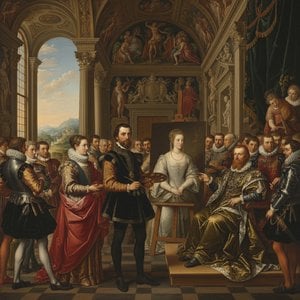
The Life and Career of Hans Werl
Hans Werl lived during the turn of the seventeenth century, a period of shifting visual traditions in Germany. Born around 1570, he spent his years working as a painter and drawer. His hands were accustomed to the specific demands of the Munich court, where he held the position of court painter. This role placed him in the direct service of the ruling nobility, requiring a steady hand for both large-scale commissions and more intimate studies.
His professional life was tied closely to the halls of power in Munich. He worked under the patronage of Duke Maximilian I of Bavaria, contributing to the visual history of the region. Much of his labor was directed toward documenting significant events and figures through large canvases. These works were intended for the Old Hercules Hall in the Munich Residenz, where they hung as part of the historical narrative of Bavaria. His output included ten massive paintings, each measuring ten metres in width, designed to depict the history of the land from the thirteenth to the fifteenth centuries.
The scope of his work moved between the monumental and the personal. While he handled the heavy task of historical storytelling for the Duke, he also captured the likenesses of high-ranking officials. His career was cut short when he died in 1608, leaving behind a body of work held within the Bavarian State Painting Collections.
Notable Artworks and Subjects
His brush often turned toward the figures of power and the weight of history. In his portrait of Ernst von Bayern, the Archbishop-Elector of Cologne and son of Duke Albrecht V, there is a focus on the specific presence of the man. He also captured historical movements, such as in Herzog Wilhelm I. von Straubing-Holland besiegt die Friesen. These works suggest a hand accustomed to documenting the people and the conflicts that shaped the Bavarian landscape.
Religious and mythological themes appear in his surviving output as well. He painted a Madonna and Child Enthroned during the late 16th or early 17th century, a subject that required a steady, quiet hand. His drawings include a study of Venus Triumphant, showing a different side of his technical interest. He also worked on larger-scale historical scenes, such as The Battle of Ampfing 1322, which he painted about 1601/05.
Pytania i odpowiedzi
Gdzie i w którym roku urodził(a) się Hans Werl?
Hans Werl urodził się w Munich w 1570 roku.
Gdzie mogę zobaczyć wszystkie dzieła Hans Werl?
Wszystkie dzieła Hans Werl dostępne w niniejsza strona można przeglądać na stronie Wszystkie dzieła artysty.
W jakim mieście i kraju urodził(a) się Hans Werl?
Hans Werl urodził się w Munich w Germany.
Czy mogę przeglądać dzieła Hans Werl według techniki wykonania?
Aby znaleźć wszystkie dzieła artysty Hans Werl wykonane w danej technice, odwiedź stronę Wszystkie techniki.