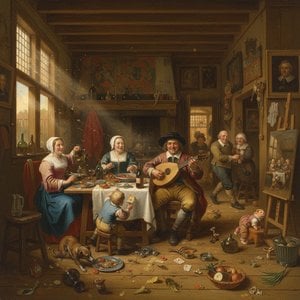
The Versatile Hand of Geert Grauss
Born in Middelburg, Netherlands, Geert Grauss possessed a creative curiosity that refused to be confined to a single medium. His early training began under W.J. Schütz, a marine painter who helped shape his foundational understanding of form. This early instruction provided the groundwork for a life spent exploring the nuances of light and human anatomy. He eventually moved beyond the borders of his home to seek deeper instruction, studying at the Royal Academy of Fine Arts in both Antwerp and Brussels. These years in Belgium were formative, allowing him to refine a technical precision that would define his later work.
His artistic vision was deeply shaped by the light of the Mediterranean. Through study trips to Algiers and Italy, specifically the island of Capri, he encountered a warmth and clarity that informed his palette. These travels were not merely escapes but essential components of his development, providing him with a new way to observe the human figure and the natural world. He returned to the Netherlands with a broadened perspective, ready to tackle a variety of subjects ranging from the delicate petals of a floral still life to the complex lines of the human nude.
A Life of Diverse Expression
Grauss was a man of many disciplines, moving between the canvas and the studio with ease. His interests were broad, and his output reflected a desire to master almost every visual form available to him. His professional life was marked by several distinct pursuits:
- Painting and drawing, with a focus on figures and genre scenes.
- Lithography and illustration, which allowed him to explore graphic storytelling.
- Stained glass design, including a period working in the Bouvy studio in Dordrecht.
- Sculpture and the creation of posters.
This versatility made him a significant presence in the Dutch art community. He was an active member of the Amsterdam art associations, Arti et Amicitiae and Sint Lucas. His skill was recognized by his peers when he was awarded the Willink van Collen Prize in 1917. Even as he matured, he remained engaged with the contemporary art scene, participating in the art competition held during the 1928 Olympic Games in Amsterdam.
Legacy and Final Years
The breadth of his teaching also left a mark on the next generation of artists. He mentored several students, including Patrick Bakker and Barthold van Riemsdijk, passing on the technical rigor he had acquired during his time in Antwerp and Brussels. His ability to move between the fine arts and applied arts, such as glass painting and poster design, showed a practical understanding of how art interacts with the world around it.
Geert Grauss passed away in The Hague at the age of 47. Though his life was relatively short, the variety of his work—from the intimate detail of a still life like Bloemstilleven to the grander scale of stained glass—demonstrates a lifetime of dedicated observation and technical exploration.
Pytania i odpowiedzi
W jakich nurtach tworzył Geert Grauss?
Nurty, w których tworzył/a Geert Grauss, można zobaczyć na stronie Wszystkie nurty artystyczne artysty, gdzie dzieła są pogrupowane według nurtów.
Ile dzieł Geert Grauss można przejrzeć w katalogu?
Możesz przeglądać 1 dzieł sztuki dzieł autorstwa Geert Grauss na stronie Wszystkie dzieła.
Jak znaleźć dzieła Geert Grauss o konkretnej tematyce?
Strona Według słów kluczowych artysty Geert Grauss grupuje jego dzieła według słów kluczowych.
Czy istnieje oś czasu prac Geert Grauss?
Strona Chronologia dzieł prezentuje dzieła Geert Grauss uporządkowane chronologicznie, rok po roku.