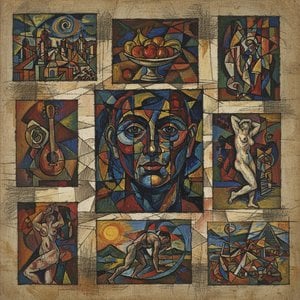
The Life and Art of Frigyes Frank
Frigyes Frank was a Hungarian painter whose career spanned the most turbulent and transformative decades of the twentieth century. Born in Budapest in 1890, he developed a visual language that refused the constraints of traditionalism. His work is firmly rooted in the modernist and avant-garde movements, marking him as a significant figure in the evolution of Central European art. He remained tied to his roots until his death in Budapest in 1976.
The importance of Frank lies in his ability to navigate diverse stylistic shifts without losing a distinct sense of purpose. He did not merely follow trends; he absorbed the energy of the era to create something specific to his own perspective. His output reflects a constant tension between descriptive clarity and an introspective, expressionist impulse. This duality allowed his work to resonate across borders, from the studios of Munich to the galleries of Paris.
To look at the trajectory of Frigyes Frank is to see the movement of a modern artist through the shifting centers of European creativity. He moved between the academic rigor of his early training and the radical experimentation of the avant-garde. His legacy is found in the way he handled color and form to capture both the external world and a more internal, psychological reality. He was a painter of the modern age, defined by a refusal to remain static.
Early Training and Studies in Budapest and Munich
The foundation of Frank's technical capability was laid in Budapest. Between 1908 and 1911, he studied at the Budapest School of Art under the instruction of Ede Balló and Tivadar Zemplényi. This period provided the formal discipline required before his departure from Hungary. His training was not merely academic; it was the necessary groundwork for the stylistic shifts that would follow his move abroad.
In 1911, Frank relocated to Munich to advance his studies. This transition moved him into a more intense professional environment. He spent time working in the atelier of Walter Thorn, gaining practical experience that went beyond the classroom. His time in Munich was further defined by his work with Angelò Jank. These years in Germany were critical in refining his approach to composition and technique before he eventually turned his attention toward the French art scene.
The Paris Years and International Success
The post-war period saw Frank move to Paris, a transition that fundamentally altered his artistic outlook. He did not merely exist within the French capital; he integrated into its competitive exhibition circuit. His presence was felt at the Societé des Artistes Français and the Salon d'Automne, where his work met the scrutiny of the Parisian art scene. This was not a period of mere experimentation but one of concrete professional recognition. In 1926, an exhibition at the Galerie Bernheim Jeune resulted in a Mention Honoraire, a distinction that solidified his standing among the international avant-garde.
Between 1926 and 1929, Frank lived in Paris with his wife, Mimi. This period of domestic and professional life in France provided the backdrop for some of his most significant developments. The influence of the Ecole de Paris was evident in his evolving technique, moving toward a more rhythmic use of color. His connection to Mimi was not merely personal; she became a recurring subject that anchored his output during these formative years in the city.
Artistic Style and Major Influences
Frank’s aesthetic identity is rooted in expressionism, yet he refused to remain confined by a single label. His approach to the canvas maintained a dual nature: it was simultaneously descriptive and introspective. This balance allowed him to capture the physical reality of his subjects while projecting a deeper, internal psychological state. He was not merely a recorder of scenes; he was an interpreter of them. His ability to navigate between these modes helped him contribute significantly to the development of the cubist movement, moving beyond simple representation toward a more structured, modern understanding of form.
The influence of the Ecole de Paris is unmistakable in his later development. His work reflects the rhythmic use of color and the structural sensibilities of Matisse, Soutine, Bonnard, and Chagall. These influences did not result in mere imitation. Instead, they provided a framework for his unique visual language. His time in Paris fundamentally altered his artistic outlook, pushing him toward a more vivid and rhythmic application of pigment. This period solidified his ability to blend the emotional weight of expressionism with the formal experimentation found in the French capital's most progressive circles.
Key Works and Subjects
Frank’s output reveals a persistent preoccupation with the intimate and the domestic, often centered on the presence of his wife, Mimi. His 1926 portrait, Mimi, marks a significant moment in this thematic cycle. This focus on a singular muse was not merely a personal preference but a structural element of his visual language. By 1938, this relationship between subject and space became more complex in Studio Atmosphere with Paintings and Mimi, where the artist integrated the figure into the very environment of his creative process.
The artist also demonstrated a command over more transient, delicate subjects through his drawings and still lifes. His 1927 drawing, Joy, provides a glimpse into his ability to capture immediate sensation on paper. Later in his career, his attention turned toward the formal qualities of inanimate objects. The 1967 work Still-Life of Flowers demonstrates a continued interest in the arrangement of organic forms, maintaining a rhythmic presence even in his later years.
- Terrace (about 1928)
Later Years and Return to Hungary
After his period in Paris, Frank returned to Hungary, shifting his focus back to his native landscape. He spent the following decade working between his hometown of Budapest and Mártély. This period saw him maintaining a steady output that spanned several decades, moving through various media and subjects. His presence in the Hungarian art scene remained consistent as he navigated the later stages of his life.
His late-period output demonstrates a continued engagement with both formal composition and everyday objects. In 1965, he produced Merry-go-round, a work executed in tempera on paper. Even as he approached the end of his life, his practice remained active. This is evidenced by his 1975 work, Still life with red dahlias, a piece created on paper. These later works show a painter who remained committed to his visual language long after his international exposure in France.
Pytania i odpowiedzi
Gdzie mogę znaleźć statystyki dotyczące dzieł Frigyes Frank?
Statystyki dotyczące dzieł artysty Frigyes Frank można znaleźć na jego stronie Statystyki odwiedzin.
Skąd pochodzi Frigyes Frank?
Frigyes Frank urodził się w Hungary.
W jakim mieście i kraju urodził(a) się Frigyes Frank?
Frigyes Frank urodził się w Budapest w Hungary.
Jakich kolorów Frigyes Frank używał najczęściej?
Profil kolorystyczny twórczości Frigyes Frank można zobaczyć na stronie Genom Palety artysty.