1630 - 1669

Kluczowe informacje

  • Top 3 works:
    • Moonlight
    • Kitchen Interior with Peeling Woman
    • Woman Behind Her Spinning Wheel
  • Color intensity: monochromatic
  • Lifespan: 39 years
  • Museums on this site:
    • Groninger Museum
    • Fries Museum
  • Also known as:
    • Francis Carre
    • Franciscus Carre
    • F. Carré
    • Carre dit le vieux
    • Carre
  • Died: 1669
  • Nationality: Netherlands

The Quiet Life of a Dutch Painter

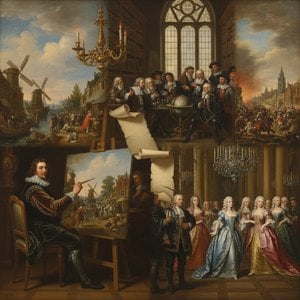
The brushstrokes of Franciscus Carree suggest a man who found his place within the shifting centers of the Dutch Republic. Born around 1630, his early years may have been spent in Leeuwarden, though some traces point toward Antwerp. By 1649, he was in The Hague, where he married Janneke Padtbrugge and joined the local guild. This was the era of his professional settling, a time when a painter’s standing was measured by his ability to secure steady work and respect within the community. He moved through the major hubs of the time, living in Amsterdam between 1658 and 1661, before his reputation grew enough to earn him a position as first painter to the Stadtholder William Frederick in Leeuwarden in 1664.

His hands were accustomed to the textures of the everyday. He did not seek the grandiosity of courtly portraiture alone, but instead turned his attention to the rhythms of rural life and the stillness of the landscape. His work often captures the atmosphere of village festivals, where the light falls on crowds and the movement of a community. There is a specific focus in his compositions on the way people gather and the way a landscape holds a moment in time.

Subject and Skill

Carree’s output reflects a steady hand and a keen eye for the social fabric of his time. His paintings often fall into two distinct categories of observation:

  • Landscapes that define the topography of the Dutch countryside.
  • Village festivals that document the communal life of the people.

Beyond the canvas, he worked in etching, leaving behind a record of the funeral catafalque of the Stadtholder in November 1664. This technical skill shows a man capable of both the broad strokes of a landscape and the fine, precise lines required for printmaking. His work remains largely a local phenomenon, known more deeply within his own country than in the wider reaches of Europe.

The Final Years

The end of his life is a matter of some uncertainty, scattered between the streets of Amsterdam, The Hague, or Leeuwarden. He died in 1669, leaving behind a body of work that remains tied to the specificities of the Dutch Golden Age. His paintings, such as those depicting a woman at her spinning wheel, offer a glimpse into the domestic and social realities of the seventeenth century. He was a painter of the seen world, recording the festivals and the fields with a quiet, observant eye.

Szybki quiz

Do każdego pytania dotyczy tylko jedna poprawna odpowiedź.

Pytanie 1:
In which year did Franciscus Carree marry Janneke Padtbrugge?
Pytanie 2:
To which Stadtholder was Carree appointed first painter in 1664?
Pytanie 3:
Between which years did Franciscus Carree live in Amsterdam?
Pytanie 4:
In which city was Carree potentially born, according to the text?
Pytanie 5:
What type of work did Carree leave an etching of in November 1664?

Pytania i odpowiedzi

Czy dostępna jest wirtualna wycieczka 3D po dziełach Franciscus Carree?

Zapraszamy na wirtualny spacer: strona Wirtualna Galeria 3D artysty Franciscus Carree prezentuje jego dzieła w galerii trójwymiarowej.

Gdzie można znaleźć dzieła Franciscus Carree uporządkowane według kolorów?

Strona Indeks kolorystyczny pozwala przeglądać dzieła Franciscus Carree z podziałem na kolory.

Gdzie mogę zobaczyć profil kolorystyczny twórczości Franciscus Carree?

Sposób wykorzystania koloru przez Franciscus Carree w pracach wymienionych na niniejsza strona można przestudiować na stronie Genom Palety artysty.

Jakie inne pseudonimy lub nazwy stosuje Franciscus Carree?

Franciscus Carree występuje również pod innymi nazwiskami: Francis Carre, Franciscus Carre, F. Carré, Carre dit le vieux, Carre.

Czy mogę przeglądać dzieła Franciscus Carree według słów kluczowych?

Aby znaleźć dzieła artysty Franciscus Carree o konkretnej tematyce, skorzystaj ze strony Według słów kluczowych, która grupuje prace według słów kluczowych.

Gdzie mogę zobaczyć dzieła Franciscus Carree w porządku chronologicznym?

Strona Chronologia dzieł prezentuje dzieła Franciscus Carree uporządkowane chronologicznie, rok po roku.

Gdzie mogę zobaczyć dzieła Franciscus Carree pogrupowane według nastroju?

Strona Sztuka według nastroju artysty prezentuje dzieła Franciscus Carree pogrupowane według ich nastroju.

Jak zmieniała się twórczość Franciscus Carree na przestrzeni lat?

Kariera Franciscus Carree rozwija się etap po etapie na stronie Osiągnięcia artystyczne: jako pozioma oś czasu dzieł, pogrupowanych w rozdziały odpowiadające poszczególnym okresom twórczości.

Gdzie mogę znaleźć statystyki dotyczące dzieł Franciscus Carree?

Dla artysty Franciscus Carree dostępna jest strona Statystyki odwiedzin, która prezentuje statystyki dotyczące jego dzieł w serwisie niniejsza strona.