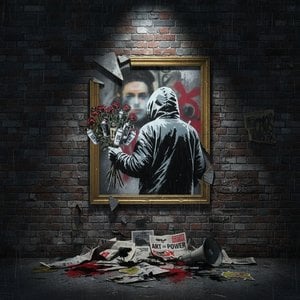
The Stencil of Tartu
Edward von Lõngus operates from the shadows of Tartu, an Estonian stencil artist whose presence is felt through political and social commentary rather than a public face. He uses the anonymity of the stencil to deliver sharp critiques, a method that has drawn direct comparisons to the approach of Banksy. His work does not rely on the traditional gallery setting to gain traction; instead, it occupies the streets and the auction houses simultaneously. This duality—existing as both a transient urban intervention and a collectible commodity—defines his current standing in the contemporary scene.
His technique is rooted in the precision of stenciling, a medium that allows for rapid deployment and high-impact messaging. By stripping away the artist's identity, the focus shifts entirely to the subject matter. This choice is deliberate. It forces the viewer to confront the social or political message without the distraction of a celebrity persona. His ability to translate complex cultural narratives into stark, visual statements is what keeps his work relevant in the public consciousness.
Digital Intersections and Cultural Echoes
The work of von Lõngus often functions as a bridge between Estonian history and modern digital reality. He does not merely paint walls; he integrates technology to expand the reach of his imagery. This was most evident during the 2018 Culture Award-winning project, (R)estart Reality. Through this initiative, he moved beyond the local confines of Tartu to engage with the broader European landscape.
His methodology involves several distinct layers of engagement:
- The use of augmented reality apps to connect life-sized painted figures with digital audio-video content.
- A focus on Estonian cultural history, specifically during the 100th anniversary of the Republic of Estonia.
- The deployment of street art across 11 European capitals, including Brussels, Rome, Berlin, Helsinki, Copenhagen, Paris, London, Vilnius, Rīga, Vienna, and Budapest.
- The transformation of traditional literary characters into modern social commentaries.
This intersection of the physical and the digital is not a gimmick. It is a way to anchor Estonian identity within a modern, e-nation framework. By using augmented reality, he ensures that a static image on a wall can tell a much larger story, connecting the past to the present through a mobile screen.
Social Commentary and Local Impact
The weight of his work is often found in how he repurposes familiar symbols to critique contemporary issues. A notable example is his 2014 Tartu City Culture Award-winning piece, "Cannabeard and the Witch-Hunter." By taking Sammalhabe, a character from Eno Raud's novel Naksitrallid, and reframing him within the context of the war on drugs, he demonstrates a capacity for subverting childhood nostalgia to address adult political realities. This ability to weaponize cultural familiarity is a hallmark of his most effective pieces.
His impact is measured by the tension he creates in the urban environment. Whether it is a hedgehog on a laptop in Berlin or a large-scale figure in Tallinn, his work demands a reaction. He uses the city as a canvas to discuss everything from the nature of power to the complexities of modern life. He remains a vital figure in the Estonian art scene because he refuses to let art remain a passive experience.