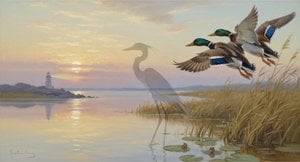
Early Life, Family and Training
Eddy Cobiness was born on July 17, 1933, in Warroad, Minnesota, United States. He grew up on the Buffalo Point First Nation's Indian reserve in southeast Manitoba. As a child, he spent his time drawing birds in the sand, in the snow, or on scraps of cardboard. These early habits of observation stayed with him as he developed into a graphic designer. He was a self-taught artist, learning through practice rather than formal schooling.
His life was shaped by the landscape of the Lake of the Woods area. He married Helen Accoby, who was from the Roseau River First Nation. Together, they had nine children. His connection to his Ojibwe-Native Canadian roots remained a constant throughout his life, influencing the subjects he chose to observe and record.
Artistic Development and Style
The early work of Eddy Cobiness focused on the literal. He began by capturing realistic scenes, often looking closely at the life found outdoors and the quiet movements of nature. As his practice matured, his approach shifted. He moved away from purely spiritual subject matter, transitioning toward a more abstract way of seeing. This evolution led him toward spare, highly stylized representations of animals and the natural world, a change influenced by his time working alongside the painter Benjamin Chee Chee.
His hand was practiced in many different ways. He did not stick to a single medium, instead moving between acrylic, oil, and ink. He used watercolour and pen and ink to capture fine details, and he often worked with coloured pencil or mixed media to build his compositions. This variety allowed him to experiment with how light and form appeared on the surface, whether he was sketching birds or more complex figures.
In his later years, the focus remained on the landscape and its inhabitants, but the forms became more stripped down. The movement from the literal to the stylized allowed him to express the essence of a subject rather than just its outward appearance. This shift in style marked a significant change in how he translated the outdoor world onto canvas and paper.
Professional Career and Movements
During his military service in the US Army from 1954 to 1957, Cobiness spent his time as a Golden Gloves boxer. It was in these years that he began working with watercolour, finding a way to translate his observations of the world onto paper. By the 1960s, his ink and watercolour drawings had found a steady commercial success, marking the start of a professional career that would eventually lead to international recognition.
He became a central figure in the Woodland School of Art. His work was part of a collective effort by the Professional Native Indian Artists Incorporation, a group often called the Indian Group of Seven. This group worked to establish a specific place for First Nations artists within the Canadian art landscape. Cobiness moved through various styles and media, from graphic design to oil and acrylic, always keeping his focus on the life found outdoors.
Key Works and Notable Pieces
In 1980, Cobiness produced Rainmaker, a work that marks a shift in his practice. The painting shows a dancer in profile, holding a drum. Three droplets of water fall from the drum into a small pool, and the figure appears caught in motion. Radiating lines surround the subject, suggesting energy emanating from the form. He signed this piece with his treaty number, a quiet protest against the assimilation policies of the time.
Much of his output from 1979 focuses on the animals and natural life he observed. These works often move toward a more stylized representation of the world. He captured the movement of birds and the presence of larger creatures through a spare, controlled hand. His subjects from this period include:
- Eagle Dancer (1979)
- Buffalo (1979)
- Porcupine (1979)
- Two Birds (1979)
- Two Ducks (1979)
- Thunderbird in Flight (1979)
His ability to translate the life of the outdoors into form is evident in these studies. Whether depicting the heavy presence of a buffalo or the flight of a bird, the work remains grounded in the specific details of the natural world. He used various media, including acrylic, ink, and watercolour, to build these images.
Legacy and International Recognition
Cobiness held a significant place in the landscape of Canadian art as the first and eldest of five artists associated with the Woodlands School of Canadian Native Art. His presence helped define the movement alongside his family members, including his son Ernest and his nephews Robert Jr., John, and Don Kakaygeesick. As an original member of the Indian Group of Seven, he worked to establish a specific niche for First Nations artists within the broader Canadian art scene.
His reach extended far beyond the local galleries of Manitoba. His paintings eventually found their way into international collections, gaining recognition across borders. This visibility reached even the highest levels of formal institutions, with his work being included in the collection of Queen Elizabeth II.
His influence remains visible through the continued presence of his works in major institutions, such as the National Gallery of Canada in Ottawa. His transition from realistic depictions to more stylized, abstract representations of nature left a mark on the way animal and landscape subjects were handled by his contemporaries.
Where to See the Works Today
His paintings and drawings can be found in several institutions across Canada. The National Gallery of Canada in Ottawa holds pieces of his work, alongside the Canadian Museum of History. You might also find his art within the McMichael Canadian Art Collection. These collections preserve the way he moved from realistic scenes toward more stylized, abstract forms.
Beyond these major galleries, his presence extends to the Clarkson University Art Gallery. His work is also held by the Sprague and Historical District Museum. These various locations keep his depictions of nature and the life of the outdoors available for study and viewing.
Pytania i odpowiedzi
Pod jakimi innymi nazwiskami znany jest Eddy Cobiness?
Eddy Cobiness występuje również pod innymi nazwiskami: Edward Cobiness, Edward Eddy Cobiness, Eddy Doc Cobiness.
Czy dostępna jest wirtualna wycieczka 3D po dziełach Eddy Cobiness?
Dzieła Eddy Cobiness można podziwiać w galerii 3D na stronie Wirtualna Galeria 3D artysty.
Gdzie można znaleźć dzieła Eddy Cobiness uporządkowane według kolorów?
Indeks kolorystyczny artysty Eddy Cobiness to strona, która porządkuje jego dzieła według kolorów.
Gdzie można zobaczyć wszystkie dzieła Eddy Cobiness?
Wszystkie dzieła Eddy Cobiness dostępne w niniejsza strona można przeglądać na stronie Wszystkie dzieła artysty.