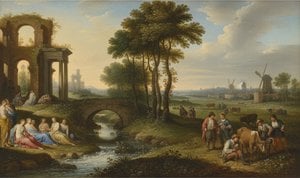
A Life Woven in Landscape: The World of Denijs van Alsloot
Denijs van Alsloot, a name resonating softly through the annals of Flemish art, occupies a fascinating transitional space between the established traditions of the 16th century and the burgeoning Baroque dynamism of the 17th. Born around 1570 in either Mechelen or Brussels, Belgium, his origins were steeped in the craft of tapestry – his father’s profession providing an early immersion into design and visual composition. Though details surrounding his formal artistic training remain elusive, it's clear that this familial connection to textile arts laid a foundational aesthetic sensibility for the young Alsloot. He entered the Brussels Guild of St Luke in 1599 as a tapestry designer, initially focusing on this craft before gradually shifting towards painting, taking on his first pupil the same year and continuing to mentor apprentices until 1625. This period suggests a deliberate evolution, a honing of skills that would eventually blossom into a distinctive landscape style.Courtly Commissions and Artistic Flourishing
A pivotal moment arrived around 1606 with Alsloot’s appointment as court painter to Albert and Isabella, the Archdukes who governed the Spanish Netherlands. This prestigious position not only provided financial stability but also thrust him into a world of influential patrons and significant commissions. The court became his canvas, demanding depictions of both grandeur and everyday life. He excelled at capturing scenes of civil processions, local festivals, and ceremonial events – vibrant snapshots of 17th-century Brussels society. Perhaps the most notable commission came from Archduchess Isabella herself: a request to paint eight panels commemorating the Ommegang procession of 1615, for which he was handsomely rewarded with 10,000 guilders. These works weren’t merely decorative; they were historical documents, preserving the spectacle and social fabric of the time. Alsloot's landscapes often blended topographical accuracy with imaginative flourishes, creating a unique aesthetic that resonated with his aristocratic clientele. He became particularly renowned for his realistic winter landscapes, frequently featuring the abbey of Groenendael in varying seasonal conditions – scenes commissioned by Archduke Albert himself, demonstrating the court’s appreciation for his skill and vision.The Sonian Forest School and Collaborative Spirit
Van Alsloot is often associated with the Sonian Forest school of landscape painters, a group who found inspiration in the sprawling woodlands surrounding Brussels. This association isn't merely geographical; it reflects a shared aesthetic preference for depicting scenes from this particular environment – its dense forests, tranquil abbeys, and atmospheric perspectives. His series of views of abbeys within the Sonian Forest exemplifies this connection, showcasing his ability to capture both the natural beauty and spiritual significance of these locations. However, Alsloot rarely worked in complete isolation. A fruitful collaboration with Hendrick de Clerck, a painter specializing in *staffage* – the figures populating landscapes – became a hallmark of his style. De Clerck’s vividly colored figures brought life and narrative to Alsloot's meticulously rendered backgrounds, creating dynamic compositions that captivated viewers. This partnership demonstrates a willingness to embrace collaborative artistry, enhancing the overall impact of their combined talents.Influences and a Developing Vision
Tracing Alsloot’s artistic lineage reveals a fascinating synthesis of influences. Early works demonstrate an affinity with 16th-century landscape painting, suggesting he studied the masters who came before him. The style of Gillis van Coninxloo is particularly evident, yet Alsloot's work generally possesses a calmer, more static quality, employing a softer palette and exhibiting greater precision in detail. He also absorbed elements from Jan Brueghel the Elder, skillfully blending these influences into his own distinctive approach. His artistic journey wasn’t simply imitation; it was an evolution. Starting with tapestry design, he gradually expanded his creative scope, embracing independent landscape painting and refining his technique over time. This progression demonstrates a commitment to growth and innovation, solidifying his position as a significant figure in the development of Flemish art.Legacy: A Window into 17th-Century Brussels
Though he passed away around 1626, likely before 1628, Denijs van Alsloot’s artistic legacy endures. His paintings are now held in esteemed museums worldwide, including the Museo Nacional del Prado in Madrid and the Victoria and Albert Museum in London, ensuring his work continues to inspire and captivate audiences centuries later. He is remembered not only for his technical skill – his topographical accuracy, atmospheric perspective, and meticulous detail – but also for his ability to document 17th-century life in Brussels. His depictions of festivals, processions, and landscapes offer invaluable insights into the social customs, architectural features, and natural beauty of the era. As a key representative of the Sonian Forest school and a transitional figure bridging earlier landscape traditions with the emerging Baroque style, Van Alsloot remains a significant subject for scholars studying Flemish landscape painting – a testament to his enduring contribution to the world of art.Pytania i odpowiedzi
Gdzie można znaleźć dzieła Denis Van Alsloot pogrupowane według słów kluczowych?
Strona Według słów kluczowych artysty Denis Van Alsloot grupuje dzieła artysty według słów kluczowych.
Czy istnieje chronologiczny opis twórczości Denis Van Alsloot?
Chronologiczne zestawienie twórczości Denis Van Alsloot można znaleźć na stronie Kronika, gdzie dzieła prezentowane są w kolejności ich powstania, podzielone na poszczególne etapy kariery.
W jakim mieście i kraju urodził(a) się Denis Van Alsloot?
Denis Van Alsloot urodził się w Mechelen w Belgia.