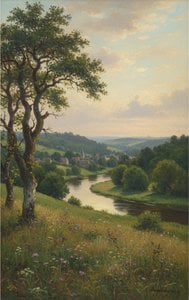
A Life Shaped by Displacement
Boris Ottenberg was a man whose life was defined by the shifting borders of early twentieth-century Europe. Born in 1891 in Saint Petersburg, Russia, his early years were marked by the formal discipline of the Society for the Encouragement of the Arts. This academic foundation provided the technical rigor that would characterize his later work, yet his path was never a straight line. Following the revolution, he moved to Estonia, becoming an active participant in the local art scene. He was a figure woven into the fabric of Estonian artistic life, contributing to the cultural dialogue of the era through various exhibitions.
The stability of his life was interrupted by the geopolitical upheavals of the 1940s. As the tides of war and resettlement forced many to move, Ottenberg left Estonia in 1940. His movements took him through Gdynia during the war years before he finally settled in Stockholm, Sweden, where he remained until his death in 1946. This period of wandering and relocation left a mark on his perspective, grounding his work in the quiet observation of the natural world.
The Language of Landscape
His artistic output was characterized by a commitment to realism, often filtered through the sensibilities of plein air painting and the subtle decorative lines of Jugendstil. He possessed a particular sensitivity to the northern landscape, a quality that became a hallmark of his style. His canvases often focused on the following elements:
- Seascapes that captured the movement and light of the water.
- Landscapes that reflected the specific moods of the northern terrain.
- Small-scale oil studies that translated vast distances into intimate formats.
Ottenberg had a way of making even the most modest dimensions feel expansive. He did not rely on grandiosity to command attention; instead, he used a precise, observant hand to make simple motifs feel deeply resonant. His work often carried a certain quietude, a sense of being a witness to the subtle shifts in light and atmosphere.
A Quiet Observer
The legacy of his work lies in its ability to capture a specific sense of place and time through a restrained, realistic lens. He was a painter of the immediate, finding depth in the textures of the coast and the stillness of the land. His ability to imbue small, signed oils with a sense of profound space remains the defining characteristic of his surviving body of work.
Pytania i odpowiedzi
Gdzie mogę zobaczyć wszystkie dzieła Boris Ottenberg?
Wszystkie dzieła Boris Ottenberg dostępne w niniejsza strona można przeglądać na stronie Wszystkie dzieła artysty.
Do jakiej epoki należał/a Boris Ottenberg?
Boris Ottenberg tworzył w okresie Modern. Epoka ta osadza twórczość artysty w kontekście historycznym.
Jak znaleźć wszystkie dzieła Boris Ottenberg wykonane w danej technice?
Dzieła artysty Boris Ottenberg można przeglądać według techniki na stronie Wszystkie techniki artysty.
Jak mogę znaleźć dzieła artysty Boris Ottenberg w konkretnej palecie barw?
Strona Według palet kolorystycznych grupuje dzieła Boris Ottenberg według ich palet kolorystycznych.