The Painter from Loreto
Born in the quiet surroundings of Loreto, within the province of Ancona, Attilio Alfieri carried the light of his Italian origins into a long and varied career that eventually found its home in Milano. His life was one of constant tactile exploration, where the boundaries between different media often blurred. He did not merely paint; he worked with the very substance of his materials, seeking a way to make pigment live upon the surface.
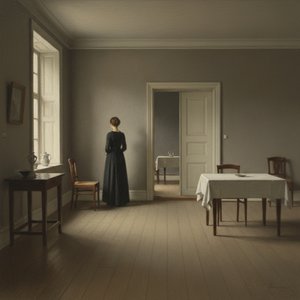
In his early years, particularly around 1934, his work began to reveal a fascination with the weight of color and the reduction of depth. In works such as Ambiente strano, he moved away from traditional drawing in favor of pure pigment. He spoke of his own method with a focus on the physical properties of his medium, using an impasto composed of pure pigment mixed with essences like lavender, poppy, and walnut. This approach allowed him to achieve a fusion of tones that sought to mirror the tonal complexities found in the works of Cézanne.
A Study of Form and Matter
As the decades passed, Alfieri’s interests drifted through various subjects, from the stillness of still lifes to the structural elements of landscapes. He possessed a restless curiosity that led him to experiment with an immense variety of supports and techniques. One might find his hand in oil on canvas, but he was equally at home applying tempera to paper, working with watercolor, or even utilizing lithography and printmaking. He often used humble materials like primed cardboard, wood, MDF, and veneered board to host his visions.
His repertoire included a wide range of subjects that captured the essence of everyday life and natural beauty:
- Still lifes featuring fruit, such as lemons or dried fruits with dates and walnuts.
- Landscapes and coastal scenes, including views of the Conero and fishing villages.
- Abstract compositions that focused on color and matter.
- Figures and portraits, ranging from female forms to masculine faces.
Legacy and Presence
The presence of Alfieri’s work remains felt in significant collections, ensuring his technical experiments are not forgotten. His pieces have found permanent homes in institutions such as the Galleria d’Arte Moderna e Contemporanea di Bergamo, where works like Ambiente strano continue to be studied for their unique handling of light and shadow. Through the preservation of his archives and the dispersal of his works through various Italian auction houses, the story of his devotion to the physical nature of paint remains intact.
Pytania i odpowiedzi
Czy mogę przeglądać dzieła Attilio Alfieri według palety kolorystycznej?
Strona Według palet kolorystycznych grupuje dzieła Attilio Alfieri według ich palet kolorystycznych.
Ile dzieł Attilio Alfieri można przejrzeć w katalogu?
Możesz przeglądać 2 dzieł sztuki dzieł autorstwa Attilio Alfieri na stronie Wszystkie dzieła.
Do jakiej epoki należał/a Attilio Alfieri?
Attilio Alfieri tworzył w okresie Modern. Epoka ta osadza twórczość artysty w kontekście historycznym.
Gdzie można znaleźć dzieła Attilio Alfieri uporządkowane według kolorów?
Strona Indeks kolorystyczny pozwala przeglądać dzieła Attilio Alfieri z podziałem na kolory.