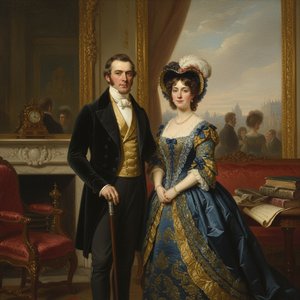
A Quiet Presence in Norwegian Portraiture
The life of Andreas Haavin was a brief one, marked by a focused dedication to the art of the portrait. Born in Norway in 1851, he moved through the mid-nineteenth century with a steady hand, capturing the likenesses of his contemporaries. His career was cut short by his death in 1891, leaving behind a body of work that offers a window into the social fabric of his era.
Haavin’s contribution to the Norwegian art scene is most clearly seen in his ability to render the individual. He did not seek to obscure the subject behind heavy abstraction, but rather to present the person as they were. His brushwork was disciplined, focusing on the subtle nuances of character and the quiet dignity of his sitters.
The Subjects of the Canvas
His surviving works provide a glimpse into the specific individuals who occupied the social circles of his time. These paintings are held in significant collections, reflecting the importance of his skill in capturing the likeness of the Norwegian people. His catalog includes:
These works, both dating from 1880, demonstrate a consistent interest in the human face. They are currently preserved within the Oslo Museum, where they serve as historical records of the people of that period.
A Legacy of Likeness
Though his time as a painter was limited, Haavin’s work remains a part of the Norwegian artistic record. He belonged to a generation of painters who sought to document the reality of their surroundings through the study of the human form. His portraits are not mere likenesses; they are studies of presence and identity. Through these works, the faces of the past remain visible, preserved by the steady hand of a man who understood the weight of a gaze.
Pytania i odpowiedzi
Czy mogę przeglądać dzieła Andreas Haavin według palety kolorystycznej?
Prace artysty Andreas Haavin można przeglądać według palety kolorystycznej na stronie Według palet kolorystycznych artysty.
Jak zmieniała się twórczość Andreas Haavin na przestrzeni lat?
Chronologiczne zestawienie twórczości Andreas Haavin można znaleźć na stronie Osiągnięcia artystyczne, gdzie dzieła prezentowane są w kolejności ich powstania, podzielone na poszczególne etapy kariery.
Które dzieła Andreas Haavin są najczęściej oglądane?
Statystyki dotyczące dzieł artysty Andreas Haavin można znaleźć na jego stronie Statystyki odwiedzin.
Do jakiej epoki należał/a Andreas Haavin?
Andreas Haavin tworzył w okresie 19th Century. Epoka ta osadza twórczość artysty w kontekście historycznym.