Podgląd w skali 1:1
 Wyślij jako kartkę
 Udostępnij
 Szczegóły dzieła
 Przewodnik

 Pobierz obraz
 Podobne obiekty
 RTG
RTG Pokaz slajdów
 Pytania i odpowiedzi
 Statystyki
Rivotril


 Rozwiń treść
Dzieło sztuki prezentowane na tej stronie podlega ochronie prawem autorskim, co oznacza, że nie mamy prawa do tworzenia ani sprzedaży jego identycznej reprodukcji. Ochrona ta jest egzekwowana na mocy umów międzynarodowych, takich jak Konwencja berneńska oraz przez przepisy prawa krajowego, w tym te określone w Prawo autorskie USA – Tytuł 17.
Metoda ta jest w pełni zgodna z przepisami prawa autorskiego, ponieważ nie polega na kopiowaniu ani powielaniu chronionego dzieła. Stanowi ona kreatywną reinterpretację – nowy obraz, który czerpie inspirację z oryginału, ale nie jest z nim tożsamy.
Giclée / Wydruk artystyczny
Wydruki giclée lub płótna o jakości muzealnej, szybka realizacja i szeroki wybór opcji wykończenia. ( Zamów ręcznie malowaną reprodukcję Przejdź do wersji cyfrowej)




P118B zł10

P118H zł10

P118W zł10

P438Z zł10

P508JH zł12

P508YH zł12

P805H zł10

P805Z zł10

P919BZ zł10

P919G zł10

P919XJ zł10

P959ZH zł10

P968JZ zł12

W106C zł8

W218G zł10

W218JH zł8

W218Y zł10

W307PJ zł10

W316G zł10

W316PJ zł8

W316Y zł10

W398PJ zł8

W4111J zł10

W500HY zł15

W500JH zł15

W692G zł12

W849H zł8

W940BG zł15

W953PJ zł8




Wybierz spośród naszych standardowych rozmiarów, które zachowują oryginalne proporcje dzieła sztuki.

Wpisz wymaganą szerokość i wysokość, aby dopasować grafikę do ramy lub ściany. Wydruk można jedynie przyciąć, nigdy nie powiększając go poza oryginalny obraz, dlatego format o innych proporcjach spowoduje utratę części kompozycji. Przed rozpoczęciem druku prześlemy Ci cyfrowy podgląd do zatwierdzenia. Obraz wyświetlany na tej stronie nie pokazuje rzeczywistego przycięcia — jedynie podgląd oddaje ten efekt.
Dostawa na cały świat () w ciągu 2 tygodni zamiast standardowych 4/5 tygodni. (4 Listopad)

Bezpłatna ekspresowa wysyłka na cały świat

Wysokiej jakości płótno lniane

Pełne ubezpieczenie przesyłki

Gwarancja zwrotu należności celnych i podatków importowych

Gwarancja wiernego odwzorowania kolorów

100-dniowa polityka zwrotów (tylko w przypadku wad)

Gwarancja 100% zwrotu pieniędzy

Zniżka przy zakupie wielu sztuk
 Opcja ze szkłem jest dostępna wyłącznie w rozmiarach poniżej 110 cm

Rivotril
Giclée / Wydruk artystyczny
Wymiary reprodukcji
-


Cena całkowita
zł 245
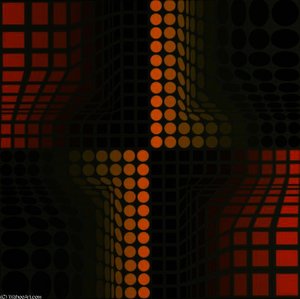
A Symphony of Geometric Perception: Exploring Victor Vasarely’s “Rivotril”
Victor Vasarely's "Rivotril" is not merely a painting; it’s an invitation into the very heart of perception, a testament to the revolutionary impact of Op Art and the burgeoning field of kinetic art. Created by the Hungarian artist, born Károly Vaszary in 1906, this vibrant composition encapsulates his lifelong fascination with geometry and its ability to manipulate our visual experience. The artwork’s genesis lies within the Bauhaus-influenced workshop of Sándor Bortnyik, where Vasarely honed his skills in functional design and geometric abstraction – principles that would become the bedrock of his iconic style. “Rivotril,” painted during a period of intense experimentation with optical illusions, exemplifies this approach perfectly, inviting the viewer to actively participate in constructing the image.
The Language of Spheres: Style and Technique
- Op Art Influence: The artwork is fundamentally rooted in Op Art (Optical Art), a movement that emerged in the 1960s, aiming to create illusions of three-dimensional forms through carefully arranged patterns. Vasarely was a key figure in this movement, pushing the boundaries of visual perception.
- Geometric Abstraction: Vasarely’s work is characterized by its rigorous geometric abstraction – circles, squares, and lines are not simply depicted but actively employed to generate dynamic effects.
- Color Field Technique: The use of bold, contrasting colors—blues, yellows, pinks, greens, oranges, and purples—is crucial to the artwork’s impact. Vasarely masterfully employs color field techniques, layering hues to create a sense of depth and movement.
- Precision and Detail: Despite its abstract nature, “Rivotril” reveals an extraordinary level of precision in its execution. Each sphere is meticulously rendered, contributing to the overall illusionistic effect.
A Historical Context: The Rise of Kinetic Art and Visual Perception
“Rivotril” was created during a pivotal moment in art history – the mid-20th century – when artists began to question traditional representational painting. The rise of Op Art coincided with advancements in psychology, particularly research into visual perception and how the human eye processes information. Vasarely’s work reflects this intellectual climate, engaging directly with these scientific explorations. His art wasn't about depicting a recognizable scene; it was about revealing the underlying mechanisms of seeing itself. The artwork speaks to a broader shift towards abstraction and a greater awareness of the subjective nature of visual experience.
Symbolism and Emotional Impact: Beyond the Surface
While ostensibly abstract, “Rivotril” evokes a powerful emotional response through its manipulation of form and color. The concentric spheres create a sense of movement, drawing the viewer’s eye across the canvas in a dynamic rhythm. The interplay of colors generates a feeling of energy and excitement, mirroring the artist's intention to stimulate the viewer's senses. Vasarely sought to create art that was not just seen but *felt*, engaging the viewer on a visceral level. The title itself, “Rivotril,” adds an intriguing layer of complexity, referencing a medication known for its calming effects – a subtle juxtaposition within this otherwise stimulating visual experience.
Pytania i odpowiedzi
Ile światła zdają się odbijać kolory dzieła "Rivotril"?
Jasność zarejestrowana dla „Rivotril” – Wiktór Wasaryli wynosi Gentle Luminance.
Jaki kolor dominuje w kompozycji „Rivotril” – Wiktór Wasaryli?
Dominującym kolorem dzieła „Rivotril” – Wiktór Wasaryli jest Gray (#7d8e5d).
Co łączy "Rivotril" z resztą twórczości Wiktór Wasaryli?
"Rivotril" dzieli z innymi dziełami Wiktór Wasaryli styl właściwy dla Op Art oraz powracające motywy: bauhaus, geometric abstraction, kinetic, visual perception, op art pioneer, signature style development, recurring sphere motifs.


Biografia artysty
A Life Forged in Geometry: The World of Victor Vasarely
Victor Vasarely (węg. Vásárhelyi Győző), (ur. 9 kwietnia 1906, Pecz, Węgry, zm. 15 marca 1997, Paryż, Francja) – artysta węgierskiego pochodzenia, który tworzył i pracował we Francji aż do śmierci. Jeden z czołowych przedstawicieli abstrakcji geometrycznej. Uważany za prekursora i przedstawiciela nurtu op-art. Tworzył poprzez komponowanie układów, wykorzystując geometryczne kształty (najbardziej charakterystyczne są kompozycje w kształcie kostki). Tworzył iluzję przestrzennej głębi na powierzchniach dwuwymiarowych, wykorzystując do tego jedynie abstrakcyjne plamy barwne. Pierwotnie w jego pracach dominowała czarno-biała kolorystyka, którą znacznie urozmaicił w swojej późniejszej działalności. Pierwotnie studiował medycynę, jednak po dwóch latach zmienił kierunek na malarstwo. Vasarely działał w węgierskim oddziale Bauhausu (Muhely) w Budapeszcie pod koniec lat 20. XX wieku. Here, Vasarely absorbed the tenets of functional design and geometric abstraction, seeds that would blossom into his signature style. These formative years weren't simply about acquiring technique; they were about dismantling traditional artistic conventions and embracing a new visual language rooted in logic and precision. From Early Abstraction to the Dawn of Op ArtThe late 1920s and early 1930s witnessed Vasarely’s gradual departure from representational art, as he delved deeper into the realm of geometric abstraction. Works like “Blue Study” and “Green Study,” created in 1929, exemplify this transition – a deliberate shedding of narrative content in favor of pure form and color relationships. While influenced by masters such as Piet Mondrian and Kazimir Malevich, Vasarely wasn’t content to simply emulate their styles. He sought to transcend the static compositions of his predecessors, aiming for a dynamism that would actively engage the viewer's perception. This quest led him to Paris in 1930, where he established himself as a graphic designer and advertising artist, honing his skills while continuing to develop his unique artistic vision. It was during this period that he began experimenting with techniques that would later become hallmarks of Op Art – manipulating shapes and colors to create illusions of movement and depth. The seeds were sown for a revolution in visual experience.The Systematic Illusion: Defining a Movement
By the 1960s, Victor Vasarely had fully emerged as a leading figure in the burgeoning Op Art movement. Unlike many artists who relied on intuition and spontaneous expression, Vasarely approached his work with a distinctly systematic methodology. He employed grids and mathematical principles to generate patterns that created powerful optical illusions – visual vibrations, swirling effects, and sensations of depth where none physically existed. This wasn’t about trickery; it was about revealing the inherent dynamism within perception itself. He believed in reproducibility and mass appeal, aiming to democratize art by making it accessible beyond the confines of galleries and museums. His work challenged viewers to question their own visual experience, forcing them to actively participate in the creation of meaning. He wasn't merely painting pictures; he was constructing experiences.Historical Significance
Vasarely’s contribution to art history is multifaceted. He moved beyond traditional painting techniques to create works that actively engage the viewer’s perception. His systematic approach challenged conventional notions of artistic creativity and paved the way for computer-generated art and digital design. By embracing reproducibility and commercial applications, Vasarely blurred the boundaries between fine art and popular culture, leaving an enduring mark on both. He wasn't simply creating aesthetically pleasing objects; he was conducting visual experiments that revealed fundamental truths about how we see the world. His work continues to resonate today, reminding us of the power of abstraction, the beauty of geometry, and the endless possibilities of human creativity.Influences and Development
Vasarely’s artistic journey began with a medical education in Budapest, but he quickly realized his true passion lay in visual expression. His enrollment at Sándor Bortnyik’s workshop – Műhely – profoundly shaped his early style, exposing him to the principles of functional design and geometric abstraction deeply rooted in the Bauhaus movement. This environment fostered a critical approach to traditional art forms, encouraging him to dismantle established conventions and develop a new visual language based on logic and precision. His time in Paris solidified this shift, as he honed his skills as a graphic designer and advertising artist while continuing to experiment with abstract forms and color relationships. The influence of Piet Mondrian’s reductive style and Kazimir Malevich's Suprematist explorations are evident in Vasarely’s early works, yet he ultimately sought to transcend mere imitation, aiming for a dynamic visual experience that engaged the viewer’s perception directly.Major Achievements
Vasarely’s legacy extends far beyond his paintings. He pioneered techniques of optical illusion and kinetic art, creating works that challenged our understanding of space and movement. His collaboration with Rosenthal porcelain resulted in the iconic “Suomi” tableware series, demonstrating his ability to integrate artistic principles into everyday objects. Perhaps most remarkably, Vasarely’s work was selected for display aboard the French-Soviet spacecraft Salyut 7 in 1982 – a testament to its universal appeal and groundbreaking nature. His Fondation Vasarely in Aix-en-Provence continues to preserve and promote his extensive body of work, ensuring that his innovative vision endures.
Wiktór Wasaryli
1906 - 1997 , Chorwacja
Krótka nota
- Artistic Movement Or Style: Op Art, Kinoart
- Artists Or Movements Influenced By This Artist: ['Projektowanie graficzne']
- Artists Who Influenced This Artist:
- Mondrian
- Malevich
- Date Of Birth: 9 kwietnia 1906
- Date Of Death: 15 marca 1997
- Full Name: Victor Vasarely
- Nationality: Węgiersko-Francuz
- Notable Artworks:
- Blue Study
- Green Study
- Place Of Birth: Pécs, Chorwacja
Powiązane artykuły
Top 10 Arcydzieł w Odcieniach Chromowej Żółci – Inspiracje do Wnętrz od ArtsDot
Odkryj 10 arcydzieł sztuki, w których króluje chromowa żółć! Van Gogh, Monet, Renoir i inni mistrzowie. Inspiracje wnętrzarskie i reprodukcje obrazów najwyższej jakości na ArtsDot.com. Eksploruj pełną kolekcję online!

Top 10 Sławnych Obrazów w Odcieniach Szaroniebieskiego – Inspiracje dla Wnętrz | ArtsDot.com
Odkryj 10 najsłynniejszych obrazów w odcieniach szaroniebieskiego! Poznaj historie Claude Moneta, Degasa i Van Gogha. Inspiracje wnętrzarskie i reprodukcje najwyższej jakości na ArtsDot.com – sztuka dla Twojego domu.

Odbitki Giclée: Jakość Archiwalna i Estetyczne Niuanse dla Wymagającego Kolekcjonera
Poznaj sekrety druku giclée – technologii zapewniającej najwyższą jakość reprodukcji sztuki i trwałość archiwalaną. Poradnik dla wymagających kolekcjonerów o wyborze papieru, tuszy i profilach kolorystycznych.

Serene Blue Backgrounds: Discover Soulful Art to Transform Your Space with Timeless Elegance
Transform your home with soulful blue art. From serene Monet impressions to modern textured sculptures, discover curated masterpieces designed to inspire calm. Explore expert art consultations and bespoke hand-painted reproductions to create your personal sanctuary.
Błękit w Sztuce: Symbolika, Historia i Psychologiczne Oddziaływanie Koloru
Odkryj fascynującą historię błękitu w sztuce! Poznaj symbolikę, psychologię i wpływ tego koloru na arcydzieła renesansu i współczesne trendy. Ekspercka analiza dla miłośników sztuki.