Zobacz w skali 1:1
 Wyślij
 Udostępnij
 Szczegóły
 Przewodnik

 Pobierz plik obrazu
 Podobne obiekty
 RTG
RTG Pokaz slajdów
 Statystyki
Axo

 Czytaj więcej
Giclée / Wydruk artystyczny
Wydruki giclée lub płótna o jakości muzealnej, szybka realizacja i szeroki wybór opcji wykończenia. ( Kup ręcznie malowany obraz Przełącz na wersję cyfrową)




P118B $10

P118H $10

P118W $10

P438Z $10

P508JH $12

P508YH $12

P805H $10

P805Z $10

P919BZ $10

P919G $10

P919XJ $10

P959ZH $10

P968JZ $12

W106C $8

W218G $10

W218JH $8

W218Y $10

W307PJ $10

W316G $10

W316PJ $8

W316Y $10

W398PJ $8

W4111J $10

W500HY $15

W500JH $15

W692G $12

W849H $8

W940BG $15

W953PJ $8




Wybierz spośród naszych standardowych rozmiarów, które zachowują oryginalne proporcje dzieła sztuki.

Możesz wprowadzić własne wymiary, aby dopasować dzieło do konkretnej ramy lub przestrzeni. Jeśli wybrany rozmiar nie będzie odpowiadał proporcjom oryginalnego obrazu, przytniecie dzieło lub rozszerzymy obraz za pomocą odbicia lustrzanego lub jednolitego wypełnienia krawędzi. Przed rozpoczęciem produkcji prześlemy cyfrową wizualizację do Twojej akceptacji.
Prosimy pamiętać, że podgląd na ekranie nie odzwierciedla faktycznego przycinania ani rozszerzania. Tylko wizualizacja dokładnie pokaże końcową kompozycję.
Mimo dostępności niestandardowych rozmiarów, zalecamy wybór wymiaru z listy zdefiniowanej, aby zachować oryginalne proporcje.
Dostawa na cały świat () w ciągu 2 tygodni zamiast standardowych 4/5 tygodni. (24 Wrzesień)

Bezpłatna ekspresowa wysyłka na cały świat

Wysokiej jakości płótno lniane

Pełne ubezpieczenie transportowe

Gwarancja zwrotu należności celnych i podatków importowych

Gwarancja idealnego odwzorowania barw

100-dniowy okres na zwrot dzieła w przypadku wykrycia wad produkcyjnych

Gwarancja 100% zwrotu pieniędzy

Oferta przy zakupie wielu sztuk
 Opcja ze szkłem jest dostępna wyłącznie w rozmiarach poniżej 110 cm

Axo
Giclée / Wydruk artystyczny
Rozmiar reprodukcji
-


Suma do zapłaty
$ 62
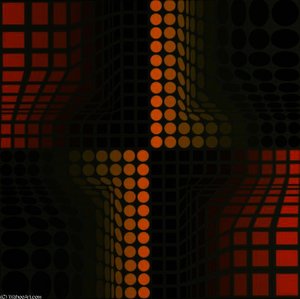
A Symphony of Illusion: Exploring Victor Vasarely’s Axo
Victor Vasarely's “Axo” isn’t merely a painting; it’s an invitation into a realm where perception bends and reality dances with geometric precision. Created in 1988, this striking piece exemplifies the zenith of Op Art—Optical Art—a movement spearheaded by Vasarely himself that sought to challenge our understanding of visual experience during the mid-20th century. It’s a testament to the power of abstraction to evoke emotion and stimulate contemplation.Composition & Visual Dynamics
The artwork immediately captivates with its deceptively simple yet profoundly complex arrangement. Two interlocking cubes dominate the canvas, positioned vertically and subtly rotating against a pristine white background. This deliberate asymmetry isn't accidental; it’s integral to Vasarely’s technique of generating visual illusions. The cubes aren’t static forms but rather conduits for movement—a feeling of kinetic energy that draws the viewer’s eye across the surface. Careful consideration was given to balance, ensuring that the visual tension created by the intersecting cubes is tempered by a harmonious overall composition.Color Palette & Geometric Harmony
Vasarely's masterful use of color elevates “Axo” beyond mere geometric abstraction. Bold hues—primarily reds, greens, and blues—are deployed in shades that range from vibrant intensities to muted tones. The upper cube pulsates with cooler blues and greens, while the lower cube radiates warmth through reds and purples. This chromatic contrast isn’t random; it's meticulously calibrated to heighten the illusion of depth and dimensionality. Each color contributes to a larger tapestry of visual stimulation, mirroring the movement implied by the cube arrangement.Technique & Material Considerations
“Axo” is executed in acrylic paint on wood—a deliberate choice that underscores Vasarely’s commitment to materiality alongside conceptual exploration. The technique involves applying pigment with exacting precision within a grid pattern, ensuring that every square contributes to the overarching illusion. This meticulous process reflects the Bauhaus ethos of functional design and highlights Vasarely's dedication to achieving optimal visual impact through careful craftsmanship. The resulting surface is smooth and matte, devoid of brushstrokes—a testament to the artist’s control over material and execution.Historical Context & Artistic Legacy
Op Art emerged in the wake of World War II as artists wrestled with anxieties about postwar society and sought new ways to engage viewers emotionally. Vasarely's pioneering work challenged conventional notions of representation, prioritizing visual sensation over literal depiction. Influenced by Cubism’s fragmentation of form and Escher’s impossible constructions—particularly “Ascending Spiral”—“Axo” embodies the spirit of experimentation that characterized the era. It stands as a cornerstone of kinetic art, demonstrating how geometric patterns can manipulate perception and provoke profound aesthetic responses. Vasarely's enduring legacy continues to inspire artists today who strive to push the boundaries of visual experience.Symbolic Resonance & Emotional Impact
Beyond its formal brilliance, “Axo” speaks to deeper themes of interconnectedness and dynamism. The interlocking cubes symbolize unity amidst complexity—a visual metaphor for navigating a turbulent world with grace and resilience. The artwork’s vibrant colors evoke feelings of excitement and stimulation, inviting contemplation on the nature of perception itself. Ultimately, Vasarely's masterpiece transcends mere decoration; it offers an immersive journey into the realm of optical illusion and invites viewers to reconsider their relationship with visual reality.


Biografia artysty
A Life Forged in Geometry: The World of Victor Vasarely
Victor Vasarely (węg. Vásárhelyi Győző), (ur. 9 kwietnia 1906, Pecz, Węgry, zm. 15 marca 1997, Paryż, Francja) – artysta węgierskiego pochodzenia, który tworzył i pracował we Francji aż do śmierci. Jeden z czołowych przedstawicieli abstrakcji geometrycznej. Uważany za prekursora i przedstawiciela nurtu op-art. Tworzył poprzez komponowanie układów, wykorzystując geometryczne kształty (najbardziej charakterystyczne są kompozycje w kształcie kostki). Tworzył iluzję przestrzennej głębi na powierzchniach dwuwymiarowych, wykorzystując do tego jedynie abstrakcyjne plamy barwne. Pierwotnie w jego pracach dominowała czarno-biała kolorystyka, którą znacznie urozmaicił w swojej późniejszej działalności. Pierwotnie studiował medycynę, jednak po dwóch latach zmienił kierunek na malarstwo. Vasarely działał w węgierskim oddziale Bauhausu (Muhely) w Budapeszcie pod koniec lat 20. XX wieku. Here, Vasarely absorbed the tenets of functional design and geometric abstraction, seeds that would blossom into his signature style. These formative years weren't simply about acquiring technique; they were about dismantling traditional artistic conventions and embracing a new visual language rooted in logic and precision. From Early Abstraction to the Dawn of Op ArtThe late 1920s and early 1930s witnessed Vasarely’s gradual departure from representational art, as he delved deeper into the realm of geometric abstraction. Works like “Blue Study” and “Green Study,” created in 1929, exemplify this transition – a deliberate shedding of narrative content in favor of pure form and color relationships. While influenced by masters such as Piet Mondrian and Kazimir Malevich, Vasarely wasn’t content to simply emulate their styles. He sought to transcend the static compositions of his predecessors, aiming for a dynamism that would actively engage the viewer's perception. This quest led him to Paris in 1930, where he established himself as a graphic designer and advertising artist, honing his skills while continuing to develop his unique artistic vision. It was during this period that he began experimenting with techniques that would later become hallmarks of Op Art – manipulating shapes and colors to create illusions of movement and depth. The seeds were sown for a revolution in visual experience.The Systematic Illusion: Defining a Movement
By the 1960s, Victor Vasarely had fully emerged as a leading figure in the burgeoning Op Art movement. Unlike many artists who relied on intuition and spontaneous expression, Vasarely approached his work with a distinctly systematic methodology. He employed grids and mathematical principles to generate patterns that created powerful optical illusions – visual vibrations, swirling effects, and sensations of depth where none physically existed. This wasn’t about trickery; it was about revealing the inherent dynamism within perception itself. He believed in reproducibility and mass appeal, aiming to democratize art by making it accessible beyond the confines of galleries and museums. His work challenged viewers to question their own visual experience, forcing them to actively participate in the creation of meaning. He wasn't merely painting pictures; he was constructing experiences.Historical Significance
Vasarely’s contribution to art history is multifaceted. He moved beyond traditional painting techniques to create works that actively engage the viewer’s perception. His systematic approach challenged conventional notions of artistic creativity and paved the way for computer-generated art and digital design. By embracing reproducibility and commercial applications, Vasarely blurred the boundaries between fine art and popular culture, leaving an enduring mark on both. He wasn't simply creating aesthetically pleasing objects; he was conducting visual experiments that revealed fundamental truths about how we see the world. His work continues to resonate today, reminding us of the power of abstraction, the beauty of geometry, and the endless possibilities of human creativity.Influences and Development
Vasarely’s artistic journey began with a medical education in Budapest, but he quickly realized his true passion lay in visual expression. His enrollment at Sándor Bortnyik’s workshop – Műhely – profoundly shaped his early style, exposing him to the principles of functional design and geometric abstraction deeply rooted in the Bauhaus movement. This environment fostered a critical approach to traditional art forms, encouraging him to dismantle established conventions and develop a new visual language based on logic and precision. His time in Paris solidified this shift, as he honed his skills as a graphic designer and advertising artist while continuing to experiment with abstract forms and color relationships. The influence of Piet Mondrian’s reductive style and Kazimir Malevich's Suprematist explorations are evident in Vasarely’s early works, yet he ultimately sought to transcend mere imitation, aiming for a dynamic visual experience that engaged the viewer’s perception directly.Major Achievements
Vasarely’s legacy extends far beyond his paintings. He pioneered techniques of optical illusion and kinetic art, creating works that challenged our understanding of space and movement. His collaboration with Rosenthal porcelain resulted in the iconic “Suomi” tableware series, demonstrating his ability to integrate artistic principles into everyday objects. Perhaps most remarkably, Vasarely’s work was selected for display aboard the French-Soviet spacecraft Salyut 7 in 1982 – a testament to its universal appeal and groundbreaking nature. His Fondation Vasarely in Aix-en-Provence continues to preserve and promote his extensive body of work, ensuring that his innovative vision endures.
Wiktór Wasaryli
1906 - 1997 , Chorwacja
Najważniejsze informacje
- Artistic Movement Or Style: Op Art, Kinoart
- Artists Or Movements Influenced By This Artist: ['Projektowanie graficzne']
- Artists Who Influenced This Artist:
- Mondrian
- Malevich
- Date Of Birth: 9 kwietnia 1906
- Date Of Death: 15 marca 1997
- Full Name: Victor Vasarely
- Nationality: Węgiersko-Francuz
- Notable Artworks:
- Blue Study
- Green Study
- Place Of Birth: Pécs, Chorwacja
Zobacz także powiązane artykuły

Poza Formą i Kolorem: Trwała Spuścizna Abstrakcji Geometrycznej w Historii Sztuki
Poznaj fascynującą historię abstrakcji geometrycznej – od rosyjskiej awangardy po wpływ na współczesną sztukę i design. Ekskluzywne analizy, kluczowi artyści i perspektywy inwestycyjne dla kolekcjonerów.

25 Arcydzieł Kandinskiego: Kolor, Duchowość i Abstrakcja w Twoim Domu | ArtsDot.com
Odkryj 25 arcydzieł Wassily Kandinskiego – pioniera abstrakcji i ekspresjonizmu! Poznaj historie, techniki i emocje kryjące się za jego kolorowymi kompozycjami. Reprodukcje obrazów najwyższej jakości na ArtsDot.com. Eksploruj pełną kolekcję online!

Geometria Sztuki: 10 Arcydzieł Abstrakcji Geometrycznej | ArtsDot.com
Odkryj 10 arcydzieł abstrakcji geometrycznej! Poznaj historię Mondriana, Kandinskiego i Maleвича. Inspiracje wnętrzarskie z malarstwem abstrakcyjnym – reprodukcje najwyższej jakości na ArtsDot.com. Eksploruj kolekcję online!

Poza Formą i Kolorem: Ewolucja Abstrakcji Geometrycznej w Sztuce XX i XXI Wieku
Odkryj fascynującą historię abstrakcji geometrycznej w sztuce XX i XXI wieku! Analiza kluczowych nurtów, artystów i technik. Ekspercka wiedza dla kolekcjonerów na ArtsDot.com.

Victor Vasarely: Pioneering Op Art & Democratizing Visual Experience
Explore the revolutionary world of Victor Vasarely, father of Op Art. Discover his geometric masterpieces, artistic system, & lasting impact on modern design. A guide for discerning art collectors.