

- 268.0 x 104.0 cm


Obraz dostosowuje się do Twoich wyborów: , .
Opis obiektu
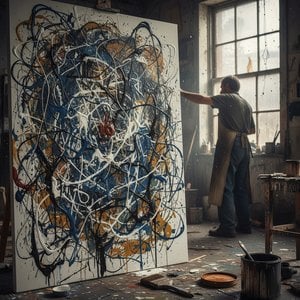
Experience Jackson Pollock's iconic 'Lucifer,' a dynamic Abstract Expressionist masterpiece from 1947 featuring layered drips and patterns in black and white. A captivating exploration of form and emotion, perfect for art lovers seeking a bold statement piece.
 Rozwiń treść
Biografia artysty
Paul Jackson Pollock (1912-1956) – amerykański malarz, pionier ekspresjonizmu abstrakcyjnego i techniki "dripping". Znany z dynamicznych, spontanicznych obrazów, które rewolucjonizowały sztukę XX wieku. #Pollock #sztukaabstraktna
Ręcznie malowana reprodukcja olejowa
Ręcznie malowany obraz olejny na płótnie, wykonany na zamówienie przez naszych artystów w wybranym przez Ciebie wymiarze i oprawie. ( Przełącz na wydania drukowane Przejdź do wersji cyfrowej)
Więcej o tym obrazie
 Podgląd w skali 1:1
 Wyślij jako kartkę
 Udostępnij
 Szczegóły dzieła
 Przewodnik

 Pobierz obraz
 Podobne obiekty
 RTG
RTG Pokaz slajdów
 Pytania i odpowiedzi
 Statystyki
Zamów swój obraz w czterech prostych krokach
Nie spiesz się. Możesz zmienić każdą odpowiedź; cena w Twoim koszyku będzie aktualizowana po każdym wyborze.
1 Pierwszy z czterech kroków
Który rozmiar wybierasz?
Te rozmiary zachowują proporcje oryginalnego obrazu. Rysunek przedstawia wybrany przez Ciebie format na ścianie, nad dwumetrową sofą.
lub podaj własne wymiary
Wybierz spośród naszych standardowych rozmiarów, które zachowują oryginalne proporcje dzieła sztuki.

Wpisz wymaganą szerokość i wysokość, aby obraz pasował do Twojej ramy lub ściany. Ponieważ jest to dzieło malowane ręcznie, w przypadku rozmiaru o innych proporcjach artysta może domalować nieco więcej wokół obrazu lub przyciąć jego fragmenty — wybór należy do Ciebie. Przed rozpoczęciem pracy prześlemy Ci cyfrową wizualizację do zatwierdzenia. Obraz widoczny na tej stronie nie przedstawia rzeczywistego efektu — jedynie wizualizacja oddaje realny rezultat.
2 Drugi z czterech kroków
W jaki sposób przygotować dzieło: w formie tuby, na krosnach czy w ramie?
Poniższe ceny dotyczą rozmiaru wybranego w pierwszym kroku.
Wybierz krawędzie płótna naciągniętego na ramę
Wybierz ramę

Białe krawędzie zł1

rozmyte krawędzie zł1

Przedłużony zł1

P118B zł10

P118H zł10

P118W zł10

P438Z zł10

P508JH zł12

P508YH zł12

P805H zł10

P805Z zł10

P919BZ zł10

P919G zł10

P919XJ zł10

P959ZH zł10

P968JZ zł12

W106C zł8

W218G zł10

W218JH zł8

W218Y zł10

W307PJ zł10

W316G zł10

W316PJ zł8

W316Y zł10

W398PJ zł8

W4111J zł10

W500HY zł15

W500JH zł15

W692G zł12

W849H zł8

W940BG zł15

W953PJ zł8

H24-GOLD zł30

H24-SILVER zł30

H36-GOLD zł45

H36-SILVER zł45
W oprawie
Profil: . Wymiar całkowity w ramie: .
3 Trzeci z czterech kroków
Czy chcieliby Państwo wprowadzić jakieś zmiany w obrazie?
Większość osób odpowiada przecząco. Ponieważ każdy obraz jest tworzony ręcznie, nasz artysta może również dostosować go do Twoich potrzeb.
Po złożeniu zamówienia zespół ArtsDot.com skontaktuje się z klientem drogą mailową w celu uzyskania instrukcji i prześle podgląd projektu
4 Krok czwarty z czterech
Kilka opcji wykończenia
Wszystkie są opcjonalne. Wybrane już odpowiedzi nie wiążą się z żadnymi dodatkowymi kosztami.
Kto jest autorem?
Dostawa na całym świecie () w ciągu 3–4 tygodni zamiast standardowych 5 tygodni. (8 Listopad). Bez kompromisów w kwestii jakości.
Tabliczka informacyjna, jak w muzeum?
Szczegóły grawerowanej brązowej tabliczki
This elegant plaque features the artist's name and the title of the artwork, finely engraved for a timeless presentation.
It is made from bronze with a refined, elegant finish. The text is precisely laser-engraved for a sharp and permanent result. Measuring 9x2 cm, the plaque is compact yet easy to read. It's built to be durable and scratch-resistant, offering a professional, museum-quality look. Mounting is simple thanks to the included adhesive backing.
Szczegóły przezroczystej tabliczki akrylowej
The plaque includes essential engraved details such as the artist's name, the title of the artwork, the date it was created, the type of media used-like oil on canvas or watercolor-a brief description of the piece, and a QR code that links to the complete artwork information.
It is crafted from clear acrylic, offering a sleek, modern appearance. The text is UV-engraved in black to ensure strong visual contrast. With a size of 10x15 cm, it ensures optimal readability. It comes equipped with two metal hooks for secure wall mounting. The plaque is designed to be weather-resistant, making it suitable for various environments, and it includes interactive features that work seamlessly with smartphone scanning.
Szczegóły czarnej tabliczki akrylowej
This elegant plaque includes engraved information such as the artist's name, the title of the artwork, the date it was created, the type of media used (like oil on canvas or watercolor), a short description of the artwork, and a QR code for quick access to more information.
The plaque itself is made from refined black acrylic with a premium finish. The text is laser-engraved in white for high contrast and readability. Its size is 10x15 cm, designed to be easy to read. It comes with two metal hooks for professional mounting. The design is sleek and fits any interior style. It is also weather-resistant and durable, with built-in digital integration for mobile compatibility.
Werniks ochronny?
Kiedy potrzebujesz dostawy?
✓ Sprawdź i zamów
Twoje dzieło, dokładnie tak, jak zamówiłeś

Lucifer
Technika reprodukcji
Wymiary reprodukcji
-

Wybitny mistrz artystyczny
Większa szczegółowość, finezja i dodatkowy czas na realizację
-

Opcje oprawy reprodukcji
-
-
W przypadku dzieł sztuki lub reprodukcji, których którykolwiek z boków przekracza 105 cm (około 41 cali), rama zostanie wysłana w formie zestawu do samodzielnego montażu. Metoda ta zapewnia bezpieczną dostawę i zapobiega uszkodzeniom podczas transportu.
Wymagany profesjonalny montaż – nie jest to produkt typu DIY.
Zestaw musi zostać złożony, a płótno naciągnięte przez doświadczonego profesjonalnego ramiarza, przy użyciu kleju do drewna (brak w zestawie), kleszczy do naciągania płótna oraz ścisków, które utrzymają krosna w równej pozycji podczas schnięcia kleju. Nieprawidłowy montaż lub nierównomierne napięcie płótna może trwale uszkodzić dzieło sztuki i nie podlega naszej gwarancji.
 W przypadku dzieł sztuki lub reprodukcji, których którykolwiek z boków przekracza 105 cm (około 41 cali), rama zostanie wysłana w formie zestawu do samodzielnego montażu. Metoda ta zapewnia bezpieczną dostawę i zapobiega uszkodzeniom podczas transportu.
W zestawie znajdują się wszystkie listwy z litego drewna, precyzyjnie docięte do wymiarów.
Montaż odbywa się przy użyciu dołączonych wkrętów oraz kleju do drewna do łączenia narożników, którego zestaw nie zawiera i który musi zostać dostarczony przez ramiarza.
Wymagane są profesjonalne narzędzia, których nie ma w zestawie: kleszcze do naciągania płótna (napinacz) oraz zaciski, które pozwolą utrzymać listwy w równej pozycji podczas schnięcia kleju.
Ważne:
Do połączenia narożników niezbędny jest klej do drewna, listwy należy unieruchomić za pomocą ścisków do momentu całkowitego wyschnięcia kleju, a naciągnięcie płótna na złożoną ramę wymaga użycia kleszczy do naciągania płótna. Żaden z tych elementów nie jest dołączony do zestawu. Przed zamówieniem tego rozmiaru zalecamy konsultację z doświadczonym ramiarzem.

Etykieta obiektu
-
-

Lakier ochronny
Lakier z połyskiem (pogłębia kolory, chroni przed światłem i wilgocią)
-

Personalizacja dzieła
Przykłady możliwości personalizacji: zastąp twarz zdjęciem klienta; dodaj zwierzę domowe (np. zamień kota na psa); umieść ukrytą wiadomość w tle; zmień krajobraz lub elementy tła.
-

Ekspresowa
Dostawa na cały świat () w ciągu 3–4 tygodni zamiast standardowych 5 tygodni. (8 Listopad). Bez kompromisów w kwestii jakości.
-
Przesyłka ekspresowa
Dostawa na cały świat () w ciągu 5 tygodni. (15 Listopad).
W cenie
Cena całkowita
zł 1029
Opcja ze szkłem jest dostępna wyłącznie w rozmiarach poniżej 110 cm
W każdym zamówieniu
- Bezpłatna ekspresowa wysyłka na cały świat
- Wysokiej jakości płótno lniane
- Pełne ubezpieczenie przesyłki
- Gwarancja zwrotu należności celnych i podatków importowych
- Gwarancja wiernego odwzorowania kolorów
- 100-dniowa polityka zwrotów (tylko w przypadku wad)
- Gwarancja 100% zwrotu pieniędzy
- Zniżka przy zakupie wielu sztuk


A Descent into Chaos: Exploring Jackson Pollock's "Lucifer"
Jackson Pollock’s “Lucifer,” painted in 1947, isn’t merely a painting; it’s an immersion. Measuring a substantial 268 x 104 cm, this work embodies the raw energy and profound emotionality of Abstract Expressionism at its zenith. The canvas explodes with a carefully orchestrated dance of black and white, a visual storm rendered through Pollock's revolutionary drip technique – a method he perfected to capture not just form, but the very essence of movement and feeling. Close inspection reveals an intricate network of layered textures, each drop and splatter contributing to a composition that feels both chaotic and meticulously controlled.
- Technique: Pollock’s “all-over” technique is central to "Lucifer's" impact. He abandoned traditional brushes, opting instead for sticks, knives, and even syringes to fling paint directly onto the canvas, creating a dense tapestry of overlapping marks.
- Color Palette: The stark contrast between black and white amplifies the painting’s dynamism, forcing the viewer to confront the interplay of light and shadow within its complex structure.
- Scale: The large format of "Lucifer" envelops the observer, drawing them into the heart of Pollock's creative process.
The Genesis of a Vision: Early Influences and Artistic Context
Pollock’s artistic journey began with a restless spirit shaped by his upbringing in Cody, Wyoming – a landscape that instilled within him a deep appreciation for natural forces and the rhythms of the West. His early exposure to Native American art, particularly through his father's surveying work, subtly informed his later explorations of composition and spiritual resonance. This influence is not overt imitation but rather a foundational layer contributing to the painting’s underlying power. Pollock’s formal training at the Art Students League under Thomas Hart Benton, a key figure in the Regionalist movement, further solidified his understanding of dynamic composition – a skill he then radically transformed through his own innovative approach. “Lucifer” stands as a testament to this evolution, building upon established principles while forging entirely new pathways for artistic expression.
Decoding the Symbolism: Layers of Interpretation
"Lucifer" resists easy interpretation, deliberately eschewing representational imagery in favor of abstract forms and textures. The interwoven patterns can be seen as symbolic representations of inner turmoil, spiritual struggle, or perhaps simply a visual manifestation of the artist’s subconscious. Some scholars suggest that the dominant black and white hues symbolize duality – light versus darkness, order versus chaos – reflecting the core themes explored by Abstract Expressionism. The seemingly random arrangement of shapes and forms actually possesses a carefully constructed dynamism, inviting viewers to engage in their own personal interpretations.
A Legacy of Innovation: "Lucifer" within the Art Historical Landscape
“Lucifer” is inextricably linked to the broader context of Abstract Expressionism, a movement that sought to liberate art from traditional constraints and explore the depths of human emotion. Works by Clyfford Still, with their similarly monumental scale and abstract forms, share conceptual affinities. Furthermore, the influence of Wassily Kandinsky’s exploration of geometric shapes and vibrant colors can be detected in Pollock's approach. Currently held within the Peggy Guggenheim Collection in Venice, "Lucifer" remains a pivotal work in Pollock’s oeuvre and a cornerstone of modern art history – a testament to his revolutionary vision and enduring impact.
Pytania i odpowiedzi
Jaki kolor dominuje w kompozycji „Lucifer” – Jackson Pollock?
Kolorem, który najbardziej wyróżnia się w "Lucifer", jest Espresso (#504f45). Dominujący kolor ułatwia dopasowanie dzieła sztuki do wnętrza.
Co łączy "Lucifer" z resztą twórczości Jackson Pollock?
"Lucifer" dzieli z innymi dziełami Jackson Pollock styl właściwy dla Abstract Expressionism oraz powracające motywy: indigenous art influence, abstract expressionist movement, inner emotional landscape, pollock’s innovative technique, key pollock artwork.
Jaki rozmiar wydruku jest zalecany dla „Lucifer” – Jackson Pollock?
Dla dzieła „Lucifer” – Jackson Pollock sugerowana jest reprodukcja w formacie Large. Rozmiar można dostosować, zachowując proporcje.
Podobne dzieła


Jackson Pollock
1912 - 1956, Stany Zjednoczone
Biografia artysty
Early Life and the Seeds of Innovation
Paul Jackson Pollock, born in Cody, Wyoming, in 1912, was a restless spirit from the outset. His early life was marked by frequent relocation as his father pursued work as a land surveyor across the vast landscapes of the American West. This itinerant existence instilled in young Pollock a deep connection to the natural world and an exposure to diverse cultures, particularly through encounters with Native American art during those surveying trips – impressions that would subtly permeate his artistic vision later in life. Though he never explicitly imitated Indigenous styles, the raw energy and spiritual resonance of these early experiences undoubtedly left their mark.
Pollock’s formal artistic training began at the Manual Arts High School in Los Angeles, followed by studies at the Art Students League of New York under the tutelage of Thomas Hart Benton. Benton, a prominent figure in the Regionalist movement, emphasized rhythmic composition and narrative themes rooted in American life. While Pollock initially absorbed these lessons, his inherent inclination leaned toward more abstract explorations. He was also profoundly impacted by Mexican muralists like José Clemente Orozco, whose powerful depictions of social struggle resonated deeply with him. These early influences laid a foundation, but it was the burgeoning world of Surrealism that truly unlocked Pollock’s artistic potential.
The Birth of Action Painting and a Revolutionary Technique
The 1930s saw Pollock experimenting with various techniques, seeking alternatives to traditional brushwork. He began pouring paint, exploring its fluidity and unpredictable nature. However, it was around 1947 that his artistic trajectory underwent a radical transformation. Abandoning the easel altogether, Pollock laid canvases directly on the floor, initiating what would become known as his “drip technique.” He then proceeded to drip, splash, and fling paint onto the canvas from above, orchestrating a dynamic dance between artist, medium, and surface.
This wasn’t merely about applying paint; it was about embodying the act of creation itself. Pollock's canvases became arenas for physical expression, capturing the immediacy of his gestures and emotions. The resulting paintings are characterized by their “all-over” composition – a lack of central focus that invites the viewer to explore the entire surface as a unified field of energy. Intricate networks of lines and colors intertwine, creating a visual complexity that is both captivating and challenging. He employed unconventional tools—sticks, knives, even syringes—to manipulate the paint in unpredictable ways, further emphasizing the spontaneous nature of his process.
Pollock’s approach was deeply influenced by Jungian psychology, seeking to tap into universal symbols and primal energies. The paintings became a record of this performance, imbued with the artist's physical presence and emotional intensity. The dynamic energy that emanates from these canvases is palpable, drawing viewers into a world of pure abstraction.
Iconic Works and Lasting Legacy
Pollock’s most celebrated works—such as Number 1, 1950 (Lavender Mist), One: Number 31, 1950, Blue Poles: Number 11, 1952, and Convergence—are testaments to his revolutionary technique. These paintings are not simply images; they are records of a performance, imbued with the artist’s physical presence and emotional intensity. The dynamic energy that emanates from these canvases is palpable, drawing viewers into a world of pure abstraction.
His style transcends mere aesthetics; it's an exploration of process over product. Pollock sought to capture the immediacy of his actions and emotions on canvas, rejecting traditional notions of composition and representation. He delved into Jungian psychology, exploring archetypes and the subconscious in his art, seeking to tap into universal symbols and primal energies.
Influence and Recognition
Pollock’s work quickly gained recognition within the burgeoning Abstract Expressionist movement, challenging established artistic norms and paving the way for future generations of artists. His innovative approach influenced a wide range of painters, including Lee Krasner, his wife and collaborator, who played a crucial role in shaping his artistic vision. Despite initial skepticism from some critics, Pollock’s reputation steadily grew throughout the 1950s, culminating in a landmark retrospective exhibition at the Museum of Modern Art in New York City in 1967. This event solidified his place as one of the most important and influential artists of the 20th century.
His legacy extends beyond the art world, impacting popular culture and inspiring countless individuals to embrace creativity and self-expression. Jackson Pollock’s daring experimentation with materials and techniques continues to resonate today, reminding us of the power of art to transcend boundaries and capture the essence of human experience.


Powiązane artykuły
Paul Jackson Pollock: A Radical Departure – Exploring Abstract Expressionism's Pioneering Figure and His Enduring Legacy
Explore the revolutionary art of Jackson Pollock & Abstract Expressionism. Discover his iconic drip paintings, lasting impact, and considerations for collecting this pivotal American artist. Expert insights at ArtsDot.

Ekspresjonizm Abstrakcyjny: Emocjonalny Krajobraz Nowojorskiej Awangardy
Poznaj fascynujący świat ekspresjonizmu abstrakcyjnego! Analiza kluczowych artystów, nurtów i wpływu na współczesną sztukę. Ekskluzywne informacje dla kolekcjonerów i miłośników.

Geometria Sztuki: 10 Arcydzieł Abstrakcji Geometrycznej | ArtsDot.com
Odkryj 10 arcydzieł abstrakcji geometrycznej! Poznaj historię Mondriana, Kandinskiego i Maleвича. Inspiracje wnętrzarskie z malarstwem abstrakcyjnym – reprodukcje najwyższej jakości na ArtsDot.com. Eksploruj kolekcję online!