

 Podgląd w skali 1:1
 Wyślij jako kartkę
 Udostępnij
 Szczegóły dzieła
 Przewodnik

 Pobierz obraz
 Podobne obiekty
 RTG
RTG Pokaz slajdów
 Pytania i odpowiedzi
 Statystyki
Lotus


 Rozwiń treść
Giclée / Wydruk artystyczny
Wydruki giclée lub płótna o jakości muzealnej, szybka realizacja i szeroki wybór opcji wykończenia. ( Zamów ręcznie malowaną reprodukcję Przejdź do wersji cyfrowej)




P118B zł10

P118H zł10

P118W zł10

P438Z zł10

P508JH zł12

P508YH zł12

P805H zł10

P805Z zł10

P919BZ zł10

P919G zł10

P919XJ zł10

P959ZH zł10

P968JZ zł12

W106C zł8

W218G zł10

W218JH zł8

W218Y zł10

W307PJ zł10

W316G zł10

W316PJ zł8

W316Y zł10

W398PJ zł8

W4111J zł10

W500HY zł15

W500JH zł15

W692G zł12

W849H zł8

W940BG zł15

W953PJ zł8




Wybierz spośród naszych standardowych rozmiarów, które zachowują oryginalne proporcje dzieła sztuki.

Wpisz wymaganą szerokość i wysokość, aby dopasować grafikę do ramy lub ściany. Wydruk można jedynie przyciąć, nigdy nie powiększając go poza oryginalny obraz, dlatego format o innych proporcjach spowoduje utratę części kompozycji. Przed rozpoczęciem druku prześlemy Ci cyfrowy podgląd do zatwierdzenia. Obraz wyświetlany na tej stronie nie pokazuje rzeczywistego przycięcia — jedynie podgląd oddaje ten efekt.
Dostawa na cały świat () w ciągu 2 tygodni zamiast standardowych 4/5 tygodni. (3 Listopad)

Bezpłatna ekspresowa wysyłka na cały świat

Wysokiej jakości płótno lniane

Pełne ubezpieczenie przesyłki

Gwarancja zwrotu należności celnych i podatków importowych

Gwarancja wiernego odwzorowania kolorów

100-dniowa polityka zwrotów (tylko w przypadku wad)

Gwarancja 100% zwrotu pieniędzy

Zniżka przy zakupie wielu sztuk
 Opcja ze szkłem jest dostępna wyłącznie w rozmiarach poniżej 110 cm

Lotus
Giclée / Wydruk artystyczny
Wymiary reprodukcji
-


Cena całkowita
zł 246
A Vision of Serenity: Exploring Roerich's "Lotus"
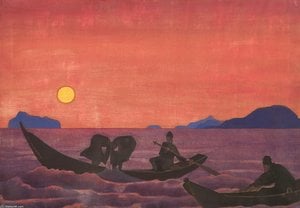
To gaze upon Nicholas Roerich’s Lotus is to step across the threshold into a realm suspended between waking life and profound meditation. This painting, executed in 1933, is not merely a depiction of a landscape; it is an immersion into a state of spiritual grace. The overall impression is one of breathtaking tranquility, achieved through a masterful handling of light and color that seems to emanate from the very heart of the scene. Roerich, whose life was a tapestry woven with threads of art, archaeology, and philosophy, imbues this canvas with his characteristic blend of cultural reverence and deep humanism.
Technique and Palette: The Artistry of Light
The technical execution speaks volumes about the artist's skill. Rendered in what appears to be oil on canvas, the visible brushstrokes lend a palpable texture to the surface, suggesting an almost tactile quality akin to impasto work. Roerich employs a warm and diffused lighting scheme, seemingly originating from the upper right corner, which bathes the entire scene in the glow of a perpetual sunset. The color palette is intoxicating—a rich symphony of oranges, soft pinks, deep purples, and earthy browns. These hues do more than decorate; they evoke emotion, wrapping the viewer in a blanket of warm nostalgia. While the perspective feels somewhat flattened, contributing to its dreamlike quality, it is this deliberate stylistic choice that allows the focus to remain entirely on the spiritual resonance rather than mere topographical accuracy.
Symbolism and Spiritual Depth
At the core of the composition lies the solitary figure, seated in deep contemplation by the still waters. This meditating form serves as the painting's anchor, universally symbolizing enlightenment, inner peace, and the journey toward self-discovery. The surrounding elements—the vast lake mirroring the sky, the gently rolling hills punctuated by stylized mountain peaks—represent the immense, sometimes overwhelming, expanse of existence itself. The lotus motif, though perhaps subtly integrated into the overall theme rather than overtly depicted, carries its weight of purity rising untainted from the mud, a potent symbol echoed throughout Indian artistic traditions that so influenced Roerich’s vision.
A Cultural Echo: Context and Style
Roerich's lifelong fascination with global cultures is evident here. The style marries what might be termed stylized realism with unmistakable influences drawn from ancient Indian art. This fusion allows the piece to feel both deeply rooted in tradition and vibrantly contemporary. Considering its creation in 1933, it stands as a testament to an era when spiritual yearning intersected powerfully with artistic expression. For collectors or designers seeking a piece that transcends mere decoration, this work offers a narrative depth—a visual meditation perfect for a sanctuary space or a grand hall where contemplation is encouraged.
Pytania i odpowiedzi
Jak można wykorzystać „Lotus” – Nikola Roerich w dekoracji wnętrz?
Zalecane zastosowanie (Focal) oraz przestrzeń (Lounge) to dwie rekomendacje dla dzieła „Lotus” – Nikola Roerich.
W jaki sposób „Lotus” – Nikola Roerich łączy Symbolism z krajem pochodzenia artysty?
Dzieło z nurtu Symbolism, zatytułowane "Lotus", zostało stworzone przez artystę urodzonego w Rosja.
Kiedy powstało i w jakim nurcie utrzymane jest dzieło „Lotus” – Nikola Roerich?
Dzieło "Lotus" powstało w 1933 roku i reprezentuje nurt Symbolism.
Podobne dzieła




Biografia artysty
A Life Immersed in Art and Spirit
Nicholas Roerich, born October 9, 1874, in the vibrant cultural heart of Saint Petersburg, Russia, was a figure whose life transcended the boundaries of artistic expression. He wasn’t merely a painter; he was an archaeologist, a writer, a philosopher, and a tireless advocate for peace and cultural preservation. His upbringing, steeped in both intellectual rigor – his father was a notary public – and artistic appreciation thanks to his mother, laid the foundation for a remarkably multifaceted career. Roerich simultaneously pursued studies in law and art at St. Petersburg University and the Imperial Academy of Arts beginning in 1893, demonstrating an early commitment to a broad understanding of the world. This dual path wasn’t contradictory for him; rather, it reflected a belief that artistic vision needed grounding in historical context and intellectual discipline. He received his artist designation in 1897 and completed his law degree the following year, setting the stage for a life dedicated to both creative exploration and reasoned action.The Allure of Symbolism and Theatrical Innovation
Roerich’s artistic development was profoundly shaped by the currents of Russian Symbolism, a movement that sought to evoke emotional and spiritual depths through evocative imagery and suggestive forms. He quickly became involved with Sergei Diaghilev's influential “World of Art” society, eventually assuming its presidency from 1910 to 1916. This association proved pivotal, exposing him to a network of innovative artists, composers, and thinkers who were redefining the landscape of Russian art. His early work revealed a fascination with archaeology and stage design, leading to groundbreaking collaborations with Diaghilev’s Ballets Russes. Roerich's designs for productions like Alexander Borodin's *Prince Igor* (1909) and, most famously, Igor Stravinsky’s revolutionary *The Rite of Spring* (1913), were not simply backdrops; they were integral components of the theatrical experience. He blended meticulous historical research with a bold imaginative vision, creating visually stunning environments that amplified the emotional power of the music and choreography. These designs weren't merely decorative; they were attempts to evoke primordial forces and ancient rituals, reflecting the Symbolist interest in myth and spirituality. His work was also influenced by apocrypha and medieval sectarian writings like the Dove Book, adding layers of esoteric meaning to his artistic creations.A Journey Towards Mysticism and Himalayan Visions
As Roerich’s career progressed, his paintings underwent a significant transformation, increasingly embracing mystical and spiritual themes. This shift was fueled by his growing interest in Theosophy and Eastern religions, philosophies that emphasized the interconnectedness of all things and the pursuit of inner wisdom. His *Architectural Studies* series (1904–1905) showcased not only his architectural skill but also a deep commitment to preserving cultural heritage, foreshadowing his later advocacy for protecting art during times of conflict. Recurring motifs began to emerge in his work: majestic landscapes, ancient cities shrouded in mystery, and figures imbued with spiritual significance like St. Panteleimon and Kuan Yin. He embarked on extensive travels throughout Central Asia, conducting archaeological research and documenting ancient cultures, experiences that deeply informed his artistic vision and reinforced his belief in the importance of cultural understanding. These journeys to remote regions profoundly shaped his worldview, leading him to believe in a universal spiritual consciousness and the interconnectedness of humanity with nature.Key Works & Continuing Relevance
- Saint Nicholas: A detailed monochrome mural showcasing medieval art and heraldic symbolism.
- City: Evocative depictions of ancient urban landscapes, reflecting his archaeological interests.
- Lake of the Nagas: A tempera painting blending symbolism and nature, exemplifying his unique artistic vision.
Legacy of Preservation and Enduring Influence
Nicholas Roerich was a dedicated activist for protecting art and architecture during times of war. Recognizing the vulnerability of cultural treasures, he spearheaded the creation of the Roerich Pact in 1935 – an international treaty designed to safeguard cultural objects from destruction. This initiative earned him multiple nominations for the Nobel Peace Prize, underscoring his profound humanitarianism. His tireless efforts demonstrated a belief that preserving cultural heritage was essential not only for understanding the past but also for building a more peaceful future. Today, Roerich’s work is celebrated in prominent museum collections worldwide, including the Astrakhan State Picture Gallery and, notably, the Nicholas Roerich Museum in New York City. His impact on Russian art and culture remains immeasurable. He bridged the gap between artistic expression and spiritual exploration, influencing generations of artists and thinkers with his visionary approach. He is remembered not only as a painter but as a scholar, a humanitarian, and a beacon of hope for cultural preservation.
Nikola Roerich
1874 - 1947 , Rosja
Krótka nota
- Artistic Movement Or Style: Символизм, духовное искусство
- Artists Or Movements Influenced By This Artist: ['Русский символизм']
- Artists Who Influenced This Artist: ['Сергей Дягилев']
- Date Of Birth: 9 октября 1874
- Date Of Death: 13 декабря 1947
- Full Name: Nicholas Roerich
- Nationality: Русский
- Notable Artworks:
- Святой Николай
- Город
- Озеро Нага
- Place Of Birth: Санкт-Петербург, Россия
Powiązane artykuły

Nicholas Roerich: Mysticism, Mountains & the Search for Ageless Wisdom in Art
Explore the captivating art of Nicholas Roerich – a visionary painter whose Himalayan landscapes blend spiritual mysticism with cultural preservation. Discover his legacy & symbolism.

John Constable: 25 Najlepszych Obrazów Mistrza Angielskiego Krajobrazu | ArtsDot
Odkryj 25 arcydzieł Johna Constable'a – mistrza angielskiego krajobrazu! Poznaj romantyczne pejzaże, technikę malarską i inspiracje z Dedham Vale. Reprodukcje obrazów najwyższej jakości na ArtsDot.com. Eksploruj pełną kolekcję online!

Romantyczny Krajobraz w Malarstwie: 10 Arcydzieł, Które Zdefiniowały Epokę | ArtsDot.com
Odkryj 10 arcydzieł romantyzmu w malarstwie! Poznaj historie Caspara Davida Friedricha, Turnera i innych mistrzów. Inspiracje wnętrzarskie & reprodukcje obrazów najwyższej jakości na ArtsDot.com. Eksploruj kolekcję online!

Evocations of Place: A Historical Journey Through Landscape Art
Explore the rich history of landscape art with ArtsDot. Discover renowned artists, movements like Impressionism & Romanticism, and expert guidance for collecting timeless pieces. Find your perfect serene escape today!

Echa Miejsca: Historyczna Podróż przez Sztukę Krajobrazu
Odkryj historię sztuki krajobrazu – od romantycznych wizji Friedricha po surrealistyczne pejzaże Dalego. Analizy, inspiracje i reprodukcje obrazów najwyższej jakości na ArtsDot.com.


