

 Podgląd w skali 1:1
 Wyślij jako kartkę
 Udostępnij
 Szczegóły dzieła
 Przewodnik

 Pobierz obraz
 Podobne obiekty
 RTG
RTG Pokaz slajdów
 Pytania i odpowiedzi
 Statystyki
Boy with Skull

- 95.0 x 66.0 cm


 Rozwiń treść
Otrzymaj plik gotowy do druku, którego jakość znacznie przewyższa podgląd internetowy. Każdy sprzedawany przez nas obraz cyfrowy pochodzi z wysokorozdzielczego pliku wzorcowego w naszej bazie — zazwyczaj o szerokości od 5 000 do 15 000 pikseli — dzięki czemu możesz drukować w dużym formacie, mocno kadrować lub z pełnym przekonaniem odwzorowywać najdrobniejsze detale.
Żaden plik nie opuszcza naszego studia bez odpowiedniej obróbki. Ekspert ds. cyfrowej edycji sprawdza zgodność kolorów z oryginałem i w razie potrzeby je koryguje, a następnie za pomocą profesjonalnych narzędzi do retuszu poprawia ostrość oraz szczegółowość — zawsze zachowując wierność pociągnięciom pędzla i stylowi artysty. Rezultatem jest obraz, który wygląda jak prawdziwe dzieło, a nie jak przefiltrowany skan.
Zatwierdzasz przed finalizacją zamówienia: nasz ekspert prześle obraz drogą mailową w ciągu 72 godzin do Twojego wglądu. Nie jesteś zadowolony? Poproś o poprawki lub korektę, bądź o zwrot kosztów, jeśli jakość nie spełnia oczekiwań.
To jakość, na której polegają wydawcy, studia projektowe, galerie oraz drukarnie.
Obraz cyfrowy
Pobierz plik o wysokiej rozdzielczości do osobistego użytku, druku oraz projektów kreatywnych. ( Przełącz na wydania drukowane Zamów ręcznie malowaną reprodukcję)
W każdym zamówieniu na obraz cyfrowy znajduje się
Profesjonalna dostawa cyfrowa z gwarancją
Wybierając ArtsDot.com, nie otrzymujesz jedynie obrazu – otrzymujesz profesjonalnie udoskonalone cyfrowe dzieło sztuki, stworzone z najwyższą precyzją i objęte gwarancją satysfakcji. Oto wszystko, co automatycznie dołączane jest do Twojego zamówienia:

Błyskawiczna wysyłka e-mailowa
Plik z obrazem cyfrowym w wysokiej rozdzielczości zostanie przesłany na Twój adres e-mail w ciągu 72 godzin od złożenia zamówienia – gotowy do natychmiastowego użycia.

Plik cyfrowy wzbogacony przez AI
Twoja grafika została profesjonalnie zoptymalizowana przy użyciu zaawansowanych narzędzi AI oraz ręcznej edycji, co zapewnia maksymalną szczegółowość, klarowność i wierność kolorów.

Darmowe ponowne przesyłki dożywotnio
Przypadkowo usunąłeś lub zgubiłeś swój plik? Bez obaw – prześlemy go Tobie ponownie w dowolnym momencie, bez żadnych opłat.

Bez opłat importowych – zawsze
Ciesz się swoją sztuką natychmiast, bez żadnych opłat celnych, należności ani kosztów dostawy – pliki cyfrowe są zawsze wolne od podatku.

Gwarancja wierności kolorów
Dzięki zastosowaniu profesjonalnych narzędzi i procesów zarządzania barwą zapewniamy, że Twoje cyfrowe zdjęcie odzwierciedla oryginalne kolory tak wiernie, jak to tylko możliwe.

Gwarancja satysfakcji przez 100 dni
Jeśli nie będziesz zadowolony ze swojego cyfrowego obrazu, dokonamy jego poprawki lub zwrócimy 100% kosztów w ciągu 100 dni – bez zbędnych pytań.

100% Gwarancja zwrotu pieniędzy
Nie jesteś zadowolony? Otrzymaj pełny zwrot kosztów w ciągu 100 dni od otrzymania pliku cyfrowego – bez zbędnych pytań.

Rabaty przy zamówieniach hurtowych
Kup 3 obrazy, oszczędź 10% - Kup 5, oszczędź 15% - Kup 10+, oszczędź 20%. Idealne do projektów kreatywnych, galerii i agencji.
A Haunting Encounter with Mortality
In the quiet, somber depths of Magnus Enckell’s 1893 masterpiece, Boy with Skull, we are invited into a moment of profound and unsettling stillness. The painting presents a scene that feels pulled from the periphery of a dream or a dark folk tale, where the innocence of childhood meets the stark reality of death. A young boy sits grounded, his small frame positioned toward the edge of the composition, yet his focus is entirely consumed by the object in his hands: a human skull. There is no fear in his gaze, only a quiet, contemplative curiosity that bridges the gap between the living and the departed. This juxtaposition creates an eerie atmosphere, one that lingers in the mind long after the viewer has looked away, making it a piece that demands emotional engagement.
As a leading figure of the Finnish Symbolist movement, Enckell was a master at navigating the complexities of the human psyche. During this period of his career, his palette remained subdued and melancholic, eschewing the bright colorism he would later adopt with the Septem group. This restraint is vital to the impact of Boy with Skull; the muted tones and soft transitions allow the shadows to breathe, wrapping the subject in a shroud of mystery. The technique emphasizes texture and light in a way that feels almost tactile, as if one could feel the coldness of the bone and the weight of the boy's heavy thoughts. For the collector, this subtlety offers a sophisticated depth, providing a focal point that is both intellectually stimulating and visually serene.
Symbolism and the Weight of Existence
Beyond its surface-level strangeness, the painting serves as a powerful memento mori—a meditation on the inevitability of death. The skull, a universal symbol of mortality, acts as a mirror to the boy's burgeoning consciousness. In the hands of a child, the object loses its terror and becomes an instrument of inquiry, representing the moment when the human spirit begins to grapple with the concept of finitude. Enckell utilizes this symbolism to explore themes of transition and the cyclical nature of life. The composition, which places the boy slightly off-center, creates a sense of imbalance that mirrors the psychological tension inherent in contemplating one's own end.
For interior designers and curators of fine art, this piece offers an unparalleled opportunity to introduce narrative depth into a space. It is not merely a decoration but a conversation starter, a work that brings a sense of historical gravity and philosophical inquiry to a room. Whether placed in a dimly lit study or as a striking centerpiece in a contemporary gallery setting, the painting’s ability to evoke both unease and wonder makes it an extraordinary acquisition for those who appreciate art that challenges the boundaries of the seen and the unseen.
Pytania i odpowiedzi
Co przedstawia „Boy with Skull” – Magnus Enckell?
Tematyka dzieła "Boy with Skull" to boy, skull, child, sitting, human figure.
Jakie emocje wywołują kolory w „Boy with Skull” – Magnus Enckell?
W "Boy with Skull" kolorystyka Earthy współgra z Mysterious nastrojem.
W jaki sposób Symbolism dzieła „Boy with Skull” nawiązuje do kraju pochodzenia artysty?
"Boy with Skull" łączy nurt Symbolism z Finland poprzez miejsce urodzenia jego twórcy.
Podobne dzieła


Biografia artysty
The Emergence of a Symbolist Vision
Born in the coastal town of Hamina in 1870, Knut Magnus Enckell was destined to become a cornerstone of the Finnish Golden Age. His early journey was one of profound transition, moving from the quiet landscapes of his youth toward the vibrant, intellectual currents of Paris. After initial studies in Helsinki under the guidance of Gunnar Berndtson, Enckell sought the rigorous training of the Académie Julian, where the influence of masters like Jules-Joseph Lefebvre and Jean-Joseph Benjamin-Constant began to shape his artistic eye. While his early education was rooted in the prevailing Naturalism of the era, a deeper, more introspective impulse soon began to stir within his work, pulling him away from mere representation toward the enigmatic and evocative realms of Symbolism.A Transformation of Light and Color
The trajectory of Enckell’s career is marked by a remarkable aesthetic metamorphosis that mirrored the shifting tides of European modernism. In his formative years, his canvases were characterized by a subdued, almost somber palette that captured the melancholic depths of the human psyche. However, from 1902 onwards, a dramatic shift occurred; the shadows retreated to make way for an increasingly bright and luminous colorism. As a leading figure in the Septem group, Enckell embraced a new language of light, pushing the boundaries of Finnish art through bold, vibrant hues. This evolution was not merely technical but spiritual, as his use of radiant colors allowed him to explore themes that were previously shrouded in muted tones, bringing a newfound vitality to the Symbolist movement.The Tapestry of Myth and Psyche
Enckell’s oeuvre is a captivating exploration of the unseen, where mythology, theatre, and the human soul converge upon the canvas. His works often feel like fever dreams or whispered legends, capturing moments of profound psychological tension and ethereal beauty. He possessed a unique ability to blend the tangible world with the subconscious, creating scenes that resonate with both mystery and grace. Among his most evocative contributions are:- Fantasia (1895): A hauntingly beautiful watercolor that utilizes impressionistic brushwork to depict a mythological figure submerged in water, evoking themes of nature and deep melancholy.
- Midsummer Day Service in Lohja Church (1899): An atmospheric oil painting that captures the solemnity of Finnish religious ceremony through warm tones and intricate Gothic details.
- Boy with Skull: A poignant exploration of mortality and the darker, more existential facets of his Symbolist explorations.
A Lasting Legacy in Finnish Art
Beyond his technical mastery, Magnus Enckell remains a figure of immense historical significance. He was more than just a painter; he was a cultural influencer who helped redefine the identity of Finnish art on an international stage. His ability to oscillate between being a traditionalist and a radical reformer allowed him to leave an indelible mark on the landscape of early 20th-century European art. Today, his legacy is preserved in the great institutions of Finland, standing as a testament to a life spent chasing the light through the shadows of the human spirit.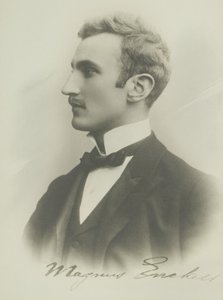
Magnus Enckell
1870 - 1925 , Finland
Krótka nota
- Full Name: Knut Magnus Enckell
- Nationality: Finnish
- Date Of Birth: 1870
- Date Of Death: 1925
- Place Of Birth: Hämeenlinna, Finland
- Notable Artworks:
- Fantasia
- Midsummer Day Service in Lohja Church
- Boy with Skull
- Artistic Movement Or Style: Symbolism