
- Strona główna

- Reprodukcja obrazu olejnego
- Józef Albers
- Homage to the Square Glow

 Zamów wydruk Kup cyfrowy obraz
 Udostępnij
 Udostępnij
 Details
 Dodaj do ulubionych

 Pobierz
 Podobne obiekty
 X-Ray
X-Ray
 Pokaz slajdów
Homage to the Square Glow
 Painting
- Other
- Abstract Art
 1966
1966- Modern
 122.0 x 122.0 cm
Ręcznie malowana reprodukcja olejowa
Ręcznie malowany olej na płótnie w Twoim wymiarze i ramie, tworzony na zamówienie przez naszych artystów.




































 Dowiedz się więcej
Wybierz spośród naszych predefiniowanych rozmiarów, które zachowują oryginalne proporcje dzieła sztuki.

Możesz wprowadzić własne wymiary, aby dopasować obraz do konkretnej ramy lub przestrzeni. Jeśli wybrany rozmiar nie będzie odpowiadał proporcjom oryginału, przytniecie dzieło sztuki lub rozszerzymy je o dodatkowe elementy, ręcznie domalowane przez artystę. Przed rozpoczęciem produkcji wyślemy projekt cyfrowy do Twojej akceptacji.
Należy pamiętać, że podgląd na ekranie nie odzwierciedla rzeczywistego przycinania ani rozszerzania obrazu. Tylko projekt dokładnie pokaże ostateczną kompozycję.
Choć oferujemy możliwość zamówienia niestandardowych rozmiarów, zalecamy wybór wymiaru z gotowej listy, aby zachować oryginalne proporcje dzieła.
Po złożeniu zamówienia zespół ArtsDot.com skontaktuje się z klientem drogą mailową w celu uzyskania instrukcji i prześle wizualizację projektu
Dostawa na całym świecie () w ciągu 3/4 tygodni zamiast standardowych 5 tygodni. (1 Lipiec). Bez kompromisów w kwestii jakości.

Bezpłatna ekspresowa wysyłka na cały świat

Wysokiej jakości płótno lniane

Pełne ubezpieczenie przesyłki

Gwarancja zwrotu należności celnych

Gwarancja pełnego zgodności kolorystycznej

Polityka 60-dniowego zwrotu (tylko w przypadku wad)

Gwarancja 100% zwrotu pieniędzy

Zniżka przy większych zamówieniach
 Opcja szkła jest dostępna wyłącznie w rozmiarach poniżej 110 cm

Homage to the Square Glow
Technika reprodukcji
Wymiary reprodukcji
-


Cena całkowita
-
Opis dzieła
The Geometry of Perception: Exploring Josef Albers' Homage to the Square Glow
To stand before Homage to the Square Glow is not merely to observe paint on canvas; it is to enter a meticulously constructed optical experience. This striking abstract composition, executed by the master color theorist Josef Albers in 1966, invites the viewer into a profound meditation on how color interacts with its neighbor. The piece commands attention with its vibrant field of red, serving as a rich, enveloping backdrop against which nine distinct yellow squares are strategically placed. These squares, varying dramatically in size—from the substantial anchor at the bottom left to the delicate whisper near the top right—do not exist in isolation. Instead, they engage in a silent, dynamic conversation across the square format, creating an undeniable visual rhythm that speaks volumes about perception itself.
A Masterclass in Color Theory and Materiality
Albers’s genius was never just in painting; it was in understanding the very physics of color. His background, steeped in the tangible realities of craftsmanship—the materials of his father's contracting business—infused his abstract work with an almost architectural solidity. Here, the technique is deceptively simple: flat planes of saturated pigment. Yet, the effect achieved is anything but flat. The juxtaposition of red and yellow forces the eye to constantly recalibrate its understanding of hue. It is a testament to Albers’s lifelong study that he could manipulate such basic elements—color and shape—to evoke such complex emotional resonance. For those drawn to modern design or collecting art that speaks to intellectual depth, this piece offers an unparalleled lesson in visual harmony.
Historical Context: Bauhaus Echoes into Abstraction
Emerging from the fertile ground of mid-century Modernism, Homage to the Square Glow carries the torch of early 20th-century design principles while speaking with a distinctly mature voice. While rooted in the rigorous explorations of form championed by movements like the Bauhaus, Albers always maintained a deeply personal, almost spiritual connection to his subject matter. The work represents a pinnacle moment where pure abstraction achieved profound emotional accessibility. It is art that rewards contemplation, suggesting that even the most rigid geometric structure can house boundless feeling.
Emotional Resonance and Interior Application
For the collector or designer seeking a focal point imbued with thoughtful history, this reproduction offers immediate impact. The intense warmth emanating from the red field, punctuated by the bright, energetic pops of yellow, injects vitality into any space. It is a piece that feels both scholarly in its execution and wildly optimistic in its spirit. Whether placed above a console table or serving as a singular statement piece in a gallery setting, Homage to the Square Glow does more than decorate; it activates the room, encouraging viewers to pause, look closer, and reconsider the simple relationship between two colors.
Podobne dzieła sztuki


Biografia artysty
A Life Forged in Material: The Early Years and Bauhaus Formation
Josef Albers’s artistic journey began not amidst the rarefied air of established academies, but within the pragmatic world of his father’s contracting business in Bottrop, Germany. Born in 1888, young Josef absorbed a deep respect for materials – carpentry, plumbing, house-painting – skills that would fundamentally shape his aesthetic sensibility. This wasn't merely vocational training; it was an immersion into the very essence of making, understanding how forms materialized and the inherent qualities within each medium. He spent his childhood observing his father’s meticulous craft, learning to appreciate the subtle nuances of wood grain, the precise application of paint, and the satisfying solidity of construction. Before dedicating himself fully to art, Albers spent five years as a schoolteacher, honing patience and pedagogical skill—attributes that would later define his influential teaching career. Formal artistic training commenced at the Königliche Kunstschule in Berlin between 1913 and 1915, where he explored printmaking, painting, and, crucially, stained glass. His early commission, “Rosa Mystica Ora Pro Nobis” (1918), a stunning stained-glass window for a local church, foreshadowed his lifelong fascination with the interplay of light and color, hinting at the abstract explorations to come. This initial work wasn’t simply decorative; it was an investigation into how light *transformed* material, a theme that would resonate throughout his career. The experience instilled in him a profound understanding of materials – their textures, weights, and how they responded to light – which would become central to his later artistic practice.The Bauhaus Crucible: Color as Subject
A pivotal moment arrived in 1922 when Albers joined the faculty of the Bauhaus, a revolutionary school seeking to unify all artistic disciplines under Walter Gropius’s visionary leadership. Initially tasked with teaching the preliminary course – *Werklehre* (workshop practice) – he immersed himself in its core principles: functionalism, geometric abstraction, and material exploration. This period proved transformative. Albers began a systematic investigation into color perception, moving away from representational art towards an increasingly abstract vocabulary. He wasn’t interested merely in *what* colors were, but *how* they interacted, how they influenced each other, and how our eyes perceived them. The influence of fellow Bauhaus masters like Paul Klee and Wassily Kandinsky is discernible in his early work, yet Albers charted a unique course, prioritizing empirical observation over metaphysical interpretation. He wasn’t seeking spiritual truths through color; he was meticulously documenting its physical effects – a scientific rigor that became the hallmark of his artistic method. This focus on perception, on how we *see*, rather than what is *seen*, set him apart and laid the groundwork for his future explorations. The Bauhaus environment fostered experimentation with unconventional materials—wire netting, matchboxes, glass shards—pushing Albers to consider the inherent qualities of each medium and their potential for artistic expression.Homage to the Square: A Laboratory of Perception
Following a period teaching at Black Mountain College – where he fostered a generation of American artists including Robert Rauschenberg and Cy Twombly – Albers embarked on what would become his most iconic series in 1949: “Homage to the Square.” This ongoing project consisted of paintings featuring nested squares within squares, each iteration exploring subtle variations in color relationships. It’s a deceptively simple premise, but one that belies an incredibly complex and rigorous investigation. Albers meticulously documented his experiments, revealing how colors aren't static entities but dynamic forces governing each other through internal logic – often misleading to the eye. A seemingly brighter square might appear to recede while a darker one advances, defying intuitive understanding. The series wasn’t intended as a celebration of geometry; rather, it was a laboratory for studying color perception. Albers’s goal was not to create beautiful pictures but to reveal the underlying mechanisms of visual experience. This research culminated in his seminal book, “Interaction of Color” (1963), a foundational text still studied by artists and designers today. The book isn't a treatise on color theory; it's a series of exercises designed to demonstrate how our perception of color is relative and contextual – a testament to Albers’ belief that seeing is not passive, but an active process of interpretation.Legacy and Enduring Influence
Josef Albers’s impact extends far beyond his paintings. His tenure as head of the design department at Yale University, from 1950 until his retirement in 1958, cemented his reputation as a profoundly influential teacher. He emphasized hands-on experimentation, critical observation, and relentless questioning of assumptions. Students weren't simply taught *what* to paint; they were taught *how* to see – to analyze, to deconstruct, and to understand the underlying principles governing visual experience. Albers’s approach fostered independent thinking and encouraged students to develop their own unique artistic voices. Interaction of Color continues to be a cornerstone of art education, shaping how generations understand color relationships. Albers is now recognized as a key figure in the development of abstract art, particularly geometric abstraction and minimalist aesthetics. His “Homage to the Square” series remains iconic for its exploration of perceptual phenomena, demonstrating that even within seemingly simple forms, there exists an infinite complexity waiting to be discovered. He died on March 25, 1976, in New Haven, Connecticut, leaving behind a legacy that continues to inspire and challenge artists, designers, and educators alike – a testament to the power of observation, experimentation, and the enduring mystery of color.Notable Works
- Gray Instrumentation I Prospectus (1975): A minimalist monochrome painting exemplifying geometric balance and subtle tonal variations.
- Study for Homage to the Square – Beaming (Date Unknown): A classic example of Albers’s exploration of color interaction within nested squares, evoking a sense of calm and spatial depth.
- Rosa Mystica Ora Pro Nobis (1918): His early stained-glass commission, foreshadowing his lifelong fascination with light and color.

Józef Albers
1888 - 1976 , Niemcy
Kluczowe informacje
- Artistic Movement Or Style: Abstrakcja geometryczna
- Artists Or Movements Influenced By This Artist:
- Minimalizm
- Pola Koloru
- Artists Who Influenced This Artist:
- Paul Klee
- Wassily Kandinsky
- Date Of Birth: 19 marca 1888
- Date Of Death: 25 marca 1976
- Full Name: Josef Albers
- Nationality: Niemiecko-Amerykanin
- Notable Artworks:
- Homage do Kwadratu
- Interakcja Kolorów
- Place Of Birth: Bottrop, Niemcy
Powiązane artykuły

25 Arcydzieł Kandinskiego: Kolor, Duchowość i Abstrakcja w Twoim Domu | ArtsDot.com
Odkryj 25 arcydzieł Wassily Kandinskiego – pioniera abstrakcji i ekspresjonizmu! Poznaj historie, techniki i emocje kryjące się za jego kolorowymi kompozycjami. Reprodukcje obrazów najwyższej jakości na ArtsDot.com. Eksploruj pełną kolekcję online!


Geometria Sztuki: 10 Arcydzieł Abstrakcji Geometrycznej | ArtsDot.com
Odkryj 10 arcydzieł abstrakcji geometrycznej! Poznaj historię Mondriana, Kandinskiego i Maleвича. Inspiracje wnętrzarskie z malarstwem abstrakcyjnym – reprodukcje najwyższej jakości na ArtsDot.com. Eksploruj kolekcję online!
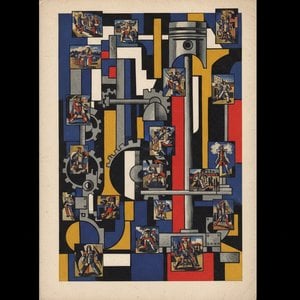
Fernand Léger: 25 Arcydzieł Kubizmu i Maszynerii - Kolekcja ArtsDot
Odkryj 25 arcydzieł Fernanda Légera – pioniera kubizmu i malarstwa maszyn. Poznaj historię, technikę i inspiracje tych ikonicznych obrazów. Reprodukcje najwyższej jakości na ArtsDot.com! Eksploruj pełną kolekcję online.

Kazimir Malevich: 25 Arcydzieł Suprematyzmu dla Miłośników Sztuki i Wystroju Domu
Odkryj 25 arcydzieł Kazimira Malevicha – pioniera suprematyzmu i abstrakcji. Poznaj historie, techniki i inspiracje za 'Czarnym Kwadratem' i innymi kultowymi dziełami. Reprodukcje najwyższej jakości na ArtsDot.com.

Poza Formą i Kolorem: Trwała Spuścizna Abstrakcji Geometrycznej w Historii Sztuki
Poznaj fascynującą historię abstrakcji geometrycznej – od rosyjskiej awangardy po wpływ na współczesną sztukę i design. Ekskluzywne analizy, kluczowi artyści i perspektywy inwestycyjne dla kolekcjonerów.

