

 Podgląd w skali 1:1
 Wyślij jako kartkę
 Udostępnij
 Szczegóły dzieła
 Przewodnik

 Pobierz obraz
 Podobne obiekty
 RTG
RTG Pokaz slajdów
 Pytania i odpowiedzi
 Statystyki
Summer (study)


 Rozwiń treść
Giclée / Wydruk artystyczny
Wydruki giclée lub płótna o jakości muzealnej, szybka realizacja i szeroki wybór opcji wykończenia. ( Zamów ręcznie malowaną reprodukcję Przejdź do wersji cyfrowej)




P118B zł10

P118H zł10

P118W zł10

P438Z zł10

P508JH zł12

P508YH zł12

P805H zł10

P805Z zł10

P919BZ zł10

P919G zł10

P919XJ zł10

P959ZH zł10

P968JZ zł12

W106C zł8

W218G zł10

W218JH zł8

W218Y zł10

W307PJ zł10

W316G zł10

W316PJ zł8

W316Y zł10

W398PJ zł8

W4111J zł10

W500HY zł15

W500JH zł15

W692G zł12

W849H zł8

W940BG zł15

W953PJ zł8




Wybierz spośród naszych standardowych rozmiarów, które zachowują oryginalne proporcje dzieła sztuki.

Wpisz wymaganą szerokość i wysokość, aby dopasować grafikę do ramy lub ściany. Wydruk można jedynie przyciąć, nigdy nie powiększając go poza oryginalny obraz, dlatego format o innych proporcjach spowoduje utratę części kompozycji. Przed rozpoczęciem druku prześlemy Ci cyfrowy podgląd do zatwierdzenia. Obraz wyświetlany na tej stronie nie pokazuje rzeczywistego przycięcia — jedynie podgląd oddaje ten efekt.
Dostawa na cały świat () w ciągu 2 tygodni zamiast standardowych 4/5 tygodni. (6 Listopad)

Bezpłatna ekspresowa wysyłka na cały świat

Wysokiej jakości płótno lniane

Pełne ubezpieczenie przesyłki

Gwarancja zwrotu należności celnych i podatków importowych

Gwarancja wiernego odwzorowania kolorów

100-dniowa polityka zwrotów (tylko w przypadku wad)

Gwarancja 100% zwrotu pieniędzy

Zniżka przy zakupie wielu sztuk
 Opcja ze szkłem jest dostępna wyłącznie w rozmiarach poniżej 110 cm

Summer (study)
Giclée / Wydruk artystyczny
Wymiary reprodukcji
-


Cena całkowita
zł 246
A Moment of Golden Joy: Exploring Sorolla’s “Summer (Study)”
Joaquín Sorolla y Bastida's "Summer (Study)," painted in 1904, is more than just a depiction of children playing on the beach; it’s an embodiment of the Spanish *luminismo*, a style defined by its masterful manipulation of light and color to evoke feelings of joy, warmth, and fleeting beauty. This evocative work captures a quintessential summer scene – innocent laughter, sun-drenched sand, and the boundless energy of childhood – rendered with a remarkable sensitivity to atmosphere and human emotion. The painting’s immediate impact stems from Sorolla's signature technique: broad, confident brushstrokes applied in rapid succession, creating an impressionistic effect that blurs the edges of form and emphasizes the shimmering quality of light reflecting off water and sand.
The Valencia-Born Master and His Light
Sorolla’s artistic journey was profoundly shaped by his Valencian origins. Born in 1863, he inherited a deep connection to the region's rich artistic heritage, particularly the influence of the *bodegones* (still life) tradition. However, it was his time spent in Rome – supported by a prestigious grant – that truly unlocked his potential. Immersed in the classical world, Sorolla absorbed the techniques of artists like Raphael and Titian, but he never abandoned his own distinctive style. His work is characterized by an almost obsessive attention to light, particularly the way it transforms surfaces and creates a sense of movement. The cholera epidemic that claimed his parents’ lives early in life undoubtedly fueled this preoccupation with transience and the preciousness of moments – themes subtly woven into the fabric of "Summer (Study)." His later works would increasingly focus on capturing these fleeting effects of light, solidifying his reputation as a master of *luminismo*.
A Symphony of Color and Composition
The composition of “Summer (Study)” is deceptively simple yet remarkably effective. Sorolla expertly utilizes the horizontal format to emphasize the expansive beach scene, drawing the viewer’s eye across the canvas. The three children – two girls engaged in playful activity and a young boy observing – are arranged with natural grace, creating a sense of spontaneity and realism. The use of warm colors – ochres, yellows, and blues – intensifies the feeling of summer heat and creates a vibrant, almost luminous effect. Notice how Sorolla employs broken color to suggest movement within the water and sand, further enhancing the painting’s dynamism. The inclusion of the dog adds an element of domesticity and reinforces the idyllic nature of the scene.
Symbolism and Emotional Resonance
Beyond its technical brilliance, “Summer (Study)” resonates with a profound sense of nostalgia and innocence. It speaks to the universal desire for carefree days spent in nature, evoking memories of childhood joy and connection. The painting’s emotional impact is heightened by Sorolla's ability to capture not just the visual appearance of the scene but also the underlying feeling of warmth, happiness, and tranquility. It’s a testament to his skill as an artist that he can transport us back to a simpler time, reminding us of the beauty and wonder that exists in everyday moments. This reproduction allows you to bring this timeless image into your own space, capturing a piece of Sorolla's radiant vision.
Pytania i odpowiedzi
Co przedstawia „Summer (study)” – Joaquín Sorolla i jaki ma nastrój?
„Summer (study)” – Joaquín Sorolla łączy w sobie beach scene, childhood play, joaquin sorolla, spanish light, coastal landscape, summer day, ocean waves z Nostalgic atmosferą.
Kto stworzył "Summer (study)"?
„Summer (study)” zostało stworzone przez Joaquín Sorolla. Informacje na tej stronie dotyczą oryginalnego dzieła autorstwa Joaquín Sorolla.
Jaki układ ma „Summer (study)” – Joaquín Sorolla?
Dzieło „Summer (study)” – Joaquín Sorolla ma format Landscape. Format ten określa proporcje kompozycji.
Podobne dzieła


Biografia artysty
A Life Bathed in Light: The World of Joaquín Sorolla
Joaquín Sorolla y Bastida, a name synonymous with the radiant light and vibrant energy of Spain, was more than just a painter; he was a chronicler of his nation’s soul. Born in Valencia in 1863, Sorolla's early life was marked by tragedy. Orphaned at the tender age of two following a cholera epidemic that claimed both parents, young Joaquín and his sister were raised by their maternal aunt and uncle. This early experience with loss perhaps instilled within him a profound appreciation for the fleeting beauty of life – a sentiment that would permeate his art. Though hardship shadowed his beginnings, it did not dim the spark of artistic talent that quickly became apparent. He received initial instruction in Valencia, demonstrating an aptitude that led to studies under established artists like Cayetano Capuz and José Benlliure, eventually culminating in a four-year grant to study in Rome. It was there, amidst the classical grandeur of Italy, that Sorolla began to forge his unique artistic path, absorbing influences while simultaneously developing a style distinctly his own.From Historical Narratives to Sun-Drenched Realism
Sorolla’s early work reflected the prevailing academic trends of the time – large-scale historical and mythological scenes. He was initially drawn to grand narratives, producing works like *The Return from Fishing* (1893), a monumental depiction of fishermen hauling their boat ashore. However, a pivotal shift occurred as he returned to Spain and began to truly observe the world around him. He found himself captivated by the everyday lives of his countrymen, particularly those along the Valencian coast. The intense Mediterranean sunlight, the shimmering sea, and the vibrant energy of the people became his primary subjects. This transition wasn’t immediate; Sorolla continued to explore social realism with works like Sad Inheritance (1899), a powerful depiction of children afflicted by polio bathing in the sea – a painting that garnered significant acclaim but also revealed a darker, more compassionate side to his artistic vision. *Sad Inheritance*, exhibited at the Universal Exhibition in Paris, brought him widespread recognition and cemented his position as a leading figure in Spanish art. Yet, it was his increasingly focused exploration of light and color, inspired by Impressionism though never fully embracing its tenets, that would define his legacy. He wasn’t merely *depicting* light; he was attempting to *capture* its very essence, the way it danced on water, illuminated skin, and transformed ordinary moments into scenes of extraordinary beauty.Master of Luminism: A Unique Artistic Voice
Sorolla's technique became instantly recognizable – a bravura display of brushwork, characterized by loose, energetic strokes that conveyed movement and atmosphere. He worked *en plein air* whenever possible, directly confronting the challenges of capturing fleeting light conditions. This dedication to painting outdoors resulted in canvases brimming with life and immediacy. His beach scenes, perhaps his most iconic works, are not simply picturesque representations of leisure; they are studies in luminosity, reflections, and the joyful interaction between people and their environment. Paintings like *Children on the Seashore* and *Sewing the Sail* exemplify this mastery – figures bathed in golden light, rendered with a remarkable sense of spontaneity and vitality. He wasn’t interested in meticulous detail; rather, he sought to convey the *impression* of reality, prioritizing atmosphere and emotion over precise representation. This approach earned him comparisons to Impressionists like Monet and Renoir, but Sorolla's work possessed a unique Spanish character – a warmth, intensity, and emotional depth that set it apart.Key Achievements & Recognition
- 1892: Gold medal at the National Exhibition in Madrid for *Another Marguerite*.
- 1894: Acclaimed for *The Return from Fishing: Hauling the Boat*, acquired by the Musée du Luxembourg.
- 1899: Grand Prix and medal of honor at the Universal Exhibition in Paris for *Sad Inheritance*.
- 1900-1923: Extensive exhibitions throughout Europe and the United States, establishing international recognition.
- 1912-1928: Commissioned to create *Vision of Spain* for the Hispanic Society of America (completed posthumously).
- Present Day: Works held in major museums worldwide, including the Museo Sorolla in Madrid.
Legacy and Enduring Influence
By the early 20th century, Joaquín Sorolla was internationally renowned. He exhibited widely throughout Europe and the United States, receiving numerous accolades and commissions. His most ambitious undertaking, *Vision of Spain*, a series of fourteen monumental murals commissioned by the Hispanic Society of America, remains a testament to his artistic vision and technical skill. Though he suffered a stroke in 1920 that curtailed his painting activity, Sorolla’s influence continued to grow after his death in 1923. His work inspired generations of artists, not only in Spain but around the world. Today, his paintings are held in major museums globally, including the Museo Sorolla in Madrid – a former home transformed into a dedicated space for showcasing his art. Sorolla’s legacy extends beyond his technical brilliance; he captured a specific moment in Spanish history and culture, immortalizing the beauty of its landscapes and the spirit of its people. He remains a master of light, color, and emotion—a painter whose work continues to resonate with audiences today, reminding us of the power of art to illuminate our world.
Joaquín Sorolla
1863 - 1923 , Hiszpania
Krótka nota
- Artistic Movement Or Style: Luminizm, Impresjonizm
- Artists Who Influenced This Artist:
- Pradilla
- Bastien-Lepage
- Menzel
- Date Of Birth: 27 lutego 1863
- Date Of Death: 10 sierpnia 1923
- Full Name: Joaquín Sorolla y Bastida
- Nationality: Hiszpański
- Notable Artworks:
- Inna Margarita
- Powrót z połowu
- Złota rybka
- Typowy Sorosianin
- Place Of Birth: Walencja, Hiszpania
Powiązane artykuły
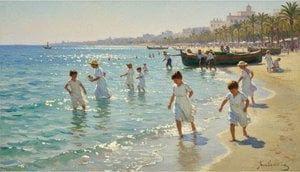
Joaquín Sorolla: Capturing Spanish Light & Life – A Legacy of Impressionism
Explore the luminous world of Joaquín Sorolla, Spanish master of Impressionism. Discover his life, techniques & legacy – a guide for art collectors and enthusiasts. Invest in timeless beauty.

Echoes of Time: Exploring the Enduring Appeal & Historical Context of Vintage Art Prints
Explore the captivating world of vintage art prints! Discover their history, collecting tips & enduring appeal. Expert insights on chromolithography and building a legacy collection with ArtsDot.

The Enduring Legacy of Fine Art Prints: Technique, History & Aesthetic Impact
Explore the rich history & techniques of fine art prints. Discover investment potential, assess authenticity, and learn how to preserve your collection with expert guidance. Trusted insights for discerning collectors.

Odbitki Giclée: Jakość Archiwalna i Estetyczne Niuanse dla Wymagającego Kolekcjonera
Poznaj sekrety druku giclée – technologii zapewniającej najwyższą jakość reprodukcji sztuki i trwałość archiwalaną. Poradnik dla wymagających kolekcjonerów o wyborze papieru, tuszy i profilach kolorystycznych.
10 Arcydzieł Impresjonizmu Krajobrazowego: Sztuka, Artyści i Dekoracje Wnetrz
Odkryj 10 arcydzieł impresjonizmu krajobrazowego! Poznaj historie Monet, Renoir i innych mistrzów. Inspiracje wnętrzarskie, techniki malarskie i reprodukcje obrazów najwyższej jakości na ArtsDot.com. Eksploruj pełną kolekcję online!


