


 Zobacz w skali 1:1
 Wyślij
 Udostępnij
 Szczegóły
 Przewodnik

 Pobierz plik obrazu
 Podobne obiekty
 RTG
RTG Pokaz slajdów
 Statystyki
Progression


 Czytaj więcej
Ręcznie malowana reprodukcja olejowa
Ręcznie malowany obraz olejny na płótnie, wykonany na zamówienie przez naszych artystów w wybranym przez Ciebie wymiarze i oprawie. ( Przełącz na wersję drukowaną Przełącz na wersję cyfrową)




































Wybierz spośród naszych standardowych rozmiarów, które zachowują oryginalne proporcje dzieła sztuki.

Możesz wprowadzić własne wymiary, aby dopasować obraz do konkretnej ramy lub przestrzeni. Jeśli wybrany rozmiar nie będzie odpowiadał proporcjom oryginału, przytniecie dzieło sztuki lub rozszerzymy je o dodatkowe elementy, ręcznie domalowane przez artystę. Przed rozpoczęciem produkcji wyślemy projekt cyfrowy do Twojej akceptacji.
Należy pamiętać, że podgląd na ekranie nie odzwierciedla rzeczywistego przycinania ani rozszerzania obrazu. Tylko projekt dokładnie pokaże ostateczną kompozycję.
Choć oferujemy możliwość zamówienia niestandardowych rozmiarów, zalecamy wybór wymiaru z gotowej listy, aby zachować oryginalne proporcje dzieła.
Po złożeniu zamówienia zespół ArtsDot.com skontaktuje się z klientem drogą mailową w celu uzyskania instrukcji i prześle wizualizację projektu
Dostawa na całym świecie () w ciągu 3–4 tygodni zamiast standardowych 5 tygodni. (25 Wrzesień). Bez kompromisów w kwestii jakości.

Bezpłatna ekspresowa wysyłka na cały świat

Wysokiej jakości płótno lniane

Pełne ubezpieczenie transportowe

Gwarancja zwrotu należności celnych i podatków importowych

Gwarancja idealnego odwzorowania barw

100-dniowy okres na zwrot dzieła w przypadku wykrycia wad produkcyjnych

Gwarancja 100% zwrotu pieniędzy

Oferta przy zakupie wielu sztuk
 Opcja ze szkłem jest dostępna wyłącznie w rozmiarach poniżej 110 cm

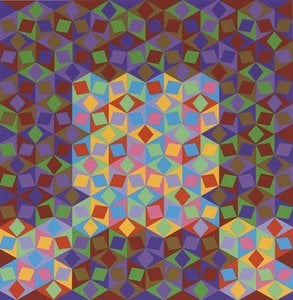
Progression
Technika wykonania
Rozmiar reprodukcji
-


Suma do zapłaty
$ 263
Podobne dzieła



Biografia artysty
The Architect of Illusion: The Life and Vision of Horacio García Rossi
Horacio García Rossi (1929–2012) was far more than a painter; he was an architect of perception, a master who constructed visual worlds that breathed, vibrated, and shifted beneath the viewer's gaze. Born in Buenos Aires, Argentina, his early years were defined by a profound intellectual curiosity that sought to bridge the gap between the aesthetic and the scientific. After honing his technical skills at the Escuela de Publicidad de Buenos Aires and refining his artistic foundation at the Escuela Nacional de Bellas Artes Prilidiano Pueyrredón, García Rossi embarked on a journey that would eventually lead him to the heart of the European avant-garde. His move to Paris in 1959 marked a transformative era, as he immersed himself in a landscape of radical experimentation, seeking to dismantle the boundaries between the canvas and the eye.
The true metamorphosis of his style occurred through his involvement with the Groupe de Recherche d’Art Visuel (GRAV). Alongside fellow visionaries, García Rossi became a founding member of this influential collective, which sought to democratize art by moving away from static representation toward an interactive experience. Within this crucible of innovation, he explored the mechanics of sight, treating the canvas not as a window into another world, but as a laboratory for optical phenomena. His work during this period became deeply intertwined with the principles of mathematics, physics, and cybernetics, reflecting a fascination with how light, geometry, and movement could trigger physiological responses in the human nervous system.
A Symphony of Geometry and Motion
To encounter a García Rossi masterpiece is to enter a state of perceptual flux. His technique relied on the meticulous arrangement of geometric primitives—circles, squares, and triangles—to create patterns that seem to defy the very laws of physics. Through the strategic use of contrast and rhythmic repetition, he achieved an extraordinary feat: the creation of optical illusions that appear to pulsate or rotate. These works are never truly still; they demand an active engagement from the spectator, whose own eye movements complete the artwork. The artist utilized the language of Op Art and Kinetic Art to challenge the viewer's assumptions about reality, turning the act of looking into a dynamic, participatory event.
The brilliance of his execution lies in the subtle tension between order and chaos. While his compositions are strictly structured by geometric precision, the resulting visual effect is one of organic vibration. His canvases often feature:
- Interlocking patterns that create a sense of depth and infinite recession.
- High-contrast color shifts designed to stimulate retinal fatigue and induce movement.
- Mathematical rhythms that mimic the natural fluctuations of light and shadow.
Legacy and Historical Significance
The historical significance of Horacio García Rossi is cemented by his role in the global expansion of the Kinetic Art movement. His inclusion in landmark exhibitions, such as documenta 3 in Kassel and the legendary "The Responsive Eye" at the Museum of Modern Art (MoMA) in New York, placed him at the forefront of a movement that redefined the relationship between art and science. He was a pivotal figure who helped transition art from the era of contemplative observation to an era of sensory interaction.
Even as the art world moved through various stylistic shifts, García Rossi’s commitment to the exploration of perception remained steadfast. His legacy lives on in the way we understand the intersection of technology and aesthetics, reminding us that art can be a powerful tool for investigating the very mechanics of human consciousness. He remains an enduring icon of Argentine-French modernism, a creator who successfully captured the ephemeral dance of light and geometry within the permanent confines of the frame.

horacio garcia-rossi
1929 - 2012 , Argentina
Najważniejsze informacje
- Artistic Movement Or Style: Op Art & Kinetic Art
- Artists Or Movements Influenced By This Artist: ['Hector García Miranda']
- Artists Who Influenced This Artist: ['Eduardo José Nery de Oliveira Goih']
- Date Of Birth: July 24, 1929
- Date Of Death: September 5, 2012
- Full Name: Horacio Garcia Rossi
- Nationality: Argentine-French
- Notable Artworks: ['Progression']
- Place Of Birth: Buenos Aires, Argentina