

 Zamów reprodukcję Kup cyfrowy obraz
 Udostępnij
 Udostępnij
 Details
 Dodaj do ulubionych

 Pobierz
 Podobne obiekty
 X-Ray
X-Ray
 Pokaz slajdów
Side-Saddle


Giclée / Wydruk artystyczny
Druk giclée lub płótno o jakości muzealnej z szybką realizacją i szerokim wyborem opcji wykończenia.
 Dowiedz się więcej



































Wybierz spośród naszych predefiniowanych rozmiarów, które zachowują oryginalne proporcje dzieła sztuki.

Możesz wprowadzić własne wymiary, aby dopasować dzieło do konkretnej ramy lub przestrzeni. Jeśli wybrany rozmiar nie będzie odpowiadał proporcjom oryginalnego obrazu, przytniecie dzieło lub rozszerzymy obraz za pomocą odbicia lustrzanego lub jednolitego wypełnienia krawędzi. Przed rozpoczęciem produkcji prześlemy cyfrową wizualizację do Twojej akceptacji.
Prosimy pamiętać, że podgląd na ekranie nie odzwierciedla faktycznego przycinania ani rozszerzania. Tylko wizualizacja dokładnie pokaże końcową kompozycję.
Mimo dostępności niestandardowych rozmiarów, zalecamy wybór wymiaru z listy zdefiniowanej, aby zachować oryginalne proporcje.
Dostawa na cały świat () w ciągu 2 tygodni zamiast standardowych 4/5 tygodni. (1 Lipiec)

Bezpłatna ekspresowa wysyłka na cały świat

Wysokiej jakości płótno lniane

Pełne ubezpieczenie przesyłki

Gwarancja zwrotu należności celnych

Gwarancja pełnego zgodności kolorystycznej

Polityka 60-dniowego zwrotu (tylko w przypadku wad)

Gwarancja 100% zwrotu pieniędzy

Zniżka przy większych zamówieniach
 Opcja szkła jest dostępna wyłącznie w rozmiarach poniżej 110 cm

Side-Saddle
Giclée / Wydruk artystyczny
Wymiary reprodukcji
-


Cena całkowita
-
Opis obiektu kolekcjonerskiego
A Glimpse into Parisian Nights: Exploring Toulouse-Lautrec’s “Side-Saddle”
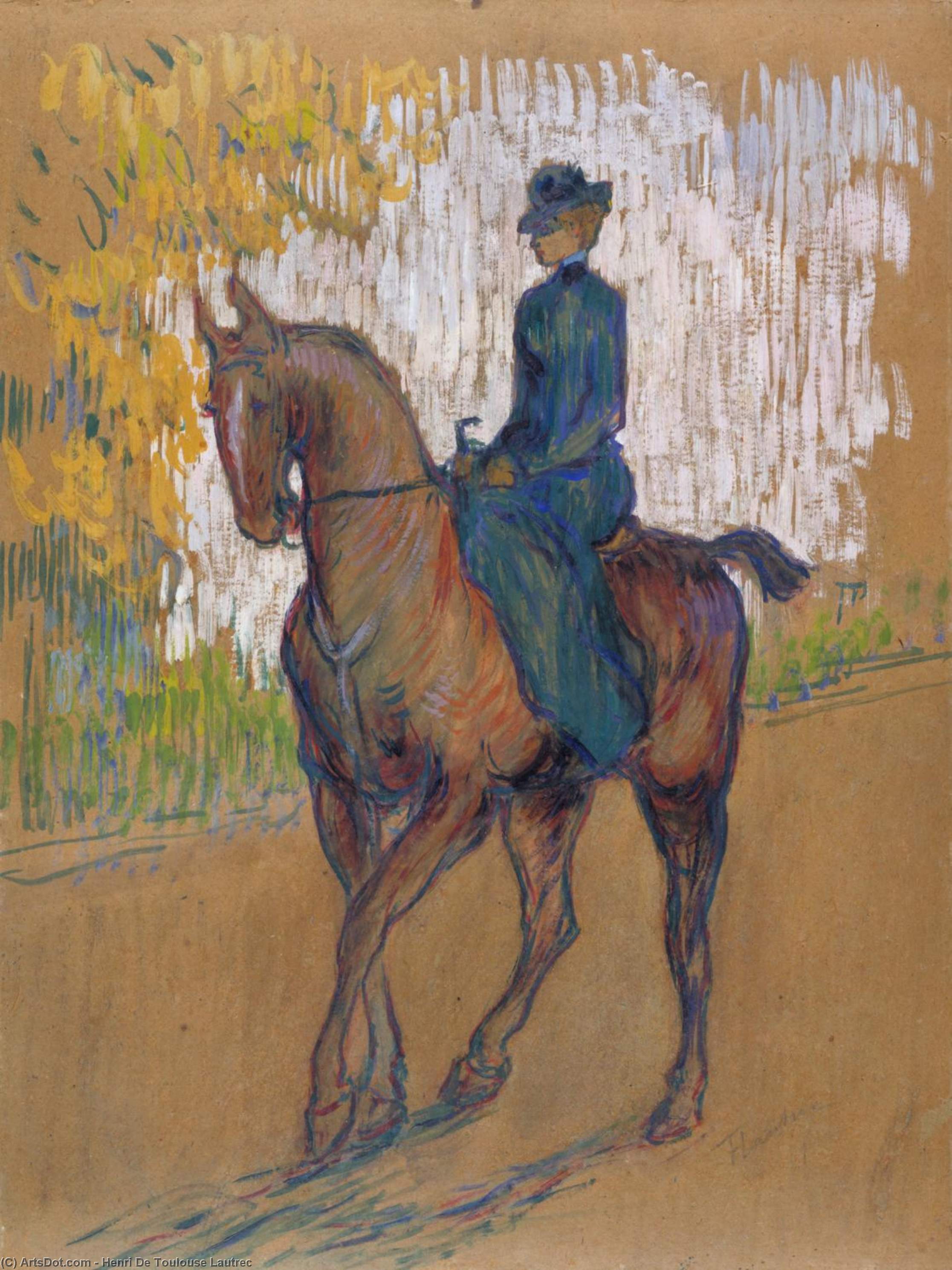
Henri de Toulouse-Lautrec's "Side-Saddle," painted in 1899, isn’t merely a depiction of a woman on horseback; it’s a vibrant portal into the heart of late 19th-century Paris – a city teeming with artistic fervor, bohemian decadence, and a captivating blend of elegance and melancholy. This oil on panel work, housed within the Tate Gallery in London, exemplifies Lautrec's signature Post-Impressionist style, moving beyond simple representation to capture the very *essence* of his subjects and the atmosphere surrounding them. The painting immediately draws the eye with its bold color palette – a rich tapestry of warm yellows, deep blues, and earthy browns that evoke both the warmth of a Parisian evening and the shadows lurking beneath the surface of urban life.
Lautrec’s genius lay in his ability to distill complex emotions and social dynamics into deceptively simple compositions. “Side-Saddle” is no exception. The woman, dressed in a striking blue gown that seems to shimmer with an inner light, embodies both grace and a subtle sense of detachment. Her posture, relaxed yet poised, suggests a confidence born from familiarity with the world around her – a world Lautrec himself keenly observed and often depicted. The horse, rendered with a remarkable attention to detail despite its secondary role, adds to the scene’s dynamism, hinting at movement and perhaps even a touch of danger.
Post-Impressionism: A Rebellion of Feeling
To fully appreciate “Side-Saddle,” it's crucial to understand the artistic context in which it was created. Lautrec emerged during the Post-Impressionist movement, a reaction against the limitations of Impressionism’s focus on capturing fleeting moments of light and color. While Impressionists sought to objectively record visual sensations, Post-Impressionists prioritized subjective expression – conveying their personal emotions, interpretations, and psychological insights. Artists like Cézanne, Van Gogh, Gauguin, and Seurat experimented with form, color, and brushstroke to create works that were more emotionally resonant than purely descriptive.
Lautrec’s use of flattened perspective, bold outlines, and intense colors aligns perfectly with this movement. He wasn't interested in creating a photographic likeness; instead, he aimed to capture the *feeling* of the scene – the energy of Montmartre, the allure of its nightlife, and the complex emotions of its inhabitants. The painting’s slightly distorted proportions and exaggerated details contribute to this sense of heightened emotion, inviting the viewer to step into Lautrec's subjective experience.
Symbolism and the Parisian Psyche
Beyond its aesthetic qualities, “Side-Saddle” is rich in symbolism. The horse itself can be interpreted as a symbol of power, freedom, and perhaps even danger – elements frequently associated with the Parisian underworld that Lautrec so often depicted. The woman’s attire, particularly her blue gown, suggests wealth and sophistication, but also hints at a certain vulnerability or loneliness. The two birds in the background, seemingly observing the scene, could represent fleeting moments of beauty or simply serve as reminders of the transient nature of life.
Furthermore, the painting reflects the broader social anxieties and shifting values of late 19th-century Paris. The rise of industrialization, urbanization, and a growing sense of alienation fueled a fascination with pleasure, decadence, and the darker side of urban life – themes that Lautrec masterfully explored in his art. “Side-Saddle” captures this spirit perfectly, offering a glimpse into a world where beauty and danger intertwined.
A Timeless Masterpiece: Reproduction and Legacy
“Side-Saddle” remains one of Toulouse-Lautrec’s most iconic works, celebrated for its vibrant colors, dynamic composition, and evocative portrayal of Parisian life. Today, reproductions of this captivating painting are highly sought after by art collectors, interior designers, and anyone seeking to infuse their spaces with a touch of bohemian elegance. A high-quality reproduction allows you to bring the energy and atmosphere of Lautrec’s Paris into your home, serving as a constant reminder of the artist's unique vision and enduring legacy.
Podobne dzieła sztuki


Biografia artysty
A Life Etched in Parisian Nights: The World of Henri de Toulouse-Lautrec
Henri Marie Raymond de Toulouse-Lautrec-Monfa, forever known simply as Toulouse-Lautrec, remains a captivating figure of the late 19th century. Born into the waning days of French aristocracy in Albi on November 24, 1864, his life was marked by both privilege and profound physical challenge. A rare genetic condition, suspected to be pycnodysostosis – though debated even today – halted the growth of his legs at a young age, leaving him with a disproportionately small lower body and an adult torso. This physical difference profoundly shaped his perspective, leading him not toward self-pity but towards an intensely observant and empathetic engagement with the marginalized figures of Parisian society. His aristocratic background afforded him access to artistic training, yet it was the vibrant, often scandalous world of Montmartre that truly ignited his creative spirit.From Academic Training to Bohemian Rhapsody
Toulouse-Lautrec’s formal artistic journey began in Paris under the tutelage of Léon Bonnat and later Fernand Cormon. While he mastered the technical skills expected of a Salon painter, it was his immersion in the bohemian heart of Montmartre that irrevocably altered his trajectory. He rejected the prevailing academic focus on historical or mythological subjects, instead turning his keen eye towards the everyday dramas unfolding around him: the dancers at the Moulin Rouge, the prostitutes of the rue des Moulins, the circus performers and café singers who populated the Parisian nightlife. This wasn’t mere observation; it was a deep dive into a world often ignored by polite society. He didn't simply paint *about* these people, he inhabited their spaces, understanding their vulnerabilities and celebrating their resilience. His early works show a clear academic foundation, but quickly evolve to embrace a more daring and unconventional style, influenced by Japanese woodblock prints – then gaining popularity in Europe – with their bold compositions and flattened perspectives. These prints provided him with a new way of seeing, emphasizing strong outlines and simplified forms, which he skillfully integrated into his own work.A Master of Line and Color: Defining a Style
Toulouse-Lautrec’s artistic innovations are readily apparent in his distinctive style. He was a master of line, using it not just to define form but to convey movement, emotion, and character. His drawings were particularly remarkable for their energy and dynamism, capturing the fleeting gestures and expressions of his subjects with astonishing immediacy. His color palette, while often muted – dominated by browns, grays, and blacks – possessed an extraordinary vibrancy when he chose to use it, capturing the artificial glow of gaslight and the smoky atmosphere of Parisian cabarets. He embraced lithography with particular enthusiasm, recognizing its potential for mass reproduction and artistic expression. This allowed his images to circulate widely, further cementing his reputation as a chronicler of modern life. His posters, advertising performers like Jane Avril and Yvette Guilbert, were not merely promotional materials; they were works of art in their own right, instantly recognizable for their dynamic compositions and striking imagery. La Blanchisseuse, sold at auction for $22.4 million in 2005, exemplifies his early talent, but it’s the later depictions of Montmartre that truly define his legacy. He wasn't interested in idealizing his subjects; he presented them with unflinching honesty, capturing their flaws and vulnerabilities alongside their beauty and spirit.The World of Montmartre: Subjects and Themes
Toulouse-Lautrec’s artistic focus centered almost exclusively on the vibrant, often disreputable world of Montmartre. He frequented cabarets, dance halls, brothels, and circus sideshows, documenting the lives of its inhabitants with a mixture of fascination and empathy. His subjects ranged from celebrated performers like Jane Avril and Yvette Guilbert to marginalized figures – prostitutes, beggars, and fortune tellers – who were often ignored by mainstream society. He wasn’t simply recording these individuals; he was attempting to understand their experiences and portray them with dignity and respect. His work offers a unique glimpse into the social dynamics of late 19th-century Paris, revealing both its glamour and its undercurrents of poverty and exploitation. The recurring motif of the dancer – particularly in his posters for the Moulin Rouge – reflects his fascination with movement, beauty, and the ephemeral nature of performance. His depictions of these figures were not romanticized; they captured their weariness, their vulnerability, and their desperate attempts to find solace or recognition in a world that often rejected them.Legacy and Lasting Influence
Toulouse-Lautrec’s life was tragically cut short at the age of 36 on September 9, 1901, a consequence of years battling alcoholism and syphilis. Despite his relatively brief career, his impact on the art world is immeasurable. He stands as a pivotal figure in the transition from Impressionism to modern art, paving the way for artists who would further explore subjective experience and psychological depth. He is considered one of the key Post-Impressionist painters alongside Cézanne, Van Gogh, Gauguin, and Seurat. His influence can be seen in everything from early 20th-century illustration to contemporary graphic design. He didn’t just paint what he saw; he revealed a hidden world, challenging conventional notions of beauty and morality. His work continues to resonate today, reminding us of the power of art to illuminate the human condition in all its complexity and contradiction.Exploring Toulouse-Lautrec’s World Further
- Discover a comprehensive collection of his artwork at /en/artists/comte-henri-marie-raymond-de-toulouse-lautrec-monfa.
- Delve into the world of Post-Impressionism and its key artists at /en/art-movements/post-impressionism.
- Learn more about his life and artistic journey through resources like Wikipedia: https://en.wikipedia.org/wiki/Henri_de_Toulouse-Lautrec

comte henri marie raymond de toulouse-lautrec-monfa
1864 - 1901 , Francja
Kluczowe informacje
- Artistic Movement Or Style: Postimpresjonizm
- Artists Or Movements Influenced By This Artist: ['Impressionizm']
- Artists Who Influenced This Artist: ['Léon Bonnat']
- Date Of Birth: 24 listopada 1864
- Date Of Death: 9 września 1901
- Full Name: Henri Marie Raymond de Toulouse-Lautrec-Monfa
- Nationality: Francuz
- Notable Artworks:
- La Blanchisseuse
- In the Wings at the Circus
- Woman in Bed — Waking
- Place Of Birth: Albi, Francja
Powiązane artykuły

Poza Światłem i Kolorem: Impresjonizm a Postimpresjonizm dla Wymagającego Kolekcjonera
Poznaj subtelne różnice między impresjonizmem a postimpresjonizmem. Ekspercka analiza dla wymagających kolekcjonerów sztuki. Inwestycje, historia i wartość dzieł.


10 Arcydzieł Postimpresjonizmu, Które Zdefiniowały Sztukę. Inspiracje do Dekoracji Domu.
Odkryj 10 arcydzieł postimpresjonizmu Van Gogha, Moneta i Cézanne'a! Poznaj historie artystów, techniki malarskie i inspiracje do dekoracji wnętrz. Reprodukcje obrazów najwyższej jakości na ArtsDot.com – sztuka dla Twojego domu.

Poza Impresjonizmem: Eksploracja Głębii Emocjonalnej Malarstwa Postimpresjonistycznego
Odkryj fascynujący świat postimpresjonizmu! Analiza dzieł Van Gogha, Cézanne'a i Gauguina. Poznaj techniki malarskie, symbolikę oraz wpływ tego ruchu na sztukę współczesną. Ekspercka wiedza i inspiracje dla miłośników sztuki.

Beyond Impressionism: Exploring Emotional Depth & Formal Innovation in Post-Impressionist Art
Explore the profound emotional depth & formal innovations of Post-Impressionism with our expert guide. Discover Cézanne, Van Gogh, Gauguin & more. Learn about art history, collecting, and investing in this pivotal movement.

25 Arcydzieł Musée d'Orsay: Monet, Van Gogh i Inni – Inspiracje do Twojego Domu
Odkryj 25 arcydzieł Musée d'Orsay! Poznaj historie Monet, Van Gogha i Degasa. Inspiracje wnętrzarskie z impresjonizmem i postimpresjonizmem. Reprodukcje obrazów najwyższej jakości na ArtsDot.com.



