

 Wyślij jako kartkę
 Udostępnij
 Szczegóły dzieła
 Przewodnik

 Pobierz obraz
 Podobne obiekty
 Pokaz slajdów
 Pytania i odpowiedzi
 Statystyki
St Luke (detail)

- 450.0 x 900.0 cm


 Rozwiń treść
Giclée / Wydruk artystyczny
Wydruki giclée lub płótna o jakości muzealnej, szybka realizacja i szeroki wybór opcji wykończenia. ( Zamów ręcznie malowaną reprodukcję Przejdź do wersji cyfrowej)




































Wybierz spośród naszych standardowych rozmiarów, które zachowują oryginalne proporcje dzieła sztuki.

Wpisz wymaganą szerokość i wysokość, aby dopasować grafikę do ramy lub ściany. Wydruk można jedynie przyciąć, nigdy nie powiększając go poza oryginalny obraz, dlatego format o innych proporcjach spowoduje utratę części kompozycji. Przed rozpoczęciem druku prześlemy Ci cyfrowy podgląd do zatwierdzenia. Obraz wyświetlany na tej stronie nie pokazuje rzeczywistego przycięcia — jedynie podgląd oddaje ten efekt.
Dostawa na cały świat () w ciągu 2 tygodni zamiast standardowych 4/5 tygodni. (10 Listopad)

Bezpłatna ekspresowa wysyłka na cały świat

Wysokiej jakości płótno lniane

Pełne ubezpieczenie przesyłki

Gwarancja zwrotu należności celnych i podatków importowych

Gwarancja wiernego odwzorowania kolorów

100-dniowa polityka zwrotów (tylko w przypadku wad)

Gwarancja 100% zwrotu pieniędzy

Zniżka przy zakupie wielu sztuk
 Opcja ze szkłem jest dostępna wyłącznie w rozmiarach poniżej 110 cm

St Luke (detail)
Giclée / Wydruk artystyczny
Wymiary reprodukcji
-


Cena całkowita
zł 247
A Fragment of Devotion
This captivating detail from Cimabue's fresco of St. Luke offers a profound window into a pivotal moment in art. Painted around 1280, the fragment focuses on St. Luke, traditionally considered the author of the Gospel of Luke and the Acts of the Apostles. He is depicted as a scholar or cleric, deeply engrossed in his work, holding open several books that likely represent the scriptures he penned. In a gesture that appears to be one of teaching or revelation, he extends a hand.
The surrounding architectural elements suggest an interior setting, perhaps a study or scriptorium, conducive to learning and contemplation. The color palette is dominated by warm earth tones, including ochre, yellow, and red, lending the scene an air of antiquity and solemnity. The composition is dense and layered, with figures overlapping and receding into a shallow depth of field.
Technique and Form
The work utilizes the fresco technique, where pigments are applied to wet plaster to create a durable surface, resulting in a textured appearance with visible brushstrokes. While exhibiting hallmarks of Byzantine art, such as flattened perspective, this piece demonstrates an interest in realism through attempts at modeling forms using subtle shading. The structure of the figures and architectural elements is defined by key linearity, while geometric shapes—such as rectangular books, arched doorways, and rounded drapery—reinforce a structured aesthetic.
Pytania i odpowiedzi
Któremu artyście przypisuje się "St Luke (detail)"?
Autorstwo dzieła "St Luke (detail)" przypisuje się Cimabue.
Jaki nastrój oddaje „St Luke (detail)” – Cimabue w ramach nurtu Proto-Renaissance?
Calm emocja dzieła „St Luke (detail)” współgra z jego stylem Proto-Renaissance.
Co przedstawia i jaką atmosferę oddaje „St Luke (detail)” – Cimabue?
„St Luke (detail)” – Cimabue przedstawia castle, tower, person, archway, red brick, windows, wprowadzając Elegant nastrój. Tematyka i atmosfera wspólnie definiują to dzieło.
Podobne dzieła


![Legend Of St Francis - [10] - Exorcism Of The Demons At Arezzo — Giotto Di Bondone, Proto Renaissance](/media/artworks/images-thumb/32/fe/32feac3fd8001d937862a24f531e4253.jpg)


![Legend Of St Francis - [20] - Death And Ascension Of St Francis — Giotto Di Bondone, Gothic Art](/media/artworks/images-thumb/9f/06/9f06c3a24fd2644cb73ccf76b03d9a70.jpg)
Biografia artysty
The Florentine Dawn: Cimabue and the Transition from Byzantium
Giovanni Cimabue, born Cenni di Pepo around 1240 in Florence, stands as a monumental figure—a bridge between the established artistic traditions of the Byzantine world and the burgeoning innovations that would define the Italian Renaissance. His life, though partially obscured by time and romanticized accounts – most notably those penned by Giorgio Vasari centuries later – marks an undeniable turning point in Western art history. Cimabue wasn’t simply a painter; he was a courageous innovator who dared to subtly challenge artistic conventions, laying the groundwork for the revolutionary changes that would soon sweep across Italy. Even his nickname, believed to mean “bull-headed,” hints at a strong will and perhaps a rebellious spirit—qualities demonstrably present in his willingness to experiment with form and expression. He represents a crucial moment where art began to shift from being solely devotional imagery towards something more humanistic and emotionally resonant.Early Influences and Artistic Development
Initially immersed in the Italo-Byzantine style prevalent throughout Florence, Cimabue’s early work adhered closely to established aesthetic principles: flattened figures adorned with shimmering gold leaf, symbolic rather than realistic depictions of space, and a profound focus on religious iconography. The influence of Byzantine mosaics was particularly strong—the use of tesserae to create vibrant, jewel-like surfaces, the stylized depiction of drapery, and the emphasis on hierarchical composition all reflected this heritage. However, even within these constraints, a nascent desire for naturalism began to emerge. He wasn’t content merely replicating existing forms; he sought to imbue his paintings with a greater sense of life and emotional depth. The early works of Cimabue show a careful study of Byzantine models – the rigid poses, the lack of perspective, and the almost ethereal quality of the figures are all hallmarks of this period. Yet, subtle changes began to appear—a slightly more rounded form to the faces, a hint of volume in the drapery, and an increased attention to detail. These were not radical departures, but rather cautious steps towards a new approach, a delicate balancing act between honoring the past and embracing new possibilities. The precise nature of his early training remains debated, though it’s likely he honed his skills within Florentine workshops, absorbing the techniques and influences of the time while simultaneously developing his own unique artistic voice.Masterpieces and Artistic Innovations
Cimabue's legacy is cemented through a series of breathtaking works that showcase his evolving style. The *Maestà* (Louvre), originally created for the Church of San Francesco in Pisa, stands as one of his most celebrated masterpieces. This monumental altarpiece exemplifies his mastery of composition and use of color, while simultaneously hinting at the shift away from rigid Byzantine conventions. The figures, though still possessing a degree of formality – particularly in their gestures and poses – exhibit a newfound sense of volume and presence. The *Crucifixion* (San Domenico, Arezzo), dating around 1270, is particularly significant as an early demonstration of his departure from strict Byzantine norms. Here, the proportions are more realistic, and the emotional weight of the scene is palpable—a stark contrast to the often-distant depictions found in earlier religious art. The *Flagellation of Christ* (Frick Collection), generally attributed to his workshop, further demonstrates this evolution. This complex composition reveals an evolving understanding of perspective and spatial relationships, showcasing a growing interest in creating more immersive and believable scenes. Cimabue’s contributions weren't limited to panel paintings; he also excelled as a mosaicist, contributing significantly to the decoration of the Baptistery of Florence—though these mosaics have unfortunately suffered from deterioration over time.A Pivotal Teacher: Giotto and Beyond
Perhaps Cimabue’s most enduring legacy lies in his role as the teacher of Giotto di Bondone. While historical accounts vary regarding the exact nature of their relationship, it is widely accepted that Giotto received crucial training under Cimabue's guidance. However, Giotto would ultimately surpass his master, revolutionizing Italian painting with an even more radical embrace of naturalism and emotional realism. The story, often recounted by Vasari, of Giotto playfully painting a fly on Cimabue’s face speaks volumes about the dynamic between master and pupil—a playful rivalry that ultimately pushed both artists to greater heights. Cimabue's influence extended beyond Giotto, impacting numerous other artists of the period. He challenged the artistic norms of his time, demonstrating that art could be more than just religious symbolism; it could also reflect human emotion and experience. His willingness to experiment with form, proportion, and expression paved the way for the innovations of the Renaissance, establishing him as a crucial transitional figure in the history of Western art.Enduring Significance
Cimabue passed away in 1302 in Pisa, leaving behind a body of work that continues to captivate and inspire. Despite his significant contributions, details surrounding his later life remain scarce. However, his artistic legacy resonates powerfully through the works of his students and the evolution of Italian art. He represents a crucial step in the development of Western painting, moving away from the stylized conventions of the Byzantine era towards a more humanistic and naturalistic approach. His paintings are not merely historical artifacts; they are windows into a pivotal moment in artistic history—a time when artists began to question established norms and explore new possibilities. He was a pioneer, a visionary who dared to challenge the status quo and lay the foundations for the artistic brilliance that would define the Renaissance. Cimabue’s work reminds us that even within tradition, there is always room for innovation, and that true artistry lies in the courage to push boundaries and explore new horizons.
Cimabue
1240 - 1302 , Włochy
Krótka nota
- Artistic Movement Or Style: Bizantyński i Renesansowy
- Artists Or Movements Influenced By This Artist:
- Giotto
- Duccio
- Artists Who Influenced This Artist:
- Giunta Pisano
- Coppo di Marcovaldo
- Date Of Birth: c. 1240
- Date Of Death: 1302
- Full Name: Giovanni Cimabue
- Nationality: Włoski
- Notable Artworks:
- Maestà
- Ukrzyżowanie
- Ostatnia Wieczerza
- Place Of Birth: Florencja, Italia
Powiązane artykuły

Earthen Hues: Exploring the Psychological & Artistic Significance of Earth Tones
Explore the captivating world of earth tones! Discover their historical significance, psychological impact & artistic techniques. Find inspiration for your home decor and museum-quality reproductions at ArtsDot.

The Resonance of Earthly Tones: Exploring Nuance, History & Emotional Impact in Art
Explore the captivating world of earth tones in art! Discover historical context, emotional resonance & artistic techniques behind these timeless colors. Find inspiration for your home decor and museum-quality reproductions.

10 Arcydzieł w Odcieniach Piasku: Inspiracje dla Wnętrz od ArtsDot
Odkryj 10 arcydzieł malarstwa w odcieniach piasku! Poznaj historie Van Gogha, Moneta i Rembrandta. Inspiracje do wnętrz z beżowymi pejzażami i portretami. Reprodukcje obrazów najwyższej jakości na ArtsDot.com

Top 10 Sławnych Obrazów w Odcieniach Grzybów: Sztuka dla Domu i Inspiracja
Odkryj 10 słynnych obrazów w ciepłych, grzybowych odcieniach! Van Gogh, Monet i inni mistrzowie. Inspiracje wnętrzarskie i reprodukcje najwyższej jakości na ArtsDot.com. Eksploruj kolekcję online!
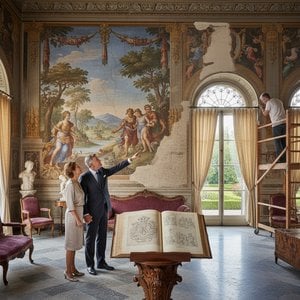
Fresk jako Rodzinna Spuścizna: Utrwalenie Dziedzictwa na Ścianach
Odkryj sztukę fresku! Poznaj historię, technikę i inspiracje. Zamów spersonalizowany fresk rodzinny – trwałe dzieło sztuki dla przyszłych pokoleń. Profesjonalna konserwacja i ochrona.


