


Obraz dostosowuje się do Twoich wyborów: , .
Opis obiektu
Admire Arnold Böcklin's haunting 'Flora, Scattering Flowers,' a Symbolist masterpiece exploring themes of death and beauty amidst serene landscapes—featuring birds & a tranquil garden.
 Rozwiń treść
Biografia artysty
Arnold Böcklin – mistyczny malarz symbolisty znany z "Wyspy Umarłych". Jego dzieła poruszają tematy śmierci, mitologii i snów w atmosferze melancholii. Odkryj jego wpływ na sztukę i muzykę!
Ręcznie malowana reprodukcja olejowa
Ręcznie malowany obraz olejny na płótnie, wykonany na zamówienie przez naszych artystów w wybranym przez Ciebie wymiarze i oprawie. ( Przełącz na wydania drukowane Przejdź do wersji cyfrowej)
Więcej o tym obrazie
 Podgląd w skali 1:1
 Wyślij jako kartkę
 Udostępnij
 Szczegóły dzieła
 Przewodnik

 Pobierz obraz
 Podobne obiekty
 RTG
RTG Pokaz slajdów
 Pytania i odpowiedzi
 Statystyki
Zamów swój obraz w czterech prostych krokach
Nie spiesz się. Możesz zmienić każdą odpowiedź; cena w Twoim koszyku będzie aktualizowana po każdym wyborze.
1 Pierwszy z czterech kroków
Który rozmiar wybierasz?
Te rozmiary zachowują proporcje oryginalnego obrazu. Rysunek przedstawia wybrany przez Ciebie format na ścianie, nad dwumetrową sofą.
lub podaj własne wymiary
Wybierz spośród naszych standardowych rozmiarów, które zachowują oryginalne proporcje dzieła sztuki.

Wpisz wymaganą szerokość i wysokość, aby obraz pasował do Twojej ramy lub ściany. Ponieważ jest to dzieło malowane ręcznie, w przypadku rozmiaru o innych proporcjach artysta może domalować nieco więcej wokół obrazu lub przyciąć jego fragmenty — wybór należy do Ciebie. Przed rozpoczęciem pracy prześlemy Ci cyfrową wizualizację do zatwierdzenia. Obraz widoczny na tej stronie nie przedstawia rzeczywistego efektu — jedynie wizualizacja oddaje realny rezultat.
2 Drugi z czterech kroków
W jaki sposób przygotować dzieło: w formie tuby, na krosnach czy w ramie?
Poniższe ceny dotyczą rozmiaru wybranego w pierwszym kroku.
Wybierz krawędzie płótna naciągniętego na ramę
Wybierz ramę

Białe krawędzie zł1

rozmyte krawędzie zł1

Przedłużony zł1

P118B zł10

P118H zł10

P118W zł10

P438Z zł10

P508JH zł12

P508YH zł12

P805H zł10

P805Z zł10

P919BZ zł10

P919G zł10

P919XJ zł10

P959ZH zł10

P968JZ zł12

W106C zł8

W218G zł10

W218JH zł8

W218Y zł10

W307PJ zł10

W316G zł10

W316PJ zł8

W316Y zł10

W398PJ zł8

W4111J zł10

W500HY zł15

W500JH zł15

W692G zł12

W849H zł8

W940BG zł15

W953PJ zł8

H24-GOLD zł30

H24-SILVER zł30

H36-GOLD zł45

H36-SILVER zł45
W oprawie
Profil: . Wymiar całkowity w ramie: .
3 Trzeci z czterech kroków
Czy chcieliby Państwo wprowadzić jakieś zmiany w obrazie?
Większość osób odpowiada przecząco. Ponieważ każdy obraz jest tworzony ręcznie, nasz artysta może również dostosować go do Twoich potrzeb.
Po złożeniu zamówienia zespół ArtsDot.com skontaktuje się z klientem drogą mailową w celu uzyskania instrukcji i prześle podgląd projektu
4 Krok czwarty z czterech
Kilka opcji wykończenia
Wszystkie są opcjonalne. Wybrane już odpowiedzi nie wiążą się z żadnymi dodatkowymi kosztami.
Kto jest autorem?
Dostawa na całym świecie () w ciągu 3–4 tygodni zamiast standardowych 5 tygodni. (4 Listopad). Bez kompromisów w kwestii jakości.
Tabliczka informacyjna, jak w muzeum?
Szczegóły grawerowanej brązowej tabliczki
This elegant plaque features the artist's name and the title of the artwork, finely engraved for a timeless presentation.
It is made from bronze with a refined, elegant finish. The text is precisely laser-engraved for a sharp and permanent result. Measuring 9x2 cm, the plaque is compact yet easy to read. It's built to be durable and scratch-resistant, offering a professional, museum-quality look. Mounting is simple thanks to the included adhesive backing.
Szczegóły przezroczystej tabliczki akrylowej
The plaque includes essential engraved details such as the artist's name, the title of the artwork, the date it was created, the type of media used-like oil on canvas or watercolor-a brief description of the piece, and a QR code that links to the complete artwork information.
It is crafted from clear acrylic, offering a sleek, modern appearance. The text is UV-engraved in black to ensure strong visual contrast. With a size of 10x15 cm, it ensures optimal readability. It comes equipped with two metal hooks for secure wall mounting. The plaque is designed to be weather-resistant, making it suitable for various environments, and it includes interactive features that work seamlessly with smartphone scanning.
Szczegóły czarnej tabliczki akrylowej
This elegant plaque includes engraved information such as the artist's name, the title of the artwork, the date it was created, the type of media used (like oil on canvas or watercolor), a short description of the artwork, and a QR code for quick access to more information.
The plaque itself is made from refined black acrylic with a premium finish. The text is laser-engraved in white for high contrast and readability. Its size is 10x15 cm, designed to be easy to read. It comes with two metal hooks for professional mounting. The design is sleek and fits any interior style. It is also weather-resistant and durable, with built-in digital integration for mobile compatibility.
Werniks ochronny?
Kiedy potrzebujesz dostawy?
✓ Sprawdź i zamów
Twoje dzieło, dokładnie tak, jak zamówiłeś

Flora, Scattering Flowers
Technika reprodukcji
Wymiary reprodukcji
-

Wybitny mistrz artystyczny
Większa szczegółowość, finezja i dodatkowy czas na realizację
-

Opcje oprawy reprodukcji
-
-
W przypadku dzieł sztuki lub reprodukcji, których którykolwiek z boków przekracza 105 cm (około 41 cali), rama zostanie wysłana w formie zestawu do samodzielnego montażu. Metoda ta zapewnia bezpieczną dostawę i zapobiega uszkodzeniom podczas transportu.
Wymagany profesjonalny montaż – nie jest to produkt typu DIY.
Zestaw musi zostać złożony, a płótno naciągnięte przez doświadczonego profesjonalnego ramiarza, przy użyciu kleju do drewna (brak w zestawie), kleszczy do naciągania płótna oraz ścisków, które utrzymają krosna w równej pozycji podczas schnięcia kleju. Nieprawidłowy montaż lub nierównomierne napięcie płótna może trwale uszkodzić dzieło sztuki i nie podlega naszej gwarancji.
 W przypadku dzieł sztuki lub reprodukcji, których którykolwiek z boków przekracza 105 cm (około 41 cali), rama zostanie wysłana w formie zestawu do samodzielnego montażu. Metoda ta zapewnia bezpieczną dostawę i zapobiega uszkodzeniom podczas transportu.
W zestawie znajdują się wszystkie listwy z litego drewna, precyzyjnie docięte do wymiarów.
Montaż odbywa się przy użyciu dołączonych wkrętów oraz kleju do drewna do łączenia narożników, którego zestaw nie zawiera i który musi zostać dostarczony przez ramiarza.
Wymagane są profesjonalne narzędzia, których nie ma w zestawie: kleszcze do naciągania płótna (napinacz) oraz zaciski, które pozwolą utrzymać listwy w równej pozycji podczas schnięcia kleju.
Ważne:
Do połączenia narożników niezbędny jest klej do drewna, listwy należy unieruchomić za pomocą ścisków do momentu całkowitego wyschnięcia kleju, a naciągnięcie płótna na złożoną ramę wymaga użycia kleszczy do naciągania płótna. Żaden z tych elementów nie jest dołączony do zestawu. Przed zamówieniem tego rozmiaru zalecamy konsultację z doświadczonym ramiarzem.

Etykieta obiektu
-
-

Lakier ochronny
Lakier z połyskiem (pogłębia kolory, chroni przed światłem i wilgocią)
-

Personalizacja dzieła
Przykłady możliwości personalizacji: zastąp twarz zdjęciem klienta; dodaj zwierzę domowe (np. zamień kota na psa); umieść ukrytą wiadomość w tle; zmień krajobraz lub elementy tła.
-

Ekspresowa
Dostawa na cały świat () w ciągu 3–4 tygodni zamiast standardowych 5 tygodni. (4 Listopad). Bez kompromisów w kwestii jakości.
-
Przesyłka ekspresowa
Dostawa na cały świat () w ciągu 5 tygodni. (11 Listopad).
W cenie
Cena całkowita
zł 1021
Opcja ze szkłem jest dostępna wyłącznie w rozmiarach poniżej 110 cm
W każdym zamówieniu
- Bezpłatna ekspresowa wysyłka na cały świat
- Wysokiej jakości płótno lniane
- Pełne ubezpieczenie przesyłki
- Gwarancja zwrotu należności celnych i podatków importowych
- Gwarancja wiernego odwzorowania kolorów
- 100-dniowa polityka zwrotów (tylko w przypadku wad)
- Gwarancja 100% zwrotu pieniędzy
- Zniżka przy zakupie wielu sztuk


A Serenade in Bloom: Capturing Nature's Ephemeral Grace
To gaze upon this scene is to step through a veil into a moment suspended between dream and reality. The painting, Flora, Scattering Flowers, presents us with an idyllic tableau where the human spirit seems perfectly attuned to the gentle rhythms of nature. At its heart stands a woman, clad in flowing blue garments that echo the tranquility of a distant river. She is not merely posing; she is participating in a quiet communion with the bounty surrounding her, holding forth blossoms as if offering secrets whispered only to the breeze. The composition guides the eye effortlessly across this pastoral setting, suggesting a leisurely stroll through an overgrown garden or meadow.
The Symbolism of Flora and Flight
The very title speaks to themes of ephemerality and abundance. The scattering flowers are more than mere decoration; they are potent symbols of life's fleeting beauty—the perfect bloom that must eventually fade, yet in its passing, it creates a breathtaking moment of perfection. This sense of delicate transience is echoed by the two birds visible in the azure expanse above. They seem to be messengers, carrying away moments of pure freedom across the sky. Furthermore, the inclusion of the potted plant anchors the scene, suggesting that even cultivated beauty finds its counterpart in wild, untamed growth. The overall atmosphere achieved is one of profound serenity, a visual balm for the modern soul.
Echoes of Symbolism and Artistic Lineage
While the specific context places this work within an unknown period, the sensibility resonates deeply with the Symbolist movements that captivated artists like Arnold Böcklin. Though perhaps not directly by him, the painting shares a kinship with the Romantic fascination for allegory and the merging of mythic narrative with natural settings. The gentle melancholy inherent in such scenes—the beauty tinged with the knowledge of its passing—is a hallmark of art that seeks to explore deeper truths beyond mere depiction. It invites contemplation on cycles: birth, bloom, scattering, and rest.
Bringing Arcadia Home: Decorating with Dreamlike Charm
For the collector or designer seeking to infuse a space with an aura of peaceful sophistication, this reproduction offers unparalleled depth. Imagine this piece gracing a sunlit drawing-room or a tranquil bedroom retreat. The soft blues and vibrant bursts of floral color provide natural focal points, while the overall pastoral calm acts as a visual anchor for any room's decor scheme. It is art that does not shout but rather whispers its beauty into your daily life, transforming a mere wall into a portal to an idealized, blooming afternoon.
Pytania i odpowiedzi
Jaki jest dominujący kolor w „Flora, Scattering Flowers” – Arnold Böcklin?
Dominującym kolorem dzieła „Flora, Scattering Flowers” – Arnold Böcklin jest Gray (#74726b).
Jakie umiejscowienie najlepiej pasuje do formatu dzieła „Flora, Scattering Flowers” – Arnold Böcklin?
Format (Tall) oraz rekomendowana przestrzeń (Living Room) to dwa parametry dotyczące rozmieszczenia dzieła „Flora, Scattering Flowers” – Arnold Böcklin.
Czy mogę zobaczyć „Flora, Scattering Flowers” – Arnold Böcklin na własnej ścianie przed zakupem?
„Flora, Scattering Flowers” posiada podgląd w rozszerzonej rzeczywistości: strona Podgląd w AR pozwala zobaczyć dzieło w Twojej własnej przestrzeni na kompatybilnym urządzeniu.
Podobne dzieła


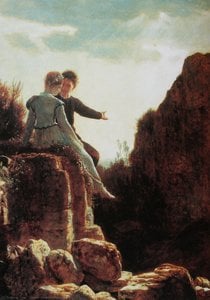


Arnold Böcklin
1827 - 1901, Szwajcaria
Biografia artysty
early life and training
Arnold Böcklin, a name synonymous with haunting beauty and melancholic symbolism, was born on October 16, 1827, in Basel, Switzerland—a city that would profoundly shape his artistic vision. His lineage traced back to an old family of Schaffhausen, distinguished by its involvement in the silk trade, while his mother, Ursula Lippe, hailed from the same vibrant city. Böcklin’s early years were marked by a rigorous academic training at the Düsseldorf Academy, where he studied under the esteemed Julius Wilhelm Schirmer. This period proved pivotal, forging a connection with Anselm Feuerbach and firmly establishing him within the circle of the Düsseldorf School of Painting—a movement known for its dramatic realism and exploration of psychological themes. The influence of this school is evident in Böcklin’s early works, characterized by a somber palette and an intense focus on capturing mood and atmosphere. His travels during his studies exposed him to diverse artistic traditions, particularly in Brussels, Antwerp, and Genoa, where he honed his skills under the guidance of Angelo Calame, absorbing elements of Italian landscape painting and classical antiquity. These formative experiences laid the groundwork for Böcklin’s unique approach to art—one that would later become deeply intertwined with themes of death, dreams, and the mystical.artistic career and symbolism
Böcklin's artistic journey extended far beyond the confines of Düsseldorf, leading him through the vibrant cities of Paris and Rome, each leaving an indelible mark on his creative development. In Paris, he found employment at the Louvre, immersing himself in the masterpieces of the Old Masters and gaining invaluable insights into composition and technique. His time in Rome proved particularly transformative, exposing him to the grandeur of ancient ruins and fostering a fascination with classical mythology—a theme that would recur frequently throughout his oeuvre. Böcklin’s artistic style evolved significantly during this period, moving away from the stark realism of the Düsseldorf School towards a more evocative and symbolic approach. He began to explore allegorical and mythological figures within carefully constructed settings featuring classical architecture, creating works that resonated with a profound sense of mystery and introspection. Notable early examples include *Great Park* (1857), which depicted ancient mythology in a dreamlike landscape, and the hauntingly beautiful *Nymph and Satyr* (1858) and *Sappho* (1859)—paintings that showcased his burgeoning talent for capturing emotion and atmosphere. A particularly striking example of this period is *Portrait of Myself, with Death Playing a Violin* (1872), a deeply personal work that explored the themes of mortality and artistic creation—a recurring motif in Böcklin’s art.the isle of the dead and legacy
Perhaps the most enduring testament to Böcklin's artistic vision is his five versions of *The Isle of the Dead* (1880-1886). Inspired by the English Cemetery in Florence—where his daughter was buried—these monumental paintings became instantly iconic, capturing the essence of loss, remembrance, and the passage of time. The series evokes a profound sense of melancholy and mystery, utilizing a muted color palette, atmospheric perspective, and carefully arranged figures to create an unforgettable visual experience. Böcklin’s *Isle of the Dead* profoundly influenced a generation of artists, including Hans Thoma, who sought to capture similar moods and themes in their own work. Clement Greenberg famously described Böcklin's work as "one of the most consummate expressions" of its time, recognizing its profound impact on the development of Symbolism and its subsequent influence on 20th-century art movements such as Surrealism. Böcklin’s style resonated with the Pre-Raphaelites, sharing their fascination with dreams, mysticism, and the darker aspects of human experience—a shared sensibility that cemented his place within the broader artistic landscape of the late 19th century.museums and collections
Arnold Böcklin's works are cherished by museums across Europe, offering visitors a chance to encounter the depth and complexity of his artistic vision. Key locations where you can find his paintings include:- Öffentliche Kunstsammlung (Basel, Switzerland)
- Kunstmuseum Basel (Switzerland)
- Museum Kunsthaus Zürich (Zürich, Switzerland)
conclusion
Arnold Böcklin remains a pivotal figure in the history of Symbolism, renowned for his evocative landscapes, haunting allegories, and profound exploration of mortality. His work continues to captivate audiences with its dreamlike quality and emotional resonance, solidifying his legacy as one of the most influential artists of the late 19th century. His art serves as a poignant reminder of the beauty that can be found even in darkness—a testament to the enduring power of the human spirit and the mysteries of existence.Powiązane artykuły

Spokój w sztuce: Top 10 arcydzieł dla harmonii wnętrz | ArtsDot.com
Odkryj 10 arcydzieł sztuki, które emanują spokojem i harmonią. Poznaj historie Moneta, Van Gogha i innych mistrzów. Znajdź idealny obraz do Twojego wnętrza na ArtsDot.com – reprodukcje najwyższej jakości!
Marianne North: 25 Najpiękniejszych Obrazów Botanicznych i Krajobrazów – Kolekcja ArtsDot
Odkryj 25 fascynujących obrazów Marianne North – wiktoriańskiej artystki i botaniczki. Egzotyczne krajobrazy, kolorowe kwiaty i inspiracje wnętrzarskie. Reprodukcje najwyższej jakości na ArtsDot.com! Poznaj pełną kolekcję online.

Blossoms of Time: A Historical Journey Through Flower Painting
Explore the captivating history of flower painting! Discover Dutch masters, symbolic meanings, & botanical art. Expert insights & high-quality reproductions at ArtsDot.