

 Podgląd w skali 1:1
 Wyślij jako kartkę
 Udostępnij
 Szczegóły dzieła
 Przewodnik

 Pobierz obraz
 Podobne obiekty
 RTG
RTG Pokaz slajdów
 Pytania i odpowiedzi
 Statystyki
The Earth


 Rozwiń treść
Dzieło sztuki prezentowane na tej stronie podlega ochronie prawem autorskim, co oznacza, że nie mamy prawa do tworzenia ani sprzedaży jego identycznej reprodukcji. Ochrona ta jest egzekwowana na mocy umów międzynarodowych, takich jak Konwencja berneńska oraz przez przepisy prawa krajowego, w tym te określone w Prawo autorskie USA – Tytuł 17.
Metoda ta jest w pełni zgodna z przepisami prawa autorskiego, ponieważ nie polega na kopiowaniu ani powielaniu chronionego dzieła. Stanowi ona kreatywną reinterpretację – nowy obraz, który czerpie inspirację z oryginału, ale nie jest z nim tożsamy.
Giclée / Wydruk artystyczny
Wydruki giclée lub płótna o jakości muzealnej, szybka realizacja i szeroki wybór opcji wykończenia. ( Zamów ręcznie malowaną reprodukcję Przejdź do wersji cyfrowej)




P118B zł10

P118H zł10

P118W zł10

P438Z zł10

P508JH zł12

P508YH zł12

P805H zł10

P805Z zł10

P919BZ zł10

P919G zł10

P919XJ zł10

P959ZH zł10

P968JZ zł12

W106C zł8

W218G zł10

W218JH zł8

W218Y zł10

W307PJ zł10

W316G zł10

W316PJ zł8

W316Y zł10

W398PJ zł8

W4111J zł10

W500HY zł15

W500JH zł15

W692G zł12

W849H zł8

W940BG zł15

W953PJ zł8




Wybierz spośród naszych standardowych rozmiarów, które zachowują oryginalne proporcje dzieła sztuki.

Wpisz wymaganą szerokość i wysokość, aby dopasować grafikę do ramy lub ściany. Wydruk można jedynie przyciąć, nigdy nie powiększając go poza oryginalny obraz, dlatego format o innych proporcjach spowoduje utratę części kompozycji. Przed rozpoczęciem druku prześlemy Ci cyfrowy podgląd do zatwierdzenia. Obraz wyświetlany na tej stronie nie pokazuje rzeczywistego przycięcia — jedynie podgląd oddaje ten efekt.
Dostawa na cały świat () w ciągu 2 tygodni zamiast standardowych 4/5 tygodni. (7 Listopad)

Bezpłatna ekspresowa wysyłka na cały świat

Wysokiej jakości płótno lniane

Pełne ubezpieczenie przesyłki

Gwarancja zwrotu należności celnych i podatków importowych

Gwarancja wiernego odwzorowania kolorów

100-dniowa polityka zwrotów (tylko w przypadku wad)

Gwarancja 100% zwrotu pieniędzy

Zniżka przy zakupie wielu sztuk
 Opcja ze szkłem jest dostępna wyłącznie w rozmiarach poniżej 110 cm

The Earth
Giclée / Wydruk artystyczny
Wymiary reprodukcji
-


Cena całkowita
zł 246
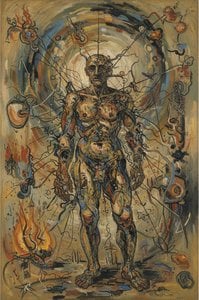
André Masson’s “The Earth”: A Descent Into Surrealist Automatism
André Masson's "The Earth," painted in 1939, stands as a quintessential example of Surrealist automatism—a technique championed by Masson and fellow artists to bypass conscious thought and tap into the subconscious realm. More than just an aesthetically striking composition, it’s a profound exploration of primal anxieties and a visual manifestation of the artist's confrontation with existential uncertainties during the turbulent years leading up to World War II.Composition and Visual Language
The artwork immediately captivates with its central oval form—a dominant presence that evokes imagery of amniotic sacs or embryonic beginnings. This organic shape isn’t merely decorative; it serves as a focal point for a dynamic network of radiating lines in shades of red, black, and white. These lines aren't meticulously drawn; rather, they erupt outwards from the center with an impulsive energy, creating a chaotic visual field that defies conventional perspective. The deliberate lack of spatial coherence underscores Masson’s rejection of rational representation, prioritizing instead the expressive power of gesture and emotion. It feels like witnessing a geological upheaval—a violent birth of form from amorphous darkness.Technique and Material Considerations
Masson employed oil paint on canvas – a medium chosen for its ability to capture subtle tonal variations and facilitate layering techniques. The artist’s approach leaned heavily into automatism, utilizing spontaneous brushstrokes and washes of color to generate the artwork's textural surface. Evidence suggests considerable reworking—a process characteristic of Surrealist practice where artists strive to liberate their creative impulses from intellectual constraints. The canvas itself appears to be lightly primed, allowing for a rich interplay between pigment and substrate, contributing to the overall impression of immediacy and visceral impact.Symbolism and Contextual Significance
Painted during the height of Surrealist fervor, “The Earth” reflects the movement’s preoccupation with Freudian psychoanalysis and its desire to delve into the unconscious mind. The oval form symbolizes fertility and rebirth—themes central to Surrealist mythology—but also carries a darker connotation of vulnerability and impending doom. The radiating lines represent forces of destruction and creation simultaneously, mirroring anxieties about societal upheaval and the looming threat of war. Masson’s work aligns with broader artistic explorations of primal instincts and fears, reflecting a collective apprehension regarding humanity's precarious position in the face of cosmic indifference.Emotional Resonance
Ultimately, “The Earth” succeeds in conveying a palpable sense of unease and mystery. The artwork doesn’t offer comforting illusions; instead, it confronts viewers with an unsettling depiction of chaos and ambiguity. It invites contemplation on themes of genesis, destruction, and the inherent instability of existence—questions that resonated deeply within Masson's own artistic vision and continue to captivate audiences today. Its raw energy and evocative imagery solidify its place as a cornerstone of Surrealist art history.Pytania i odpowiedzi
Jaki nastrój oddaje „The Earth” – André Masson w ramach nurtu Surrealist?
W nurcie Surrealist dzieło „The Earth” zostało ujęte w Mysterious tonie.
Czy istnieją dzieła podobne do „The Earth”?
Dzieła podobne do „The Earth” – André Masson można znaleźć na stronie Podobne dzieła danego dzieła.
Kto stworzył "The Earth" i w jakim stylu jest to dzieło?
Za dziełem "The Earth" stoi André Masson oraz nurt Surrealist.
Podobne dzieła


Biografia artysty
André Masson: A Life Dedicated to the Unconscious
André Masson, a name synonymous with Surrealism and groundbreaking artistic techniques, was born on January 4th, 1896, in Balagny-sur-Thérain, a small town just north of Paris. From his earliest years, he exhibited an intense connection to nature, spending much of his youth immersed in the landscapes surrounding his home – a formative experience that would profoundly influence his later work. His artistic journey began at the age of eleven when he enrolled at the Académie Royale des Beaux-Arts in Brussels, where he received a foundational training under Constant Montald, laying the groundwork for his future explorations of various styles and movements. Early works hinted at an interest in Cubism, demonstrating an immediate engagement with the radical innovations shaping the art world of the early 20th century.The Surrealist Embrace: Automatic Drawing and Collaborative Visions
Masson’s life took a dramatic turn when he became deeply involved in the burgeoning Surrealist movement in the mid-1920s. He wholeheartedly embraced automatic drawing – a technique that prioritized spontaneity and intuition, rejecting conscious control in favor of allowing the subconscious to guide the hand. This process involved creating artwork without deliberate thought, trusting the unconscious mind to manifest itself on paper. This approach wasn’t practiced in isolation; Masson actively collaborated with other leading figures within the Surrealist circle, including Antonin Artaud, Michel Leiris, Joan Miró, Georges Bataille, Jean Dubuffet, and Georges Malkine. These collaborations fostered a vibrant artistic community, characterized by experimentation, shared ideas, and a relentless pursuit of new forms of expression. Masson’s work during this period frequently delved into unsettling themes – violence, eroticism, and the raw, visceral experience of metamorphosis – deliberately challenging conventional notions of beauty and representation.Revolutionary Techniques: Sand and Glue on Canvas
Perhaps Masson's most distinctive contribution to the art world lies in his innovative technique of applying sand and glue directly onto canvas. This process involved throwing handfuls of dry sand and adhesive onto a prepared surface, creating an unpredictable and chaotic pattern. The resulting textured surface was then painted over with oil paints, transforming the random shapes into evocative landscapes and dynamic compositions. This method, born out of a desire to capture the fluidity and dynamism of the unconscious mind, resulted in paintings that possessed a unique energy and depth. Alongside automatic drawing, this technique became synonymous with Masson’s artistic identity, establishing him as a pioneer of unconventional materials and processes.A Shift Towards Landscape: War, Exile, and Artistic Rebirth
By the late 1920s, Masson began to move away from the strict confines of Surrealism, developing a more structured style influenced by artists like André Derain. This shift is particularly evident in his landscape paintings, which showcased a newfound interest in capturing the beauty and power of nature. The Second World War brought immense upheaval to Masson’s life. His work was condemned as “degenerate” by the Nazi regime, forcing him to flee France with the assistance of Varian Fry. He found refuge in the United States, where his presence significantly impacted American Abstract Expressionists like Jackson Pollock, who were deeply influenced by his techniques and approach to spontaneous creation. After returning to France following the war, Masson settled in Aix-en-Provence, dedicating himself to landscape painting – a return to his roots, but now imbued with a new sense of maturity and perspective.Legacy and Enduring Influence
André Masson’s legacy extends far beyond his own lifetime. His pioneering work in Surrealism, coupled with his revolutionary techniques, fundamentally altered the course of modern art. He demonstrated that art could be a direct expression of the unconscious mind, bypassing rational thought and embracing spontaneity. His influence can be seen across numerous artistic movements, from Cubism to Abstract Expressionism, solidifying his position as a pivotal figure in 20th-century art history. Masson’s exploration of subconscious imagery and innovative processes continues to inspire artists today, reminding us of the boundless potential of creative expression. He died on October 28th, 1987, leaving behind a body of work that remains both challenging and profoundly rewarding for those willing to delve into its depths.
André Masson
1896 - 1987 , Francja
Krótka nota
- Artistic Movement Or Style:
- Surrealizm
- Kubizm
- Artists Or Movements Influenced By This Artist:
- Jackson Pollock
- Abstr. Ekspresjonizm
- Artists Who Influenced This Artist: ['André Derain']
- Date Of Birth: 4 stycznia 1896
- Date Of Death: 28 października 1987
- Full Name: André Aimé René Masson
- Nationality: Francuz
- Notable Artworks:
- Les Quatre éléments
- Krajobraz z kamieniami
- Przemiana kochanków
- Pygmalion
- Place Of Birth: Balagny-sur-Thérain, Francja
Powiązane artykuły

25 Arcydzieł Kandinskiego: Kolor, Duchowość i Abstrakcja w Twoim Domu | ArtsDot.com
Odkryj 25 arcydzieł Wassily Kandinskiego – pioniera abstrakcji i ekspresjonizmu! Poznaj historie, techniki i emocje kryjące się za jego kolorowymi kompozycjami. Reprodukcje obrazów najwyższej jakości na ArtsDot.com. Eksploruj pełną kolekcję online!

Top 10 arcydzieł ekspresjonizmu abstrakcyjnego – inspiracje dla Twojego wnętrza | ArtsDot.com
Odkryj 10 arcydzieł ekspresjonizmu abstrakcyjnego – Pollock, Rothko, de Kooning i inni. Poznaj historie artystów, techniki i inspiracje dla Twojego wnętrza. Reprodukcje najwyższej jakości na ArtsDot.com!

Od Pracowni do Salonu: Gestualność, Emocje i Filozoficzne Podłoże Współczesnej Abstrakcji
Odkryj fascynującą historię abstrakcji! Analiza gestu, emocji i filozofii w sztuce współczesnej. Ekspercka wiedza dla kolekcjonerów i miłośników malarstwa. ArtsDot.

Geometria Sztuki: 10 Arcydzieł Abstrakcji Geometrycznej | ArtsDot.com
Odkryj 10 arcydzieł abstrakcji geometrycznej! Poznaj historię Mondriana, Kandinskiego i Maleвича. Inspiracje wnętrzarskie z malarstwem abstrakcyjnym – reprodukcje najwyższej jakości na ArtsDot.com. Eksploruj kolekcję online!
André Masson: Automatism, Surrealism & Primal Expression in 20th-Century Art
Explore the revolutionary art of André Masson – pioneer of automatism & Surrealist expression. Discover his powerful imagery, innovative techniques, and lasting influence on modern art. Learn more at ArtsDot.
