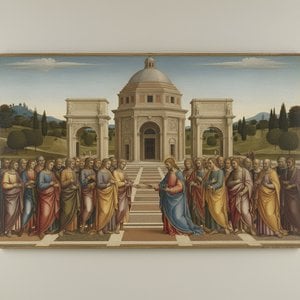
A Journey of Light and Line: The Life of Pelegrí Clavé
In the grand tapestry of nineteenth-century art, few figures bridge the cultural landscapes of Europe and the Americas as elegantly as Pelegrí Clavé i Roqué. Born in the vibrant Mediterranean atmosphere of Barcelona in 1811, Clavé emerged from a rigorous academic foundation to become a master of the Romantic style. His early years were defined by a profound dedication to his craft, beginning with his studies at the Escola de la Llotja under the guidance of masters like Salvador Mayol and Pau Rigalt. This formative period in Catalonia instilled in him a technical precision that would later allow him to navigate the complex emotional depths of Romanticism while maintaining a clarity of form reminiscent of the great Neoclassical traditions.
The trajectory of Clavé’s soul as an artist took a transformative turn when he ventured to Rome. Immersed in the eternal city, he enrolled at the Accademia di San Luca, where his artistic vision was expanded by the influence of Pietro Tenerani and Tommaso Minardi. It was here that he encountered the Nazarene school, a movement dedicated to revitalizing Christian art through a return to spiritual purity and medieval aesthetics. This exposure to the Nazarenes, alongside the refined elegance of artists like Friedrich Overbeck, infused his work with a sense of profound devotion and a meticulous approach to composition that would become a hallmark of his later career.
The Mexican Chapter and Academic Legacy
Perhaps the most defining chapter of Clavé’s life began in 1846, when a commission from the Mexican Chargé d'affaires in Rome beckoned him across the Atlantic. Alongside his companion Manuel Vilar, Clavé traveled to Mexico, where he would spend over two decades shaping the future of Latin American art. His appointment as the Director of Painting at the prestigious Academy of San Carlos in Mexico City was not merely a professional milestone but a cultural mission. In this role, he became a pivotal figure in the academic landscape, nurturing new generations of talent and introducing European Romantic sensibilities to a burgeoning Mexican art scene.
During his tenure in Mexico, Clavé’s brush captured the essence of the era's high society. His portraits are celebrated for their sophisticated execution, often echoing the smooth, luminous textures found in the works of Jean Auguste Dominique Ingres. Beyond the intimacy of portraiture, Clavé contributed to the very architecture of devotion; he and his students participated in the magnificent decoration of the cupola of the Temple of San Felipe Neri. Though much of this monumental work was tragically lost to fire in later years, the legacy of his decorative mastery remains a testament to his ability to blend large-scale architectural grandeur with delicate, painterly grace.
A Return to Roots and Enduring Significance
As the mid-nineteenth century drew to a close, Clavé returned to his beloved Barcelona in 1868, bringing with him a wealth of international experience and a matured artistic voice. His homecoming was marked by high honors, including election to the Reial Acadèmia Catalana de Belles Arts de Sant Jordi. In his final years, he remained an influential arbiter of taste, serving on juries that determined the future of artistic fellowships in Rome, thereby completing a full circle from student to master.
The historical significance of Pelegrí Clavé lies in his role as a cultural conduit. His life work represents a seamless fusion of several distinct artistic currents:
- The Romantic Spirit: A deep emotional resonance and dramatic sensibility derived from his Italian training.
- Academic Rigor: A steadfast commitment to the classical foundations of drawing and composition learned in Barcelona.
- Transatlantic Influence: The ability to transplant European academic traditions into the heart of Mexico, fostering a period of immense growth for the Academy of San Carlos.
When he passed away in Barcelona in 1880, Clavé left behind more than just canvases; he left a legacy of connection—between Spain and Mexico, between the classical past and the romantic future, and between the disciplined hand and the inspired heart.
Spørsmål og svar
Finnes det en komplett liste over Pelegrí Clavé sine kunstverk?
Utforsk alle verk av Pelegrí Clavé på denne nettsiden via kunstnerens Alle kunstverk-side.
I hvilke kunstretninger arbeidet Pelegrí Clavé?
Siden Alle kunstretninger grupperer Pelegrí Clavé sine kunstverk etter kunstretning.
Finnes det en virtuell 3D-omvisning av Pelegrí Clavé sine verk?
Virtuelt 3D-galleri til Pelegrí Clavé er en side som viser kunstnerens verk i et virtuelt tredimensjonalt galleri.