The Life and Artistic Evolution of Herb Aach
Born in Cologne, Germany, Herb Aach was a painter and writer whose journey took him from the Weimar Republic to New York City in 1938. After serving in the United States Army during World War II, he returned to New York to study under John Ferren and Rufino Tamayo at the Brooklyn Museum Art School. His education continued in Mexico City at the Escuela de Pintura y Escultura. Aach’s practice involved a period of relative isolation in Hazleton, Pennsylvania, between 1954 and 1963, before he returned to New York City. He became a dedicated educator at Queens College, where he taught studio art and color theory, eventually serving as the chairman of the arts department.
Technique and Color Theory
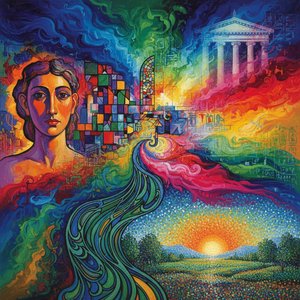
Aach’s work was defined by an intense interest in color theory and color relationships. His technical approach evolved significantly over time; he utilized pigments from the Art Crayon Company and DuPont, eventually incorporating fluorescent paints to achieve a sense of inner light. In his Precession of Equinoxes series, he applied thin layers of gesso to create surfaces reminiscent of Giotto's frescoes, using sharp lines to separate regions of color. Beyond the canvas, Aach was a notable writer who edited and translated Goethe's Theory of Colours. His artistic legacy is preserved in collections such as the Metropolitan Museum of Art and the Albright-Knox Art Gallery.
Spørsmål og svar
Hvilke andre navn eller pseudonymer bruker Herb Aach?
Herb Aach er også kjent under navnene Herbert Aach.
Kan jeg bla gjennom Herb Aach sine verk etter medium?
Herb Aach sine verk kan utforskes etter medium på Herb Aach sin Alle medier-side.
Hvilke farger brukte Herb Aach oftest?
Herb Aach sin fargebruk i verkene oppført på denne nettsiden kan studeres på kunstnerens Fargepalettens sjel-side.
Kan jeg utforske verkene til Herb Aach etter nøkkelord?
For å finne verk av Herb Aach innen et spesifikt tema, kan du bruke kunstnerens Søk etter nøkkelord-side, som grupperer kunstverkene etter nøkkelord.