

- 156.0 x 43.0 cm


The picture follows your choices: , .
Beskrivelse av objektet
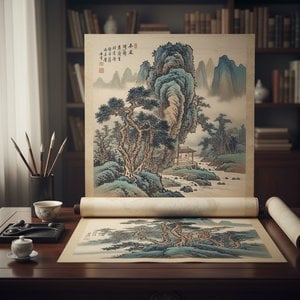
Exquisite Chinese calligraphy scroll by Zhang Ruitu (1570-1641). A dynamic ‘Poem in Cursive Script’ showcasing traditional Shuibanjing technique & symbolic beauty. Explore this rare Ming Dynasty masterpiece.
Om kunstneren
Explore the elegant calligraphy of Zhang Ruitu (1570-1641), renowned for his cursive scripts of poems & landscapes like 'Han Capital' & 'Red Cliff'. Discover classic Chinese art.
 Vis hele teksten
Håndlaget oljereproduksjon
Håndmalt olje på lerret i din valgte størrelse og ramme, laget på bestilling av våre kunstnere. ( Bytt til trykk Bytt til digitalt bilde)
More about this painting
 Forhåndsvisning
 Send
Send Del
Del
 Vis detaljer
 Utskriftsvennlig guide

 Last ned bilde
 Liknende objekter
 Røntgenundersøkelse
 Lysbildefremvisning
 Q&A
Q&A Statistikk
Order your painting in four simple steps
Take your time. You can change any answer; the price in your order card follows each choice.
1 Step one of four
Which size would you like?
These sizes keep the proportions of the original painting. The drawing shows your choice on a wall, above a two-metre sofa.
Or give your own measurements
Velg mellom våre forhåndsdefinerte størrelser som bevarer kunstverkets opprinnelige proporsjoner.

Skriv inn ønsket bredde og høyde for å tilpasse bildet til din ramme eller vegg. Siden dette er håndmalt, kan kunstneren male litt mer rundt motivet eller beskjære det noe dersom du velger et annet format — valget er ditt. Vi sender deg en digital mockup til godkjenning før maleriet påbegynnes. Bildet som vises på denne siden representerer ikke det faktiske resultatet — kun mockuppen viser det endelige uttrykket.
2 Step two of four
How should it be prepared: rolled, stretched or framed?
The prices below are for the size you chose in step one.
Choose the edges of the stretched canvas
Choose your frame

White Nkr1

Blurside Nkr1

Extended Nkr1

P118B Nkr10

P118H Nkr10

P118W Nkr10

P438Z Nkr10

P508JH Nkr12

P508YH Nkr12

P805H Nkr10

P805Z Nkr10

P919BZ Nkr10

P919G Nkr10

P919XJ Nkr10

P959ZH Nkr10

P968JZ Nkr12

W106C Nkr8

W218G Nkr10

W218JH Nkr8

W218Y Nkr10

W307PJ Nkr10

W316G Nkr10

W316PJ Nkr8

W316Y Nkr10

W398PJ Nkr8

W4111J Nkr10

W500HY Nkr15

W500JH Nkr15

W692G Nkr12

W849H Nkr8

W940BG Nkr15

W953PJ Nkr8

H24-GOLD Nkr30

H24-SILVER Nkr30

H36-GOLD Nkr45

H36-SILVER Nkr45
Innrammet
Moulding: . Overall size with the frame: .
3 Step three of four
Would you like anything changed in the painting?
Most people answer no. Because each painting is made by hand, our artist can also adapt it for you.
After order, ArtsDot.com team will email client for instructions and provide a mockup preview
4 Step four of four
A few finishing options
All of them are optional. The answers already selected cost nothing extra.
Who paints it?
Verdensomspennende levering () på 3–4 uker i stedet for standard 5 uker. (2 November). Ingen kompromisser med kvaliteten.
A nameplate, as in a museum?
Detaljer om gravert bronseplate
This elegant plaque features the artist's name and the title of the artwork, finely engraved for a timeless presentation.
It is made from bronze with a refined, elegant finish. The text is precisely laser-engraved for a sharp and permanent result. Measuring 9x2 cm, the plaque is compact yet easy to read. It's built to be durable and scratch-resistant, offering a professional, museum-quality look. Mounting is simple thanks to the included adhesive backing.
Detaljer om gjennomsiktig akrylplate
The plaque includes essential engraved details such as the artist's name, the title of the artwork, the date it was created, the type of media used-like oil on canvas or watercolor-a brief description of the piece, and a QR code that links to the complete artwork information.
It is crafted from clear acrylic, offering a sleek, modern appearance. The text is UV-engraved in black to ensure strong visual contrast. With a size of 10x15 cm, it ensures optimal readability. It comes equipped with two metal hooks for secure wall mounting. The plaque is designed to be weather-resistant, making it suitable for various environments, and it includes interactive features that work seamlessly with smartphone scanning.
Detaljer om plakett i svart akryl
This elegant plaque includes engraved information such as the artist's name, the title of the artwork, the date it was created, the type of media used (like oil on canvas or watercolor), a short description of the artwork, and a QR code for quick access to more information.
The plaque itself is made from refined black acrylic with a premium finish. The text is laser-engraved in white for high contrast and readability. Its size is 10x15 cm, designed to be easy to read. It comes with two metal hooks for professional mounting. The design is sleek and fits any interior style. It is also weather-resistant and durable, with built-in digital integration for mobile compatibility.
A protective varnish?
When do you need it?
✓ Check and order
Your painting, as you ordered it

POEM IN CURSIVE SCRIPT
Trykkmetode
Størrelse på reproduksjon
-

Utvalgte mesterkunstnere
Mer detaljrikdom, finesse og ekstra produksjonstid
-

Innramming av reproduksjon
-
-
For kunstverk eller reproduksjoner som er større enn 105 cm (ca. 41 tommer) på noen side, vil rammen bli sendt som et sett som må monteres. Denne metoden sikrer trygg levering og forhindrer skader under transport.
Krever profesjonell montering – dette er ikke et DIY-produkt.
Settet må monteres og lerretet strammes av en erfaren profesjonell rammelegger, ved bruk av trelim (følger ikke med), en lerretstang og klemmer for å holde rammelisten vinkelrett mens limet tørker. Feilaktig montering eller ujevn stramming av lerretet kan påføre kunstverket permanente skader og er
 For kunstverk eller reproduksjoner som er større enn 105 cm (ca. 41 tommer) på noen side, vil rammen bli sendt som et sett som må monteres. Denne metoden sikrer trygg levering og forhindrer skader under transport.
Alle massive trelister er inkludert, presist tilpasset i størrelse.
Monteres med de medfølgende skruene, samt trelim til hjørnene, som ikke er inkludert og må anskaffes av din rammehandler.
Profesjonelt verktøy er nødvendig og er ikke inkludert: en lerretstang (strammer) og klemmer for å holde rammene vinkelrette mens limet tørker.
Viktig:
Hjørnene krever trelim, listene må holdes på plass med tvinger til limet er helt tørt, og stramming av lerretet på den ferdige rammen krever en lerretstang. Ingen av disse produktene er inkludert i settet. Vennligst sørg for tilgang til en erfaren profesjonell rammehandler før du bestiller denne størrelsen.

Navneskilt
-
-

Beskyttende ferniss
Blank lakk (forsterker farger, beskytter mot lys og fuktighet)
-

Tilpass mitt kunstverk
Eksempler på hva som kan endres: Erstatt ansikt med bilde av kunden; Legg til kjæledyr (f.eks. bytt ut katt med hund); Inkluder en skjult melding i bakgrunnen; Endre bakgrunnslandskap eller elementer.
-

Ekspresslevering
Verdensomspennende levering () på 3–4 uker i stedet for standard 5 uker. (2 November). Ingen kompromisser med kvaliteten.
-
Ekspresslevering
Verdensomspennende levering til innen 5 uker. (9 November).
Inkludert frakt
Totalpris for valgte alternativer
Nkr 2530
Glassalternativet er kun tilgjengelig i størrelser under 110 cm
Included with every order
- Gratis ekspressfrakt over hele verden
- Lerretsduk av lin av høy kvalitet
- Full transportforsikring
- Garanti for refusjon av toll og importavgifter
- Garantert fargegjengivelse
- 100 dagers returrett ved fabrikasjonsfeil
- 100% pengene tilbake-garanti
- Rabatt ved flere kjøp


Lignende kunstverk


Zhang Ruitu
1570 - 1641
Om kunstneren
A Life Etched in Ink: The Calligraphy of Zhang Ruitu
Zhang Ruitu (1570-1641) stands as a pivotal figure in the late Ming dynasty, not for grand political maneuvers or battlefield victories, but for the exquisite grace and profound emotional depth he brought to Chinese calligraphy. Born in Jinjiang, Fujian province, Zhang’s life unfolded against a backdrop of dynastic shifts and personal trials, experiences that subtly infused his art with a poignant sensibility. He entered imperial service in 1607, navigating the complex currents of courtly life, but his true passion lay in the mastery of brush and ink. While achieving high rank – eventually reaching the grand secretariat – Zhang’s career was marked by political upheaval. A temporary fall from favor during the decline of Wei Zhongxian's power saw him stripped of his position, though he later regained some standing through financial restitution. This period of adversity seems to have deepened his commitment to artistic expression as a refuge and a means of self-cultivation. He ultimately retreated to his native Fujian in his later years, dedicating himself fully to painting and calligraphy until his death in 1641.The Art of Cursive Script: A Rejection of Convention
Zhang Ruitu’s artistic legacy rests primarily on his mastery of cursive script – *caoshu* – a style known for its fluidity, abstraction, and expressive power. He didn't simply replicate existing models; instead, he embarked on a deliberate path to forge his own unique voice within this venerable tradition. While deeply respectful of the Northern Song monumental landscape style, Zhang consciously moved away from Dong Qichang’s emphasis on dynamic brushwork and calligraphic abstraction. His work reveals a lyrical interpretation, prioritizing emotional resonance over sheer technical display. He favored satin as his support material rather than paper, contributing to the unique texture and luminosity found in his pieces. His calligraphy wasn't merely about beautiful forms; it was an embodiment of inner feeling, a visual manifestation of poetic thought. The works he created often featured poems by renowned Tang dynasty masters like Du Fu and Meng Haoran, imbuing his art with layers of literary allusion and historical depth.Major Works and Artistic Characteristics
Among Zhang Ruitu’s most celebrated pieces are ‘Han Capital,’ a stunning 1622 cursive scroll that exemplifies his dynamic style and historical awareness, and ‘Red Cliff’, another masterpiece showcasing his ability to capture the essence of classical poetry through elegant brushwork. ‘Calligraphy in Running Script’ demonstrates his technical prowess with traditional Chinese techniques. His compositions often feature a linear arrangement, emphasizing the flow and rhythm of the characters. A key characteristic is his use of the *shuibanjing* technique – a method involving careful control of ink wash to create subtle gradations and atmospheric effects. Beyond these specific works, Zhang’s ‘Poem in Cursive Script’ scrolls are particularly noteworthy for their symbolic beauty and rarity within the Ming Dynasty context. His signature style is easily recognizable through his powerful regular script inscriptions accompanying his cursive compositions.Influences and Legacy
Zhang Ruitu's artistic development was shaped by a deep engagement with classical Chinese literature and painting traditions. He drew inspiration from the Northern Song monumental landscape style, adapting its principles to suit his own aesthetic sensibilities. His work also reflects an understanding of earlier calligraphers, but he never simply imitated them; instead, he synthesized these influences into something distinctly his own. His rejection of Dong Qichang’s more abstract approach and his focus on lyrical expression set him apart from many of his contemporaries. Zhang Ruitu's influence extended beyond his immediate circle, inspiring later generations of calligraphers to explore the expressive potential of cursive script. Today, he is remembered as a master of his craft, whose works embody the elegance, depth, and emotional power of Chinese calligraphy at its finest.Historical Significance
Zhang Ruitu’s work provides valuable insight into the cultural climate of the late Ming dynasty – a period marked by political instability and social upheaval. His art reflects a yearning for tranquility and spiritual renewal amidst these turbulent times. His ability to seamlessly blend poetry, history, and calligraphy speaks to the broader intellectual currents of his era. The fact that he was able to navigate the complexities of courtly life while maintaining his artistic integrity is testament to his resilience and dedication. Zhang Ruitu’s legacy extends beyond the realm of art; it offers a glimpse into the soul of a scholar-official grappling with the challenges of a changing world, finding solace and meaning in the timeless beauty of ink and brush. His pieces are now held in prestigious collections like The Metropolitan Museum of Art and the Asian Art Museum, ensuring his enduring place in the history of Chinese art. His work continues to captivate audiences today, offering a profound meditation on the power of calligraphy as a form of self-expression and cultural preservation.Relaterte artikler
Pu Xinyu's 'Puru': A Legacy of Literati Painting & Emotional Resonance
Explore the captivating world of Pu Xinyu (Puru), the last great literati painter. Discover his imperial heritage, masterful ink wash techniques & enduring legacy – a valuable addition to any discerning art collection.

Ephemeral Expressions: Exploring the Nuances of Ink on Paper Through History & Contemporary Art
Explore the captivating world of ink wash painting – from its ancient origins to contemporary masters. Discover techniques, symbolism & conservation insights with ArtsDot.com.

Xie Zhiliu: A Legacy of Ink Wash Painting & Modern Chinese Literati Tradition
Explore the legacy of Xie Zhiliu, a master of Chinese ink wash painting & prominent figure in modern art. Discover his techniques, influences, and contributions to literati tradition. A guide for discerning collectors.