

 Forhåndsvisning
 Send
Send Del
Del
 Vis detaljer
 Utskriftsvennlig guide

 Last ned bilde
 Liknende objekter
 Røntgenundersøkelse
 Lysbildefremvisning
 Spørsmål og svar
 Statistikk
Fair Exchange, No Robbery


 Vis hele teksten
Giclée / Kunsttrykk
Giclée- eller lerretsprint av museumskvalitet med rask produksjon og fleksible valgmuligheter for etterbehandling. ( Kjøp håndmalt maleri Bytt til digitalt bilde)




P118B Nkr10

P118H Nkr10

P118W Nkr10

P438Z Nkr10

P508JH Nkr12

P508YH Nkr12

P805H Nkr10

P805Z Nkr10

P919BZ Nkr10

P919G Nkr10

P919XJ Nkr10

P959ZH Nkr10

P968JZ Nkr12

W106C Nkr8

W218G Nkr10

W218JH Nkr8

W218Y Nkr10

W307PJ Nkr10

W316G Nkr10

W316PJ Nkr8

W316Y Nkr10

W398PJ Nkr8

W4111J Nkr10

W500HY Nkr15

W500JH Nkr15

W692G Nkr12

W849H Nkr8

W940BG Nkr15

W953PJ Nkr8




Velg mellom våre forhåndsdefinerte størrelser som bevarer kunstverkets opprinnelige proporsjoner.

Skriv inn ønsket bredde og høyde for å tilpasse trykket til din ramme eller vegg. Et trykk kan kun beskjæres, aldri skaleres opp utover motivets opprinnelige størrelse, noe som betyr at et format med andre proporsjoner vil føre til tap av deler av bildet. Vi sender deg en digital mockup for godkjenning før vi starter trykkeprosessen. Bildet som vises på denne siden viser ikke den faktiske beskjæringen — det er kun mockuppen som viser dette.
Verdensomspennende levering () på 2 uker i stedet for standard 4/5 uker. (9 November)

Gratis ekspressfrakt over hele verden

Lerretsduk av lin av høy kvalitet

Full transportforsikring

Garanti for refusjon av toll og importavgifter

Garantert fargegjengivelse

100 dagers returrett ved fabrikasjonsfeil

100% pengene tilbake-garanti

Rabatt ved flere kjøp
 Glassalternativet er kun tilgjengelig i størrelser under 110 cm

Fair Exchange, No Robbery
Giclée / Kunsttrykk
Størrelse på reproduksjon
-


Totalpris for valgte alternativer
Nkr 602
A Moment Frozen in Time: William Sidney Mount’s Fair Exchange
William Sidney Mount's *Fair Exchange*, completed in 1865, transcends mere depiction; it embodies the spirit of American genre painting at its finest. Housed within the Museums at Stony Brook, this oil on canvas offers a glimpse into rural life during Reconstruction America—a period marked by profound social and economic upheaval yet simultaneously imbued with an enduring appreciation for tradition and resilience. Mount’s masterful technique—characterized by meticulous detail and tonal gradation—captures not just what was seen but also how it felt to inhabit that landscape. The artist's unwavering commitment to realism elevates the scene beyond a simple snapshot, transforming it into a poignant meditation on human interaction and societal values.- Subject Matter: The painting portrays two men engaged in a tense negotiation before a fence laden with corn stalks—a commonplace occurrence on farms throughout Long Island during Mount’s era. One figure holds a firearm, symbolizing authority and potential conflict; the other gestures emphatically toward something unseen, conveying urgency and perhaps apprehension.
- Style & Technique: Mount's signature style is unmistakably genre painting – he prioritized portraying everyday life with unflinching honesty rather than grand historical narratives or idealized portraits. His meticulous brushwork—particularly evident in the rendering of textures like weathered wood and rustling corn stalks—creates a palpable sense of atmosphere.
- Historical Context: Painted during Reconstruction, *Fair Exchange* speaks to the anxieties surrounding rebuilding America after the Civil War. The presence of the firearm underscores tensions between law enforcement and marginalized communities, while the gesture toward the unseen hints at unspoken concerns about justice and fairness.
Symbolism Within Rural Tranquility
The corn stalks themselves serve as potent symbols—representing prosperity, sustenance, and the cyclical rhythms of agricultural life. They stand in stark contrast to the firearm, highlighting the precarious balance between order and disruption. Mount’s careful composition directs the viewer's gaze toward these elements, prompting reflection on themes of negotiation, vulnerability, and the importance of upholding moral principles amidst challenging circumstances. The artist skillfully uses light and shadow to emphasize the emotional core of the scene—a palpable tension underscored by the unspoken anxieties of those involved.Connections to Other Works by William Sidney Mount
Mount’s artistic vision aligns closely with his contemporaries, notably Just in Tune and Loss and Gain – all available as exquisite handmade oil painting reproductions on https://ArtsDot.com. Like these pieces, *Fair Exchange* exemplifies Mount's dedication to capturing the subtleties of human emotion and conveying the beauty inherent in ordinary moments. His ability to imbue seemingly simple subjects with profound psychological depth distinguishes him as a pioneer of American genre painting—a legacy that continues to inspire artists today. Explore more about William Sidney Mount’s oeuvre at https://ArtsDot.com or delve deeper into his life and artistic influences on Wikipedia.Discovering Fair Exchange Today
Bring the timeless artistry of *Fair Exchange*, No Robbery* into your home with a stunning reproduction crafted by ArtsDot.com. Experience unparalleled quality and convenience—enjoy delivery in less than 3 weeks instead of standard 4/5 weeks, and benefit from our commitment to exceptional craftsmanship. Visit https://ArtsDot.com/en/art/william-sidney-mount-fair-exchange-no-robbery-8XXBGJ-en/?srsltid=AfmBOorg4JYtriR-Fst4QhPgvYm59F5wA5LGuJTtOeiGzGHfYqwOho8l to personalize your order and bring this masterpiece to life.Spørsmål og svar
Fremstår fargene i "Fair Exchange, No Robbery" som sterke eller duse?
"Fair Exchange, No Robbery" av William Sidney Mount har en Vivid fargeintensitet.
Hvor gammel var William Sidney Mount da "Fair Exchange, No Robbery" ble skapt?
William Sidney Mount var 58 år gammel da Fair Exchange, No Robbery ble skapt i 1865. Alderen er beregnet ut fra kunstnerens fødselsår, 1807.
Hvilken atmosfære tilfører "Fair Exchange, No Robbery" av William Sidney Mount et interiør?
Med sin Elegant stemning anbefales "Fair Exchange, No Robbery" for et Living Room.
Lignende kunstverk


Om kunstneren
A Pioneer of American Genre Painting
William Sidney Mount, born November 26, 1807, in the quiet hamlet of Setauket, Long Island, emerged as a pivotal figure in the development of distinctly American art. He wasn’t drawn to the grand historical narratives or formal portraiture championed by many of his contemporaries; instead, Mount turned his keen eye toward the everyday lives unfolding around him – the farmers, musicians, and ordinary folk who populated the rural landscapes of 19th-century Long Island. This unwavering dedication to depicting scenes of common life established him as a true innovator—a pioneer of genre painting in America—a style that celebrated the dignity and inherent beauty found within the mundane. His artistic journey was profoundly shaped by his upbringing; his father operated a bustling farm, store, and tavern, fostering an environment brimming with both practical experience and observation of human character. Micah Hawkins, Mount’s uncle, possessed a remarkable breadth of talents – a composer, playwright, mimic, and poet – nurturing within young William a spirit of artistic curiosity and engagement with diverse forms of expression.Early Training and Artistic Awakening
Mount’s initial foray into the art world commenced not in a prestigious academy but through an apprenticeship with his older brother, Henry Smith Mount, a skilled sign painter residing in New York City. This formative experience honed his draughtsmanship skills and instilled within him a foundational understanding of painting technique—a grounding that would prove invaluable as he pursued his artistic ambitions. However, it was a visit to the American Academy of the Fine Arts exhibition in 1825 that irrevocably altered Mount’s artistic trajectory. Surrounded by the works of established artists—figures like Benjamin West and William Hogarth—he experienced an awakening, shifting away from conventional subjects toward capturing authentic moments from daily existence. This pivotal encounter spurred him to forge his own path, independent of academic dogma, recognizing the compelling narrative potential inherent in portraying ordinary life. He established his own studio in New York City in 1829, marking a decisive step towards artistic autonomy and solidifying his commitment to pursuing art as a vocation—a dedication that would define his entire career. Despite initial influences from historical painting—he created works like *Christ Raising the Daughter of Jairus* (1828)—Mount swiftly discovered his true calling lay in portraying the world he knew best: the rural life of Long Island.Capturing Rural Life with Realism and Warmth
Mount’s artistic style is characterized by an unwavering realism tempered by a remarkable ability to infuse his scenes with warmth, humor, and profound empathy. He didn't idealize rural existence; rather, he presented it as it truly was—a tapestry woven from threads of labor and leisure, hardship and joy—acknowledging the complexities inherent in human experience. His meticulous attention to detail is evident throughout his oeuvre, from the textures of clothing to the subtle nuances of facial expressions, creating a palpable sense of immediacy and authenticity that distinguishes his work from more stylized approaches. *Dancing on Barn Floor* (1831), arguably one of Mount’s earliest masterpieces, exemplifies this distinctive aesthetic—a vibrant depiction of a rural dance brimming with energy and capturing the spirit of communal celebration. Subsequent paintings like *The Banjo Player* (1856) demonstrate not only his technical prowess but also a deep sensitivity to his subjects—particularly African American musicians—challenging prevailing stereotypes of the time and advocating for dignified representation. Other notable compositions include *The Long Story*, *Right and Left*, and *School Boys Quarreling*, each offering poignant glimpses into the lives and experiences of ordinary Americans.Innovation Beyond the Canvas
Mount’s artistic creativity extended far beyond the confines of painting; he possessed a multifaceted talent encompassing music and invention. He was a proficient violinist, composing music that reflected his profound understanding of human emotion—a testament to his belief in art's capacity to communicate universal truths. Furthermore, demonstrating an extraordinary spirit of innovation, Mount constructed a portable studio within a horse-drawn wagon in 1860—a bold decision that allowed him to travel freely throughout Long Island and capture spontaneous moments as they unfolded. This mobile workspace underscored his unwavering commitment to authenticity and his desire to engage directly with the subjects he depicted—a characteristic that distinguishes him from many of his contemporaries.Legacy and Enduring Influence
William Sidney Mount passed away on November 19, 1868, in Setauket, Long Island—the place of his birth and lifelong residence—leaving behind a legacy that continues to inspire artists today. He is remembered not merely for his technical skill or meticulous realism but also for his compassionate portrayal of everyday people—a recognition of their dignity and inherent worth. His pioneering work in genre painting fundamentally reshaped the landscape of American art, establishing it as a significant force within the broader artistic discourse and paving the way for future generations to explore themes of rural life and human connection with similar sensitivity and conviction. Mount’s paintings stand as enduring reminders of the beauty found within simplicity—a testament to his profound understanding of what constitutes true artistic expression. His contribution to American art is undeniable, securing his place among the most influential figures of his era.
William Sidney Mount
1807 - 1868 , USA
Kort om kunstneren
- Artistic Movement Or Style: Genre maleri, Realisme
- Artists Or Movements Influenced By This Artist: ['American Genre Painting']
- Artists Who Influenced This Artist:
- Benjamin West
- William Hogarth
- Date Of Birth: November 26, 1807
- Date Of Death: November 19, 1868
- Full Name: William Sidney Mount
- Nationality: Amerikaner
- Notable Artworks:
- The Banjo Player
- The Long Story
- Dancing on Barn Floor
- Right and Left
- Place Of Birth: Setauket, USA
Relaterte artikler

Amerikansk Realisme: 10 Mesterverk som Formet Kunsten – ArtsDot.no
Utforsk 10 ikoniske mesterverk fra amerikansk realisme! Oppdag Edward Hopper, Andrew Wyeth og Grant Wood – historiene bak kunsten, teknikker & farger. Finn reproduksjoner av høy kvalitet for ditt hjem på ArtsDot.com. Utforsk samlingen online!

Grant Wood & American Regionalism: Identity, Myth & the Rural Landscape
Explore the world of Grant Wood & American Regionalism with ArtsDot. Discover the symbolism behind 'American Gothic', recurring themes, and the movement's lasting impact on art history. High-quality reproductions available.

Thomas George Webster: Navigating Genre Boundaries & American Identity in 19th-Century Landscape Painting
Explore the captivating genre scenes of Thomas George Webster, a Victorian painter bridging British traditions with American themes. Discover his style, influences & legacy in 19th-century art history.
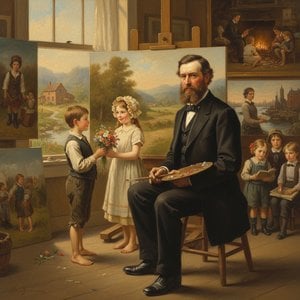
John George Brown: Capturing American Life & Sentiment in 19th-Century Genre Painting
Explore the captivating genre paintings of John George Brown, celebrated for his realistic depictions of 19th-century American life. Discover his legacy & find museum-quality reproductions at ArtsDot.

Frederick William Jackson: Capturing the American West Through Luminist Vision & Narrative Detail
Explore the captivating works of Frederick William Jackson, a pioneer of Western realism & Luminist painting. Discover his atmospheric landscapes, depictions of Native American life, and lasting legacy. Learn more at ArtsDot.