


 Se i rommet
 Del som digitalt kort
 Del
Del
 Detaljer
 Studentguide

 Last ned
 Liknende objekter
 Røntgen
 Lysbildefremvisning
 Besøksstatistikk
Untitled 63


 Les mer
Kunstverket som vises på denne siden er beskyttet av opphavsretten, noe som betyr at vi ikke har juridisk tillatelse til å lage eller selge identiske reproduksjoner. Denne beskyttelsen håndheves i henhold til internasjonale avtaler som for eksempel Bernerkonvensjonen og av nasjonale lover, inkludert de som er fastsatt i Amerikansk opphavsrettslov – Tittel 17.
Som et respektfullt og lovlig alternativ tilbyr vi skreddersydde, håndmalte kunstverk inspirert av originalen. Våre dyktige og profesjonelle kunstnere studerer nøye originalens stil, stemning og kunstneriske essens for å skape et nytt og unikt verk som vekker den samme følelsen – samtidig som det forblir en original skapelse i seg selv.
Denne metoden er i fullt samsvar med opphavsrettslige regler, da den ikke innebærer kopiering eller duplisering av det beskyttede kunstverket. I stedet er det snakk om en kreativ nytolkning – et nytt maleri som er inspirert av originalen, men ikke identisk med den.
Håndlaget oljereproduksjon
Håndmalt olje på lerret i din valgte størrelse og ramme, laget på bestilling av våre kunstnere. ( Bytt til trykkversjon Gå til digitalt bilde)




P118B Nkr10

P118H Nkr10

P118W Nkr10

P438Z Nkr10

P508JH Nkr12

P508YH Nkr12

P805H Nkr10

P805Z Nkr10

P919BZ Nkr10

P919G Nkr10

P919XJ Nkr10

P959ZH Nkr10

P968JZ Nkr12

W106C Nkr8

W218G Nkr10

W218JH Nkr8

W218Y Nkr10

W307PJ Nkr10

W316G Nkr10

W316PJ Nkr8

W316Y Nkr10

W398PJ Nkr8

W4111J Nkr10

W500HY Nkr15

W500JH Nkr15

W692G Nkr12

W849H Nkr8

W940BG Nkr15

W953PJ Nkr8




Velg mellom våre forhåndsdefinerte størrelser som bevarer kunstverkets opprinnelige proporsjoner.

Skriv inn bredden og høyden du trenger, slik at den passer til din ramme eller vegg. Dette er håndmalt, så for en størrelse med en annen form kan kunstneren male litt mer rundt bildet, eller beskjære det noe — du velger selv. Vi sender deg en digital mockup for godkjenning før maleriet påbegynnes. Bildet som vises på denne siden viser ikke det faktiske resultatet — kun mockuppen gjør det.
Etter bestilling vil ArtsDot.com-teamet sende e-post til kunden for instruksjoner og sende et utkast (mockup) som forhåndsvisning.
Verdensomspennende levering () på 3–4 uker i stedet for standard 5 uker. (22 October). Ingen kompromisser med kvaliteten.

Gratis ekspressfrakt over hele verden

Lerretsduk av høykvalitets lin

Full transportforsikring

Garanti for refusjon av toll og importavgifter

Garantert fargeekthet

100 dagers returrett ved fabrikasjonsfeil

100% pengene tilbake-garanti

Mengderabatt
 Glassalternativet er kun tilgjengelig i størrelser under 110 cm

Untitled 63
Reproduksjonsmetode
Format på reproduksjon
-


Totalpris
Nkr 2482
The Genesis of Color and Displacement
Mark Rothko's "Untitled 63" isn’t merely a painting; it’s an immersion. Born in 1903 in Dvinsk, Latvia – a region steeped in historical tension and shifting borders – Rothko’s early life profoundly shaped his artistic vision. His family’s journey from the Pale of Settlement to Portland, Oregon, in 1913 marked a dramatic cultural upheaval, a displacement that resonated deeply within him. The loss of his father at a young age, coupled with the challenges of assimilation and the ever-present anxieties of Jewish life under Tsarist rule, instilled a sensitivity to human suffering – a core theme that would permeate much of his work. This early experience of loss and uncertainty isn’t just biographical; it's woven into the very fabric of the painting, manifesting as an underlying sense of melancholy and yearning.
Rothko’s upbringing was remarkably intellectual. His father, a pharmacist and socialist, fostered a home filled with debate and learning, exposing young Mark to radical ideas and encouraging critical thinking. This environment instilled in him a deep appreciation for knowledge and a questioning spirit – qualities that would later inform his approach to art. The move to the United States wasn’t simply a geographical shift; it was a severing of ties to a familiar past, forcing Rothko to confront new identities and grapple with the complexities of belonging. This foundational experience of displacement is arguably the key to understanding the emotional depth of "Untitled 63" – a painting that speaks volumes about the human condition through its carefully orchestrated fields of color.
Color as Emotion: The Language of Abstract Expressionism
"Untitled 63" exemplifies Rothko’s signature style within Color Field Painting, a movement he helped pioneer. The work eschews traditional representation, instead focusing on the pure emotional impact of color itself. Large, rectangular blocks of deep violet, verdant green, and resonant red dominate the canvas, layered upon one another to create an almost palpable sense of depth and atmosphere. These aren’t simply colors; they are vessels for feeling – evoking a range of emotions from quiet contemplation to profound sorrow. Rothko meticulously applied thin layers of paint, allowing the colors to bleed subtly into each other, creating hazy, luminous effects that seem to vibrate with inner light.
The technique is deceptively simple yet incredibly complex. Rothko’s process involved applying multiple coats of thinned paint, often using a squeegee to create smooth, even surfaces. He avoided brushstrokes, opting instead for a flat, almost sculptural quality that further emphasizes the colors' inherent luminosity. This deliberate flatness invites the viewer to step into the painting, to lose themselves within its chromatic depths and experience it not as an object to be observed, but as a space to be inhabited.
Symbolism and the Search for Meaning
While Rothko vehemently resisted any attempt to interpret his paintings literally, the arrangement of the vases and cups within "Untitled 63" offers intriguing clues. The central vase, holding a single cup, can be seen as a symbol of containment – perhaps representing the human spirit struggling against the weight of existence. The surrounding vases, in varying sizes and positions, suggest a network of interconnectedness, hinting at relationships, memories, and the cyclical nature of life and death. The scattered cups, both near and far from the central composition, could symbolize fleeting moments of joy or sorrow, reminders of past experiences that linger in our consciousness.
However, Rothko’s intention wasn't to provide a concrete narrative. Instead, he sought to create paintings that would evoke a profound emotional response in the viewer – a sense of awe, mystery, and perhaps even transcendence. The ambiguity of the imagery allows for individual interpretation, inviting each observer to project their own experiences and emotions onto the canvas. It’s this very openness that makes "Untitled 63" such a powerful and enduring work of art.
A Legacy of Emotional Resonance
Mark Rothko's “Untitled 63” stands as a testament to the power of color to communicate profound emotions. Reproductions, like those offered by ArtsDot.com, allow viewers to experience this emotional depth firsthand, bringing Rothko’s evocative vision into their own spaces. The painting’s enduring appeal lies in its ability to tap into universal human experiences – loss, longing, and the search for meaning – making it a timeless masterpiece that continues to resonate with audiences today.
Spørsmål og svar
Er "Untitled 63" tilgjengelig som et kunsttrykk?
"Untitled 63" er tilgjengelig som et kunsttrykk på bomullslerret eller arkivbestandig lerretspapir. Bestillinger legges inn på siden for Kunsttrykk i høy kvalitet, i den størrelsen du selv velger.
Er "Untitled 63" av Mark Rothko et lyst eller mørkt kunstverk?
De registrerte verdiene for "Untitled 63" av Mark Rothko er: bright lysstyrke, Gentle Luminance luminans.
Hvilket kontrastnivå viser "Untitled 63" av Mark Rothko?
Lys-mørke-kontrasten i "Untitled 63" er registrert som Bold. Kontrast beskriver hvor sterkt lyse og mørke områder skiller seg fra hverandre.
Relaterte kunstverk


Kunstnerbiografi
Early Life and the Seeds of Artistic Vision
Mark Rothko, born Markus Yakovlevich Rothkowitz in Dvinsk, Latvia, in 1903, carried within him from the outset a sense of displacement that would profoundly shape his artistic journey. His early years were marked by the anxieties of a Jewish family living within the Pale of Settlement, shadowed by pogroms and political unrest. This atmosphere instilled a deep sensitivity to human suffering, a theme that would resonate throughout his oeuvre. The 1913 immigration to Portland, Oregon, represented not just a geographical shift but a cultural upheaval for the young Rothko. While his father, a pharmacist and intellectual with socialist leanings, fostered a home filled with debate and learning, the loss of Jacob Rothkowitz shortly after their arrival cast a long shadow. This early experience of loss, coupled with the challenges of assimilation, fueled a lifelong exploration of existential themes – mortality, trauma, and the search for meaning in a chaotic world. Though he excelled academically at Yale University, Rothko found himself drawn more to the vibrant energy of New York City, abandoning formal studies to pursue his passion for art at the Art Students League. These formative years laid the groundwork for an artistic vision that would ultimately challenge conventional notions of painting and redefine the emotional power of color.From Figurative Beginnings to Abstract Expressionism
Rothko’s initial artistic explorations were firmly rooted in realism, depicting urban scenes and portraits with a keen eye for detail. However, these early works already hinted at the psychological depth that would become his hallmark. As the 1940s unfolded, and the world grappled with the horrors of World War II, Rothko’s art underwent a dramatic transformation. Influenced by Surrealism and mythology, he began to move away from representational imagery, seeking instead to express universal human emotions through symbolic forms. This period saw the emergence of multi-form paintings – canvases populated by ambiguous, biomorphic shapes that seemed to hover between figuration and abstraction. These works were not merely experiments in form; they were deeply felt responses to the anxieties and uncertainties of a world at war. By the late 1940s, Rothko had arrived at his signature style: large-scale canvases featuring rectangular blocks of color that appeared to float and resonate with one another. He stripped away all vestiges of recognizable imagery, focusing instead on the pure emotional impact of color and form. This marked a pivotal moment in the development of Abstract Expressionism, and established Rothko as a leading figure in this groundbreaking movement.The Color Field and the Pursuit of Transcendence
Rothko’s mature work is defined by what came to be known as “Color Field” painting – vast expanses of luminous color that envelop the viewer in an immersive experience. These paintings are not about *what* they depict, but rather *how* they make you feel. Rothko believed that art should engage the viewer viscerally, bypassing intellectual analysis and speaking directly to the emotions. He meticulously layered thin washes of paint, creating subtle variations in tone and texture that seemed to emanate from within the canvas. The edges of his rectangular forms are often blurred, allowing them to blend and interact with one another, creating a sense of depth and movement. Rothko deliberately avoided titles beyond numbers – “No. 1,” “No. 6” – encouraging viewers to confront the paintings without preconceived notions and allow their own emotional responses to guide their experience. He sought to create a space for contemplation, a sanctuary where viewers could connect with something larger than themselves. His ambition was nothing less than to evoke profound spiritual experiences through the language of color.Major Achievements and Lasting Legacy
Among Rothko’s most significant achievements are “No. 10 (1950),” a pivotal work that exemplifies his evolving style, and the Seagram Murals (1958). Commissioned for the Four Seasons Restaurant in New York City, these murals were ultimately rejected by Rothko, who felt they would be compromised by their intended environment. He instead donated them to the Tate Gallery in London, where they continue to inspire awe and contemplation. Perhaps his most ambitious project was the Rothko Chapel (1971) in Houston, Texas – a non-denominational sanctuary housing fourteen of his paintings. Designed as a space for quiet reflection, the chapel is considered a sacred place by many, embodying Rothko’s belief in the spiritual power of art. Rothko's influence on subsequent generations of artists has been immense. He paved the way for Minimalist art and continues to inspire contemporary painters who explore the emotional possibilities of abstraction. Despite struggling with depression throughout his life, culminating in his tragic suicide in 1970, Mark Rothko remains one of the most important and influential artists of the 20th century – a master of color whose work continues to resonate with audiences around the world. ## The Enduring Power of Emotional Resonance- Rothko’s paintings are celebrated for their ability to convey universal human emotions—tragedy, ecstasy, despair, and hope.
- His exploration of color as a vehicle for emotional expression revolutionized abstract painting.
- The Rothko Chapel stands as a testament to his belief in the spiritual power of art.
- He remains a pivotal figure in Abstract Expressionism and a major influence on contemporary artists.

Mark Rothko
1903 - 1970 , Latvia
Kort om kunstneren
- Artistic Movement Or Style: Color Field Painting
- Artists Or Movements Influenced By This Artist: ['Minimalism']
- Date Of Birth: September 25, 1903
- Date Of Death: February 25, 1970
- Full Name: Markus Yakovlevich Rothkowitz
- Nationality: Russisk Empire- Amerikansk (fra 1938)
- Notable Artworks:
- No. 10 (1950)
- Seagram Murals
- Rothko Chapel
- Place Of Birth: Dvinsk, Latvia
Relaterte artikler

Topp 10 mesterverk fra abstrakt ekspresjonisme – Kunst for ditt hjem | ArtsDot.no
Oppdag de 10 mest ikoniske verkene fra abstrakt ekspresjonisme! Lær historien bak Jackson Pollock, Mark Rothko og andre mestere. Finn kunsttrykk av høy kvalitet for ditt hjem på ArtsDot.com – museumskvalitet & inspirasjon.

Chromatic Atmospheres: Exploring the Philosophical Foundations of Color Field Painting
Explore the philosophical and aesthetic foundations of Color Field painting with ArtsDot. Discover key artists like Rothko & Newman, its spiritual influences, and lasting impact on modern art. Expert insights for collectors.
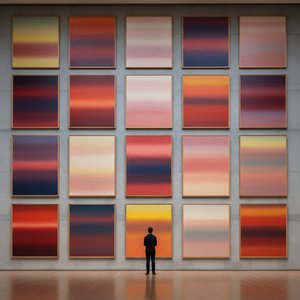
Mark Rothkos 25 Mesterverk: Følelser i Farge – Kunst for Ditt Hjem | ArtsDot.no
Oppdag Mark Rothkos 25 mest ikoniske malerier! Fordyp deg i abstrakt ekspresjonisme, fargefeltmaling og emosjonell kunsthistorie. Finn inspirasjon til ditt hjem med museumskvalitets reproduksjoner på ArtsDot.com.

The Sublimity of Color: Exploring the Emotional Landscapes of Mark Rothko's Abstract Expressionism
Explore the profound emotional depth of Mark Rothko's abstract expressionism. Discover the history, techniques & lasting impact of this pivotal Color Field painter. Expert insights for collectors and art enthusiasts.

Beyond Representation: Exploring the Emotional Landscape of Abstract Expressionism
Explore the profound emotional world of Abstract Expressionism with ArtsDot. Discover key artists like Pollock & Rothko, learn about collecting, and find museum-quality reproductions to inspire your space.


