

 Bestill trykk Kjøp digitalt bilde
 Send
Send
 Del med andre
 Details
 Legg til i favoritter

 Last ned bildet
 Liknende objekter
 X-Ray
X-Ray
 Lysbildefremvisning
Teagown


Håndlaget oljereproduksjon
Håndmalt olje på lerret i din valgte størrelse og ramme, laget på bestilling av våre kunstnere.




P118B $10

P118H $10

P118W $10

P438Z $10

P508JH $12

P508YH $12

P805H $10

P805Z $10

P919BZ $10

P919G $10

P919XJ $10

P959ZH $10

P968JZ $12

W106C $8

W218G $10

W218JH $8

W218Y $10

W307PJ $10

W316G $10

W316PJ $8

W316Y $10

W398PJ $8

W4111J $10

W500HY $15

W500JH $15

W692G $12

W849H $8

W940BG $15

W953PJ $8




 Les mer om dette
Velg mellom våre forhåndsdefinerte størrelser som bevarer kunstverkets opprinnelige proporsjoner.

Du kan angi egne mål for å tilpasse en spesifikk ramme eller plass. Dersom den valgte størrelsen ikke samsvarer med originalbildets proporsjoner, vil vi enten beskjære kunstverket eller utvide maleriet med ytterligere håndmalte elementer. En digital mockup vil bli sendt til din godkjenning før produksjonen starter.
Vennligst merk at forhåndsvisningen på skjermen ikke gjenspeiler den faktiske beskjæringen eller utvidelsen. Kun mockuppen vil vise den endelige komposisjonen nøyaktig.
Selv om tilpassede størrelser er tilgjengelige, anbefaler vi å velge et mål fra den forhåndsdefinerte listen for å bevare de originale proporsjonene.
Etter bestilling vil ArtsDot.com-teamet sende e-post til kunden for instruksjoner og sende et utkast (mockup) som forhåndsvisning.
Verdensomspennende levering () på 3–4 uker i stedet for standard 5 uker. (1 July). Ingen kompromisser med kvaliteten.

Gratis ekspressfrakt over hele verden

Lerretsduk av høykvalitets lin

Full forsikring under transport

Garanti for refusjon av toll og importavgifter

Garantert korrekt fargegjengivelse

60 dagers returrett (kun ved feil)

100% pengene tilbake-garanti

Rabatt ved flere kjøp
 Glassalternativet er kun tilgjengelig i størrelser under 110 cm

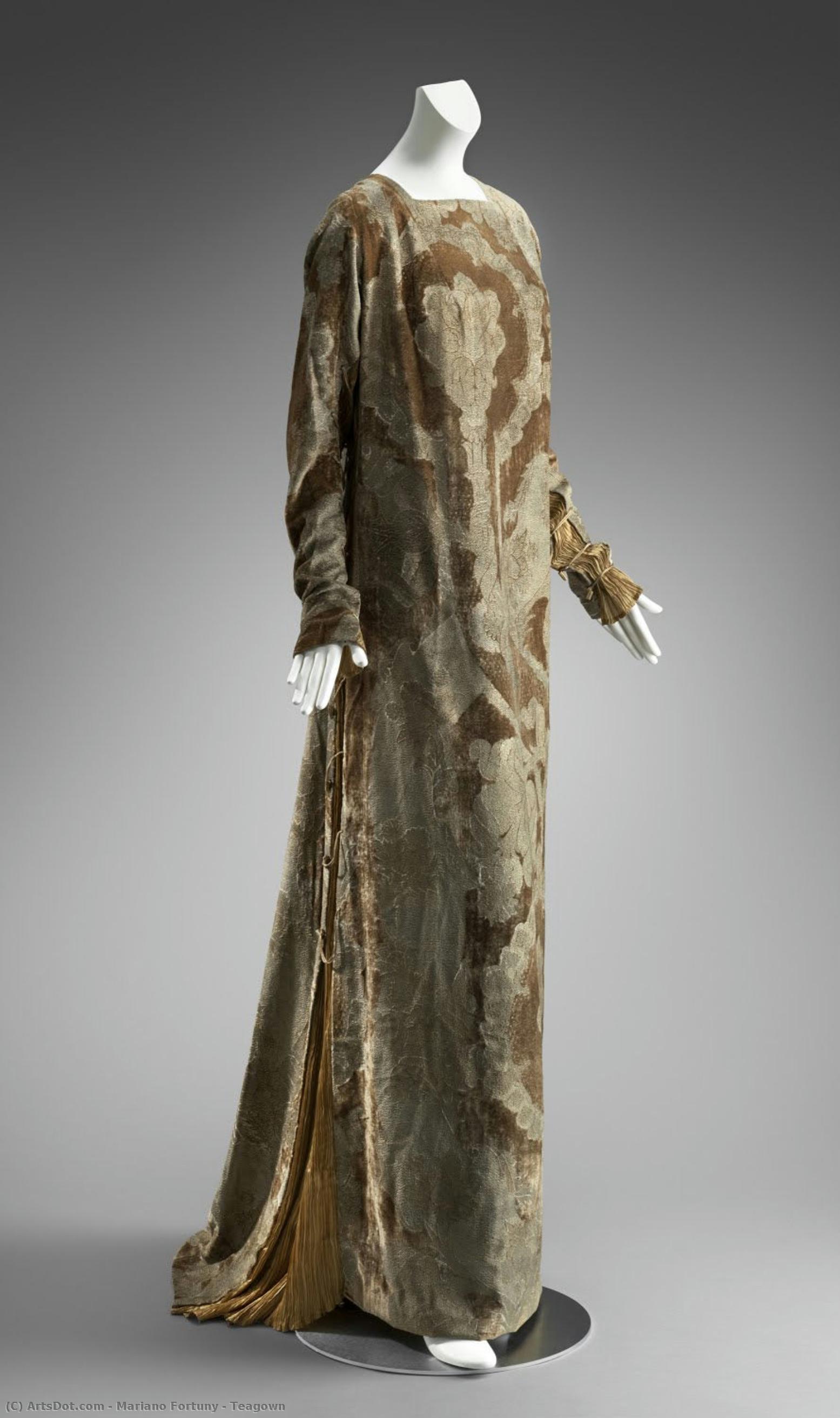
Teagown
Teknikk for reproduksjon
Størrelse på reproduksjon
-


Endelig pris
-
Beskrivelse av kunstverket
Teagown: A Venetian Echo of Grecian Elegance
Mariano Fortuny’s “Teagown,” completed in 1920, transcends mere textile art; it embodies the spirit of a bygone era—specifically, the opulent Belle Époque and its fascination with classical antiquity. This stunning silk velvet dress isn't simply draped fabric; it’s a meticulously crafted homage to the chiton, the simple tunic worn by Greek maidens revered for their purity and beauty.
- Subject Matter: The central focus is undeniably the dress itself—a full-length garment designed to convey grace and sophistication. However, its visual impact extends beyond its form, drawing inspiration from sculptural representations of ancient Greece.
- Style & Technique: Fortuny’s masterful technique exemplifies Venetian textile artistry at its finest. Stenciled gold detailing mimics the shimmering surface of Delphic bronze sculptures, creating a textural interplay that captivates the eye. The undulating stems and large leaves—characteristic of Ventian velvets—are deliberately chosen to evoke the organic forms found in Greek landscapes.
- Historical Context: Created during a period marked by artistic revival and intellectual curiosity, “Teagown” reflects the broader movement towards rediscovering classical ideals. Fortuny’s contemporaries were captivated by the elegance of ancient Greece, influencing fashion trends and decorative arts alike. The dress's design deliberately references this cultural fascination.
- Symbolism: The chiton itself carries profound symbolic significance—representing innocence, virtue, and idealized femininity. By adopting this motif, Fortuny elevates the dress beyond a mere garment into an emblem of timeless beauty and refinement. The gold accents further symbolize wealth and prestige, mirroring the lavish tastes of the aristocracy during the 1920s.
- Emotional Impact: Viewing “Teagown” evokes feelings of serenity, luxury, and nostalgia for a romanticized past. Its muted color palette—primarily browns and golds—contributes to an atmosphere of quiet elegance, inviting contemplation and admiration for artistic craftsmanship. The dress’s flowing silhouette embodies grace and movement, mirroring the fluidity of classical sculpture and conveying a sense of effortless beauty.
The meticulous pleating method employed by Fortuny—and subsequently adopted by Henriette Nigrin—was revolutionary in its time, achieving an unprecedented level of drape and comfort. This innovation underscores Fortuny’s commitment to pushing artistic boundaries while honoring the legacy of classical art.
Ultimately, “Teagown” stands as a testament to Mariano Fortuny's genius—a captivating fusion of Venetian textile tradition and Grecian inspiration that continues to inspire collectors and designers today. Its enduring appeal lies in its ability to transport viewers back to an era defined by artistic splendor and intellectual refinement.
Lignende kunstverk


Om kunstneren
Early Life and Inspiration
Mariano Fortuny, a name synonymous with theatrical innovation and exquisite textiles, was born in Granada, Spain, on May 11, 1871. His early life was marked by profound loss – his father, Mariano Fortuny y Marsal, a celebrated genre painter, tragically passed away when the young boy was just three years old. This event profoundly shaped his family’s trajectory, leading them to relocate to Paris, France, where his mother, Cecilia de Madrazo, fostered his artistic development and introduced him to the world of luxurious fabrics and textiles. From a tender age, Mariano displayed an extraordinary talent for various art forms: painting, photography, sculpting, architecture, etching, and even theatrical stage lighting—a diverse range that foreshadowed his future as a polymath. The family’s exposure to these materials, particularly during their time in Paris, would become a cornerstone of his creative vision. His mother's background as an artist herself instilled in him a deep appreciation for artistic heritage and technique.Artistic Talents and Revolutionary Inventions
Mariano Fortuny quickly established himself as a prodigious talent, demonstrating skills across multiple disciplines with remarkable speed. He wasn’t merely a painter; he was an inventor, a designer, and a visionary. His early work showcased a keen eye for detail and a fascination with capturing the essence of movement and light—qualities that would later define his theatrical innovations. Crucially, Fortuny's artistic journey was intertwined with a relentless pursuit of technological advancement. Between 1901 and 1934, he patented over twenty groundbreaking inventions, fundamentally altering the landscape of theater design. His most celebrated creation is undoubtedly the *fortuny cyclorama dome*, a quarter-dome structure constructed from plaster or cloth, ingeniously designed to create seamless transitions between scenes through the strategic use of indirect lighting. His treatise, “Eclairage Scenique” (1904), meticulously documented his revolutionary approach to reflecting light off various surfaces, manipulating its color, intensity, and overall effect—a scientific method applied to artistic expression. This wasn’t simply about illumination; it was about crafting an immersive experience for the audience.Collaborations and Recognition
Fortuny's work gained significant recognition in the 1920s, catapulting him into the international spotlight. His collaborations with prominent figures cemented his place in art history. He worked closely with Richard Wagner, the German composer, whose operas deeply influenced his artistic sensibilities, inspiring scenes filled with dramatic intensity and evocative atmosphere. His installation of the cyclorama dome at La Scala opera house in Milan was a monumental undertaking—a testament to his engineering prowess and artistic vision. Adapting the dome for the larger theater space presented significant challenges, which he masterfully overcame by inventing a sophisticated suction fan system to maintain its taut structure. Fortuny’s influence extended beyond music; he collaborated with stage designers and performers, shaping the very fabric of theatrical spectacle.Legacy and Lasting Influence
Mariano Fortuny passed away on May 3, 1949, in Venice, Italy, leaving behind a legacy that continues to resonate today. His work profoundly impacted French novelist Marcel Proust, who drew inspiration from Fortuny’s artistic world for his epic novel *In Search of Lost Time*. Fortuny's life and achievements were also depicted in Pere Gimferrer’s novel *Fortuny*, further solidifying his place in literary history. Beyond the immediate impact on theatrical design, Fortuny’s innovations—particularly in textile printing and lighting technology—laid the groundwork for future developments in both fields. His dedication to blending art, science, and engineering established him as a true pioneer, whose influence can still be felt across multiple creative disciplines. Explore more about Mariano Fortuny's inventions and designs at ArtsDot’s collection. Discover the impact of his work on theatrical lighting in the museum destroyed by fire (united states), a story of an unfortunate event that shaped american art history, available at ArtsDot’s blog.
Mariano Fortuny
1871 - 1949 , Spania
Kort om kunstneren
- Artistic Movement Or Style: Orientalism kunst
- Artists Or Movements Influenced By This Artist: ['Marcel Proust']
- Artists Who Influenced This Artist: ['Richard Wagner']
- Date Of Birth: 11 mai 1871
- Date Of Death: 3 mai 1949
- Full Name: Mariano Fortuny y Marsal
- Nationality: Spansk
- Notable Artworks:
- Teagown
- Portrett av Henriette Fortuny
- Place Of Birth: Granada, Spania
Relaterte artikler

Mariano Fortuny: A Fusion of Art, Fashion & Design – Exploring a Venetian Innovator's Legacy
Explore the captivating world of Mariano Fortuny – artist, designer & innovator. Discover his revolutionary textiles, iconic Delphos gown, and lasting influence on art, fashion & interiors. A collector's guide to a Venetian master.


Azure Visions: Exploring Representations of the Blue Dress in Western Art History
Explore the rich history of the blue dress in Western art! Discover its symbolism, from Renaissance masterpieces to modern interpretations by artists like Martin & Schiele. Uncover cultural meanings and artistic techniques.
Geometric Design in Art: A Historical Survey & Contemporary Appeal for Collectors
Explore the enduring legacy of geometric abstraction! Discover key artists, historical movements & investment insights for discerning art collectors. Expert guidance from ArtsDot.

Crimson Threads of Narrative: Exploring Symbolism & Representation in Artworks Featuring the Red Dress
Explore the rich symbolism of the red dress in art history! From ancient power displays to iconic portraits like Cézanne’s 'Madame Cezanne', discover the cultural and artistic significance behind this captivating color. Expert analysis & insights.

Veggmaling som interiørdesign: En guide for hoteller og designere
Lær hvordan veggmalerier kan transformere hotellinteriør og skape unike gjesteopplevelser. Ekspertguide for designere, med tips om stil, materialvalg og mer.


